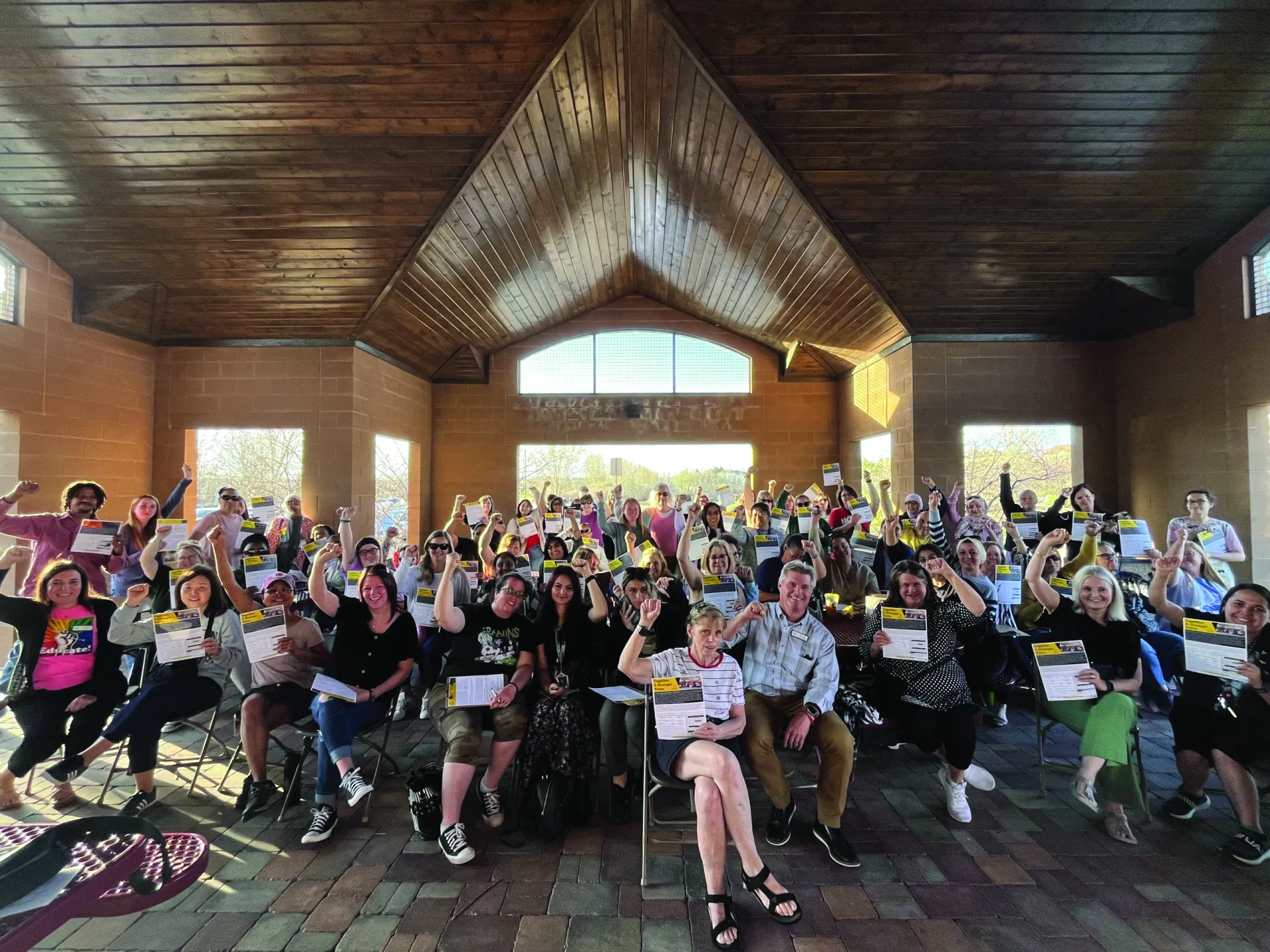
I’d like to share a bit about how I’ve found my power and how each of us can find our power in the union.
I consider myself a baby in this union work. My journey is just beginning, and I have so much to learn. But I hope my story sparks courage for you to tap into your own power.
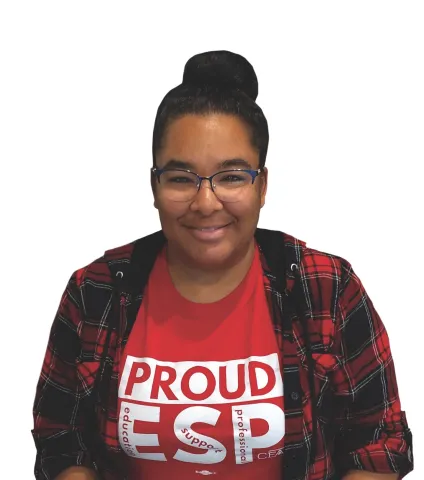
I was a stay-at-home mom, dropping off my twins at their elementary school each day. One day, a paraeducator at the school who’d seen me at several Parent Teacher Organization meetings, stopped to ask me a life-changing question. “Are you interested in getting a job here?”
Fast forward eight years, and I now work at an integrated learning center for 3- to 5-year-olds. I am a severe-needs paraprofessional, working with children who have significant cognitive, medical, or behavioral challenges. I help students with daily-living skills, personal care, and specialized learning goals.
Throughout my time as a paraeducator, I’ve encountered people who don’t understand what I do. Their limited perspective has sometimes made me question my work and my purpose. It’s taken me time to understand that the care and dedication I show students is valuable and important.
It’s also taken time for me to understand that I have power. We all have power as paraeducators, as bus drivers, as food service workers, and as every education support professional (ESP) reading this column.
We want more training
I’d like to share a story of a student who is on an individualized education program (IEP). He prefers to play alone, but this is something we’re working on as a team.
I decided to join him one day as he played trains alone on the carpet. We took turns connecting pieces to build the track. He happily drove his train around the track and allowed me to follow with mine. We continued this way for a few minutes—and I felt
good about the progress we were making together.
Suddenly, without warning, he wanted to take my train, which quickly escalated into an emotional and physical reaction. I was able to address the situation and did the best I could in that moment. But I left that day thinking, this is not OK. Not for him,
and not for me.
I must admit, the training the district provides doesn’t always meet the needs of my students or prepare me or my colleagues to best handle these situations.
Paraeducators and all ESPs need training to support our success and that of our students. We have the desire and the ability to do more, but we need a contract that empowers
us. Our students deserve better, and so do we!
Power in numbers
The good news is that we have our union. Last spring, my local began negotiating our first contract, and we began building language around safety and training. For example, the contract acknowledges the importance of paraeducators having specific details about the students they support. It also states that severe-needs paraeducators should have access to core components of a student’s IEP. Additionally, the contract includes the formation of a district and union committee to assess and prioritize training needs and procedures for paraeducators.
Securing this contract language allows us to develop on the skills we need to serve all of our students, including my student with the trains.
Power through our union allows us to advocate for student needs at the most foundational level, while also speaking to our needs as ESPs.
While the union begins at our local, we also have connection and power at the state and the national levels. Our opportunities and power expand when we work together, whether locally, statewide, or nationally.
For me, that has meant leadership development, connection with fellow members of color, and the opportunity to be in community with all ESPs.
We all know this work is difficult and means late nights, a lot of text chains, and difficult conversations, but my union siblings in Colorado and across the country have kept me going and filled my cup on the days I needed it. My power is fueled by my ESP siblings and the important work we do to push for the change we deserve.
It wasn’t easy for us to start our union. Negotiating our first contract was difficult, and we were told some of our positions may be cut. Some days ended in tears, and I often wondered what’s next.
But I believe in the power of the union. We are our union. Together, we are stronger. Together, we are heard. We know that there is power in numbers and collective action, which is most important for pushing change.
But it starts with me, and it starts with you, when we commit to standing in our power. Sometimes power is having courageous conversations with your co-workers or administrators. Other times, it’s making your voice heard on issues you care about at the local, state, or even at the national level.
Finding your power can look different for each of us. I’m asking each of you, today, to be brave enough to stand in your truth and unleash your power!