Student Debt Support NEA is Working to End the Student Loan Crisis
Student Loan Changes Launched July 1
The Public Service Loan Forgiveness program has stayed the same (so far). Although the Department is making student loans even less affordable, it has indicated that it has no plans to eliminate PSLF, which would require an act of Congress. We recommend that eligible borrowers continue to apply annually.
Make sure you are in a repayment plan that qualifies for PSLF. You can use the NEA Student Debt Navigator to help!
You may need to select a new payment plan. The SAVE Plan has ended. All current enrollees will receive a letter from the Department of Education this summer giving them 90 days to choose a new repayment plan or you will automatically be assigned to the Standard Tiered Repayment Plan, which does not qualify for Public Service Loan Forgiveness.
Income-Based Repayment Plans: These plans base your monthly payment amount on how much money you make and your family size. The Repayment Assistance Plan is the administration’s new income-driven repayment plan. Until July 1, 2027, existing borrowers can also enroll in IBR, PAYE and ICR plans, though PAYE and ICR will sunset on July 1, 2028. These plans qualify for Public Service Loan Forgiveness.
Standard Tiered Repayment Plan: Under this plan, your monthly payment is a fixed amount calculated using your total balance, interest rate, and term limit. It does not fluctuate based on your income. For example, if your balance is less than $25,000, you will be given 10 years to repay the loan. If you owe $25,000-$50,000, you will be given 15 years. If you don't pick an income-driven repayment plan, you will automatically be placed in this plan. This plan does NOT qualify for Public Service Loan Forgiveness.
Choosing the best option for you will differ based on several factors. These include your income, debt amount, whether you plan to receive PSLF, and more. We recommend working with the NEA Student Debt Navigator to review your options and choose your plan. You can switch your plan through the NEA Student Debt Navigator (free for NEA Members) or through your StudentAid.Gov account.
There are new restrictions on federal loans and grants.
On July 1, the administration launched new limits on graduate and Parent PLUS loans. Borrowing limits were placed on federal loans for “professional” and “graduate” degrees, with lower limits of $20,500 a year or $100,000 aggregate applying to most education-related degrees. Parent PLUS loans are now capped at $20,000 per student per year or $65,000 per dependent in aggregate. This change does not apply to students who took out loans before July 1, 2026 and are actively studying in the same program at the same school.
Fewer students are eligible for Pell Grants. Students who receive grants or scholarships (institutional, state, or private) that cover their entire cost of attendance—regardless of financial need—are no longer eligible for Pell Grants. Students with Student Aid Index (SAI) equal to or greater than $14,790 (SAI is the number calculated by using your FAFSA data to determine your eligibility for financial aid) are also no longer eligible. This change applies to new and existing students.
The new limitations on federal loans and Pell Grants make college harder to afford and will likely drive many people to borrow from predatory private loan servicers. Private loans don’t qualify for Public Service Loan Forgiveness or other federal programs.
The experts at NEA are working hard to create the tools you need to navigate your student loan repayment options.
- Frequently Asked Questions: We have gathered answers to the questions we get the most about Public Service Loan Forgiveness.
- Expert Webinars: NEA experts host regular webinars to highlight the information they want you to know about student loan repayment options. Our most recent webinar discussed the July 1 changes and what you can do to prepare.
- The NEA Student Debt Navigator: NEA has partnered with a company called Savi to offer an online student debt navigator tool, free for one year for NEA members.
We will continue to share the latest news and advice for educators and families. Stay tuned for more resources!
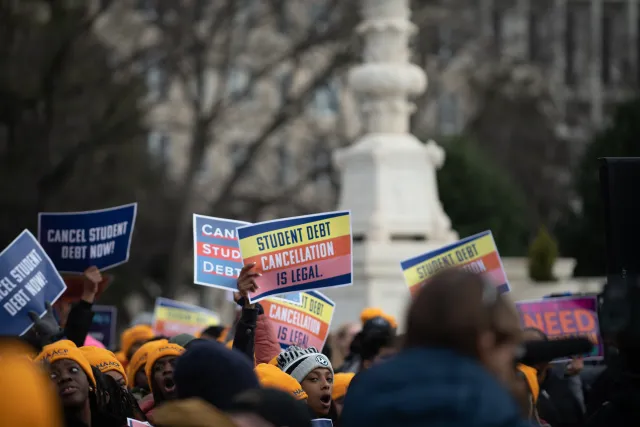
Higher education must be affordable and accessible to all. Yet, for too many, pursuing our college and career dreams means years, even decades of paying off student debt. This is especially true for educators. This system is working for the student loan providers and banks, but not for us.
Fixing the student debt crisis makes our public schools stronger.
Young or old, Black or white, educators of all ages and races have had to take on student debt to enter the profession. This reality keeps too many talented young people out of the profession and pushes out those who do enter it. With this crisis, however, comes the opportunity to create a better, more just system.
Imagine it. A world where every student, educator, parent, and friend can dream without limits. Where having a higher education only means greater possibilities. Together, we will create this world.
Manage Your Student Debt

The NEA Student Debt Navigator

Public Service Loan Forgiveness (PSLF)
Expert Webinars
Stories of Student Debt Forgiveness
Did you get your student debt forgiven? We want to hear from you!
If you are one of these thousands of individuals impacted by this life changing advocacy, please fill out this short survey so we can capture what loan forgiveness has meant to our educators.
A Future Free From Student Debt
Thanks to NEA members who are speaking up and demanding change, we have helped to improve the Public Service Loan Forgiveness program, making it actually work for educators.
Our voices are strongest when we are united. Become a member of the National Education Association today to be part of the movement to make higher education affordable for everyone.