
Key Takeaways
- In 2025, the Trump Administration made deep cuts to federally funded scientific research.
- A new survey from the Pew Research Center reveals Americans across party lines strongly support the nation's role as a leader in scientific achievement.
- The survey also found that a majority of U.S. adults believe colleges and universities make significant contributions to science.
“The bald truth is that if this level of science funding cuts continues... No one has any idea who will come in to fill the gap,” says Meera Sitharam, professor of computer science at the University of Florida and president of the United Faculty of Florida-University of Florida chapter.
In 2025, the Trump administration disrupted $29.86 billion in grants from the National Institutes of Health (NIH), National Science Foundation (NSF), and Environmental Protection Agency (EPA) combined. Since Trump took office, nearly 2,000 NSF grants—a major source of research funding in the higher education sciences—were cancelled or suspended.
And now, new numbers from the Pew Research Center suggest that Americans, regardless of political affiliation, are not happy with these cuts.
Pew’s Findings
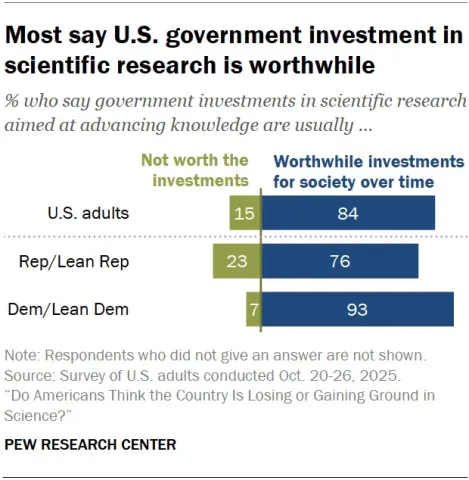
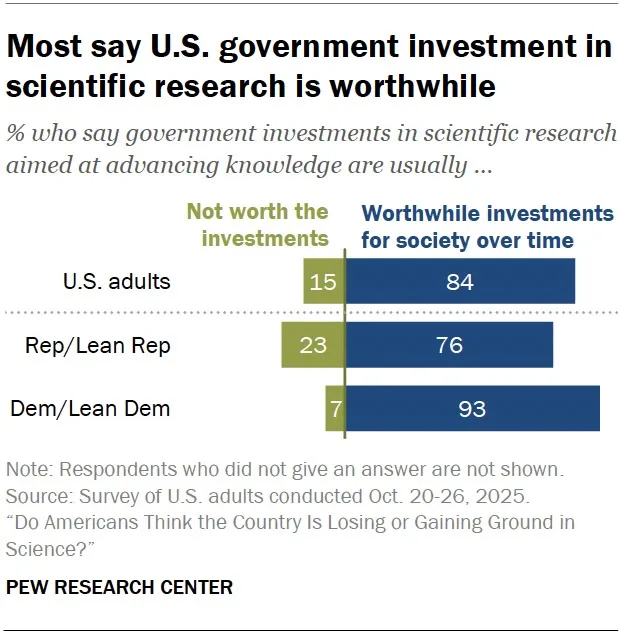
According to Pew’s survey of 5,111 American adults, Republicans and Democrats alike support government investment in scientific research and want to see the U.S. as a leader in the field.
Nearly half told Pew that the U.S. is losing ground in scientific achievements when compared to other countries, a notable increase from 2023 and 2024. Pew also found that 84% of Americans believe investments in scientific research aimed at advancing knowledge are usually worthwhile.
Where Democrats and Republicans tend to differ, according to the Pew survey, is how much of this innovation should come from institutions of higher education versus private companies. While Democrats are more likely to say colleges and universities contribute to science, Republicans are more likely to attribute this research to private companies.
What’s Next?
The impacted grants cover a wide range of topics, including quantum physics, botany, food insecurity, software bugs, elementary school education, astronomy; the list goes on.
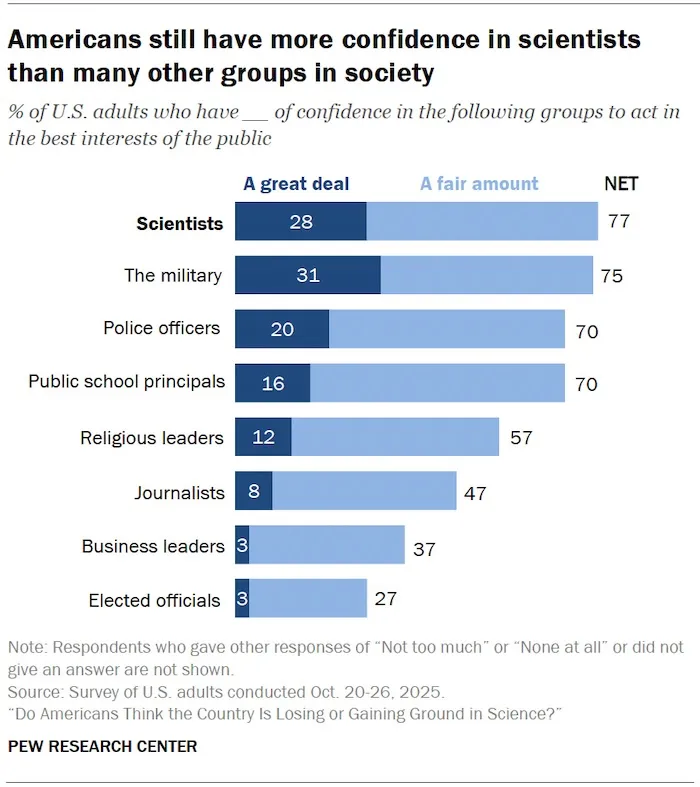
Universities—and Americans in general—will not feel this shift immediately, as the funding is doled out over the course of several years, Sitharam points out. Rather, we will slowly, over the next half-decade, watch funding trickle away from essential areas of research at universities nationwide.
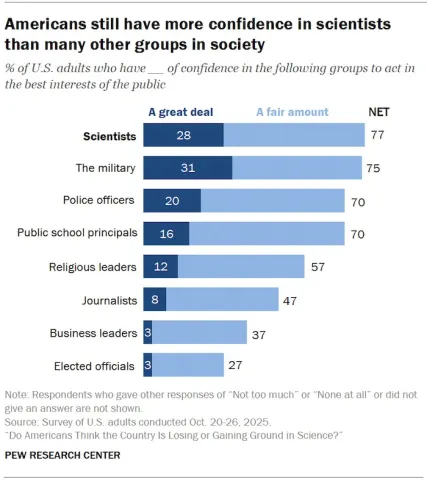
These cuts come even though, according to Pew’s findings, 77% of Americans trust scientists to act in the public’s best interests. When asked the same question about police officers, journalists, business leaders, and elected officials, scientists came out on top.
Additionally, 61% of Americans say science has had a mostly positive effect on society, an increase when compared to 2023.
The good news is that Congress seems to understand and value this trust, and recently rejected the Trump administration’s attempts to make further cuts to scientific research. The latest funding package approved by Congress ensures that federal funding for scientific agencies, including the NSF, remain steady from 2025 through 2026.
However, this step may not be enough to shield researchers, and the American people, from the future consequences of funding cuts that have already been set in motion. Eventually, the impacts of these cuts will become impossible to ignore.
Research on cancer, Alzheimer's, vaccines, and HIV, just to name a few, are already being impacted. Long term the price will be measured not in dollars, but in lives – the diseases we couldn’t cure and the disasters we couldn’t prevent.
Who Will Fill the Gaps?

As the federal government cuts funds, many universities are forced to turn to private donors.
Private funders can be invaluable for scientific innovation, but as Sitharam points out, they exact a price. “They want to only invest in things that will push their agenda forward,” she says.
For example, the field of computer science has a wide range of areas to be studied, but private funders are obsessed with only one trendy topic: “they want to push everything into AI,” Sitharam shares.
For now, universities are left to grapple with smaller budgets and make impossible decisions about which essential research to continue and which to abandon.
Schools will stretch and court every dollar they can, but as Sitharam puts it, “nothing compares to the NSF budget.” And as evidenced by Pew’s recent research, most Americans, regardless of political affiliation, already know this too.