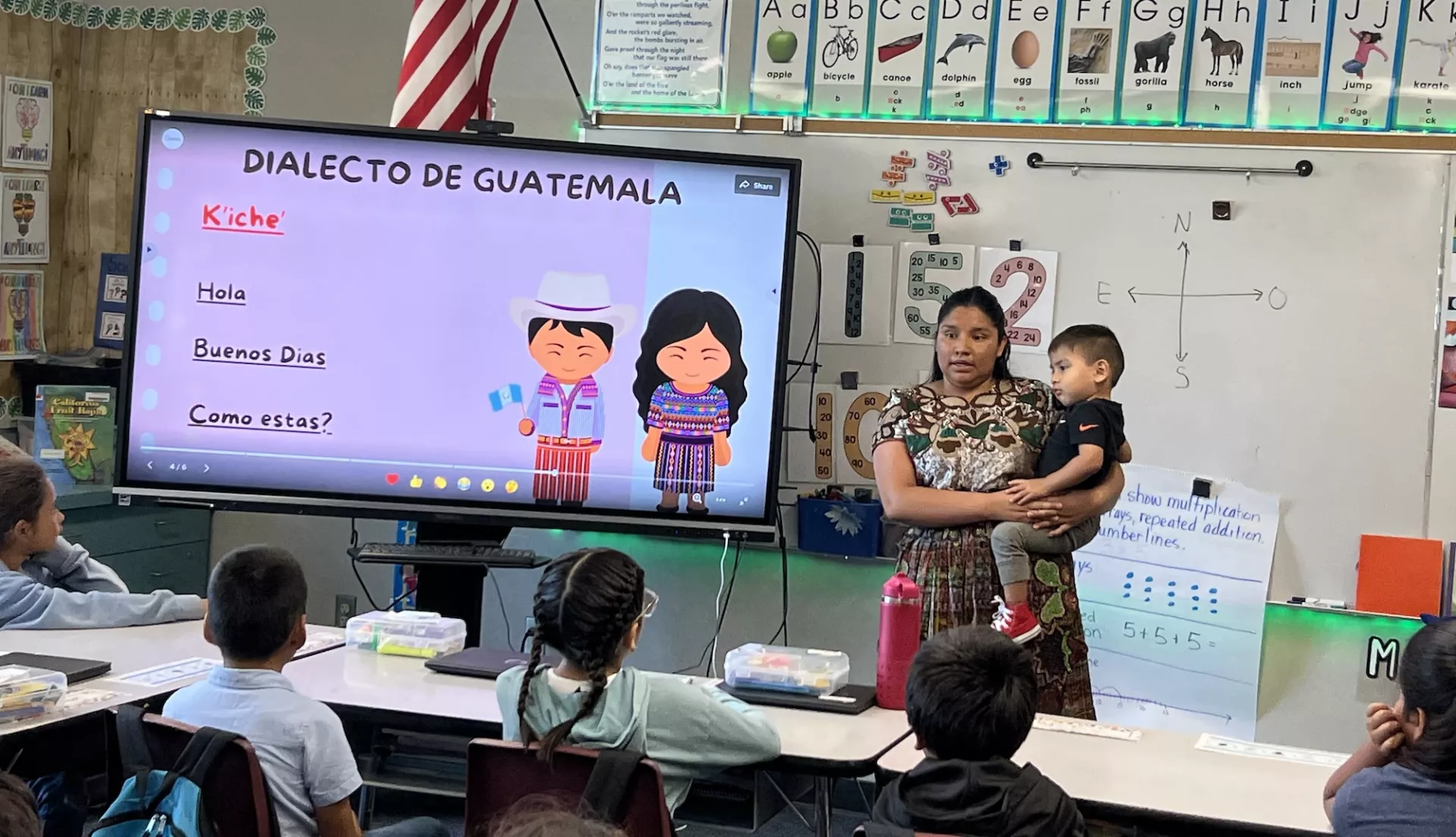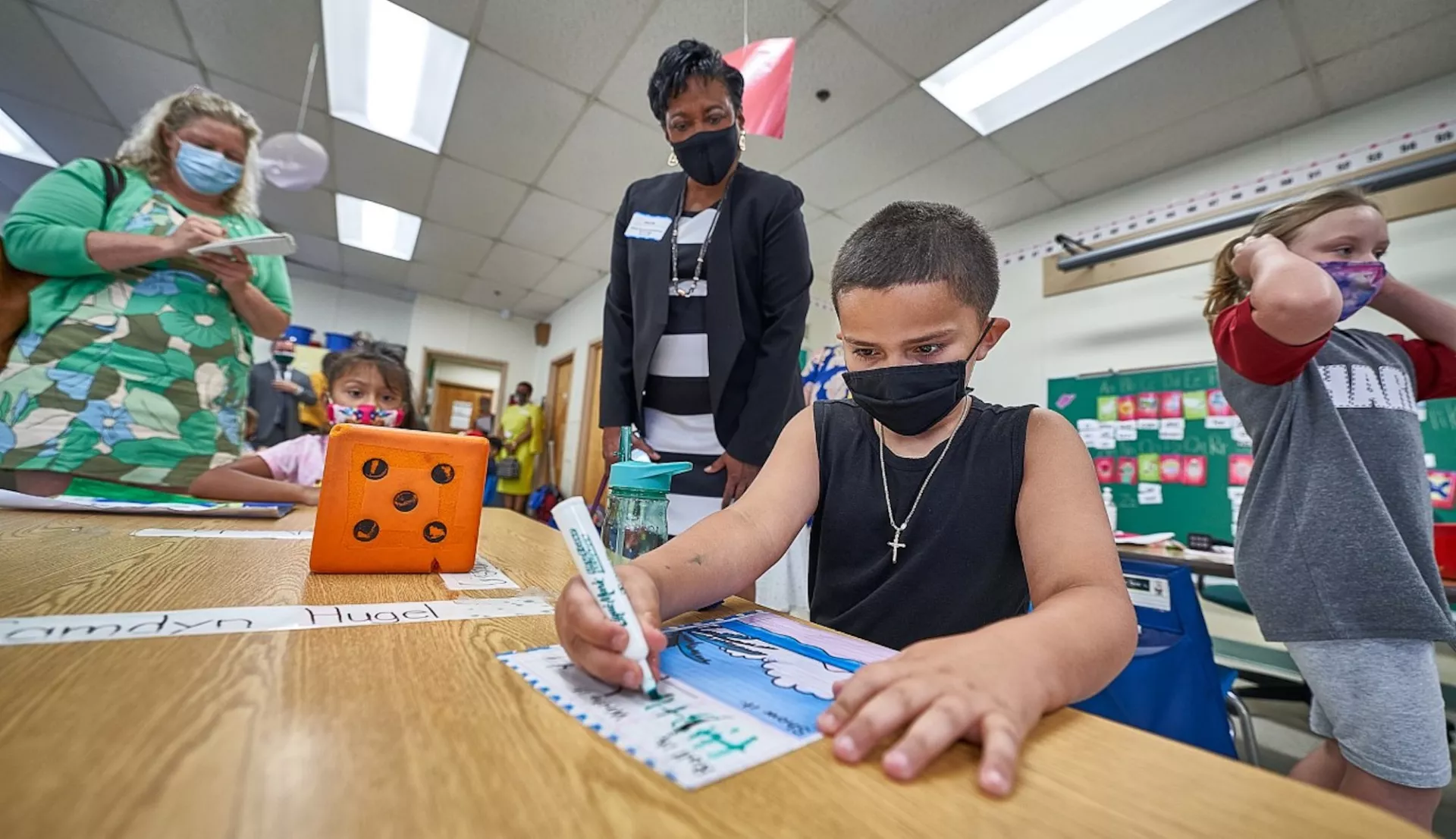
Amber Bradley, a social science teacher at River City High School in Sacramento, California, knows that educators alone can’t provide all of the resources a student needs to learn – like regular access to nutritious meals outside of the school day, healthcare, clean clothing, or housing. That’s why her school adopted the Full-Service Community Schools (FSCS) model to bring in local partners to help provide access to basic services.
“We had a food bank, after school enrichment, school and basic necessity supply closets, language support, legal services, tutoring, and other resources that a school itself wouldn’t be able to provide without community partners,” she says. “We became a hub for the entire community, not just for students and their families, but for everybody.”
That ended last December when the Trump Administration abruptly cut $132 million in multiyear grants for Full-Service Community Schools (FSCS) programs across 11 states and Washington, D.C. The decision broke from department policy that long-term grants be issued based on performance – FCSC programs have proven to be extremely effective – and did not include adequate explanation for the decision, which is a clear violation of the Administrative Procedures Act, legal experts state.
Hundreds of school employees around the country lost their jobs as a result with many more fearing their jobs will be next. The services that were supported by the grants were halted and the impacts were felt almost immediately.
“At our high school, attendance has taken a hit because a lot of students have decided they have to work to support their family without these extra supports and resources,” Bradley says. “Our school had really become a community center that helped people and where the whole community gathered. Now everyone feels like we’re missing out, and the economy isn’t getting any better so it’s just harder for everyone.”
The Grass Roots of Local Communities
Like many of the Trump Administration’s public education cuts, the rescinding of grants for community schools seems cruel in its intent to spread fear and hopelessness. But the community schools movement is resilient and is on the cusp of a historic expansion nationwide.
States like California and Maryland are incubating statewide community school systems that could serve as a blueprint for what a post-Trump federal education policy could look like, offering a vision for how to rebuild a better and more just education system.
In his May budget revision for the 2026-27 fiscal year, California Governor Gavin Newsom reaffirmed his landmark commitment to community schools by proposing an additional $1 billion annually to expand the Full-Service Community School model across the state, on top of the $4.1 billion already allocated, which could more than double the number of community schools across the state.
Maryland is another state rapidly expanding its community school network, with community schools now making up nearly 50 percent of all public schools across the state. This growth is heavily supported by the Blueprint for Maryland's Future.
Other states that have used state resources to spread Community Schools include New Mexico, Minnesota, Florida, Vermont, Kentucky, New York, Maine, and more.
Even in Ohio, which has traditionally supported charter schools, a community school is opening in Columbus, thanks to city funding.
Community schools are seeded in the grass roots of local communities, but federal support of community schools is a small investment with major returns for taxpayers, data shows. Slashing commitments to community school grants is fiscally irresponsible, education advocates say.
NEA Joins Lawsuit
It’s also illegal.
NEA has joined a coalition of educators, school districts, and nonprofit groups to challenge the unlawful discontinuation of grants issued through the Full-Service Community Schools (FSCS) program.
On December 29, 2025, the department began issuing denials of grantees’ appeals. According to Democracy Forward, the Education Department (ED) did not base its discontinuations on written agency priorities or analyses of grantee performance. Instead, the termination notices targeted applications for simply containing Diversity, Equity, and Inclusion (DEI)-related terms rather than what the grants were actually supporting, which the lawsuit claims is a violation of their First Amendment rights.
ED had previously reviewed and approved how this funding would be used when the grants were awarded. Schools were transparent from the outset about how they planned to support students; ED signed off on those plans, and districts relied on that approval to hire staff and build programs.
The lawsuit alleges that ED’s actions violate the Administrative Procedure Act, federal education regulations, and the U.S. Constitution, which gives Congress – not executive agencies – the authority to direct federal spending.
The move not only defies law, it also defies logic, according to those who are familiar with the success of community schools.
There is substantial evidence that community schools have a positive impact. For example, Democracy Forward notes:
- At Joseph A. Taub School in Paterson, NJ, participants in programs funded by FCSC grants were 16 percentage points less likely to be chronically absent, missed six fewer days of school, and earned 18% higher math and ELA grades than non‑participants.
- In Wayne County, NY, food pantries provided monthly support to thousands of children and adults, chronic absenteeism decreased by over seven percentage points across the County, and 85% of grantee schools experienced a decrease in the proportion of students who reported feeling unsafe in school.
- In Kentucky, nearly all participating schools showed lower levels of chronic absenteeism, on average, dropping by 8.24 percentage points year-over-year, and made major gains in academic achievement, including average gains of 10.79 percentage points in math and 9.24 percent points in reading compared to prior years.
Community Schools’ Big Impact
Research from the Learning Policy Institute found that chronic absenteeism at community schools declined, on average, 30% more than at comparison schools and that suspension rates decreased by an average of 15% while there were slight increases at comparison schools.
It also found that students at community schools improved their English scores, equaling 36 additional days of learning, and math scores, equating to 43 additional days of learning, more than at comparison schools.
The Atlantic recently reported on a study that demonstrates the long-term effects of community schools. Benjamin Goldman, an assistant professor of economics at Cornell, and Jamie Gracie, a postdoctoral fellow at Harvard, evaluated data on more than 16 million Texas students over two decades, examining data from the Census Bureau and IRS, as well as state records on academic outcomes. They found that the implementation of community schools led to higher test scores, lower absenteeism, and fewer suspensions in Texas schools. The program boosted high-school graduation rates by 5.2 percent and matriculation rates at two-year colleges by 9.1 percent. At age 27, students who had attended a community school earned $1,140 more a year than students who had not.
The program’s impact is “quite big,” Gracie told The Atlantic. The researchers estimated that every $3,000 in community school investment would increase income tax revenue by $7,000.
The federal government chose to cut the funding for community schools not despite the success of community schools but because of it, educators claim. It’s part of the broad effort, outlined in Project 2025, to weaken public education by removing resources necessary for success.
“Parents, educators, and community leaders know that illegally cutting grants to community schools will hurt our students, which is why we will do everything in our power to protect our students and their futures,” says National Education Association President Becky Pringle. “As educators, we see firsthand that full-service community schools – which bring academic coursework, health and social services, and community engagement under one roof – are one of the most effective ways to address the gaps students face, improve learning, and build stronger communities. America’s educators and parents will not be silent as Donald Trump and Linda McMahon try to steal opportunities from our students.”
Federal Legislation
On May 12, U.S. Senators Chris Van Hollen (D-Md.), Kirsten Gillibrand (D-N.Y.), Ben Ray Luján (D-N.M.), and U.S. Representative Susie Lee (D-Nev.-03) reintroduced the Full-Service Community School Expansion Act, legislation to provide essential resources for school districts to plan for, implement, expand, and support full-service community schools.
“A quality education is a cornerstone of our children’s success, but for many students, the challenges they face outside of the classroom impact their success inside the classroom. Community schools offer a solution – empowering local education and community leaders to connect families with vital services they need while providing a top-notch education. As we’ve seen across Maryland, this innovative approach has been proven to make a positive difference in the lives of our students and their families. This bill will further invest in and create a pathway for more community schools, ensuring all of our students have the support they need to succeed,” said Senator Van Hollen.
In addition to Senators Van Hollen, Gillibrand, and Luján, the legislation is cosponsored in the U.S. Senate by Senators Angela Alsobrooks (D-Md.), Cory Booker (D-N.J.), Richard Blumenthal (D-Conn.), Dick Durbin (D-Ill.), John Fetterman (D-Pa.), Martin Heinrich (D-N.M.), Mazie Hirono (D-Hawaii), Tim Kaine (D-Va.), Amy Klobuchar (D-Minn.), Alex Padilla (D-Calif.), and Bernie Sanders (I-Vt.).