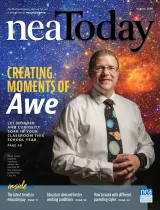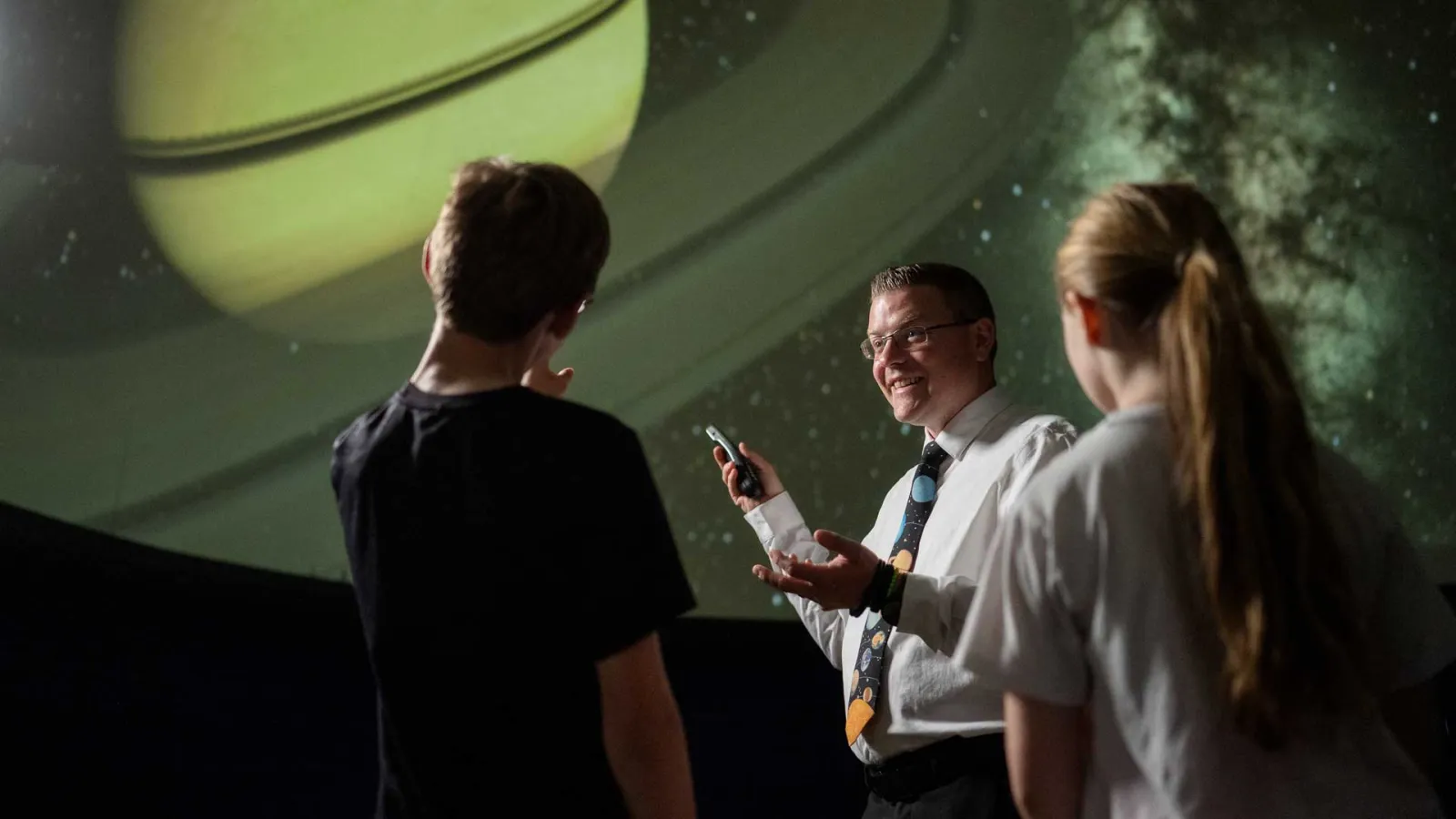
For science teacher Ryan Tucek, the excitement and possibilities that come with a new school year are energizing. But capturing that excitement and extending it through the following months is what really sustains him.
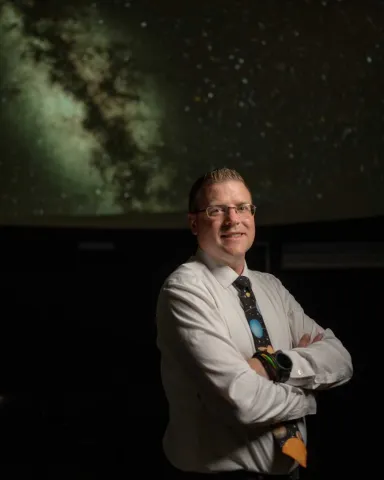
As educators, we get a different group of young people each year, and “everything we’re going to show them … is new,” says Tucek, who teaches physics and astrophysics as well as Earth and space science at Penn Trafford High School, in western Pennsylvania. “Relaying lessons in projects or experiments with real-world applications that build toward a big reveal, the kind that make your students go, ‘Ohhh!’ The anticipation of that? That’s the best part of my job.”
Those “ohhh!” moments come when educators take curriculum from memorization of facts and figures to true discovery, turning a drab, grey lesson into vibrant technicolor. Helping students find these moments of awe sets them up for a lifetime of wonder, curiosity, and the ability to look for and appreciate the beauty and connections that surround all of us.
Tucek strives to create those moments for his students as often as possible because he’s learned they’re more likely to remember that lesson for the rest of the year, maybe even for the rest of their lives.
“Awe is what makes you go wow!” he says. “When you aren’t sure how something works, but then explore and come to understanding—those are the moments of awe that I want to see.”
Connecting with something bigger than ourselves
In the book, Awe: The New Science of Everyday Wonder and How It Can Transform Your Life, author Dacher Keltner writes: “As children develop, regular feelings of awe animate their curiosity in school and predict better academic performance.”
When educators tap into awe, Keltner finds, they quickly realize that so much of their work is getting students to be amazed, to wonder, and to question. Their students not only want to learn more, but they also feel more connected to each other and to the world.
After more than 20 years of research across 26 cultures around the world, Keltner identified eight wonders of life that spark awe: the moral beauty of others, collective movement, nature, visual design, music, spirituality, big ideas, and encountering the beginning and end of life.
“Awe is the feeling we get in the presence of something vast that challenges our understanding of the world, like looking up at millions of stars in the night sky,” Keltner says.
It’s a feeling that we don’t immediately understand, he adds, but it can be sparked by everything from noticing someone’s exceptional courage and strength to experiencing the power of nature or feeling transported by soaring music or by the collective movement of people dancing.
Finding awe in the night sky
Tucek’s school, in Harrison City, is about 30 miles outside of Pittsburgh, and the night sky isn’t the inky black of more remote areas. But it’s dark enough for students to see the constellations they learn about in his class. The high school also has its own planetarium, which Tucek’s classes visit at least once a week. The planetarium itself is awe inspiring, but he says the real magic is applying what they learn to the actual night sky.
One of those occasions came last spring with the Lyrid meteor showers, which, according to NASA, are among the oldest meteor showers
that stargazers have marveled at for nearly 3,000 years.
The students learned about the constellation Lyra in the planetarium. “Being able to find it in the sky, and then witnessing meteor showers, numbering 15 to 20 an hour, is an unforgettable experience,” Tucek says.
Quote byRyan Tucek, Science Teacher, in Pennsylvania
Seeing a new life begin
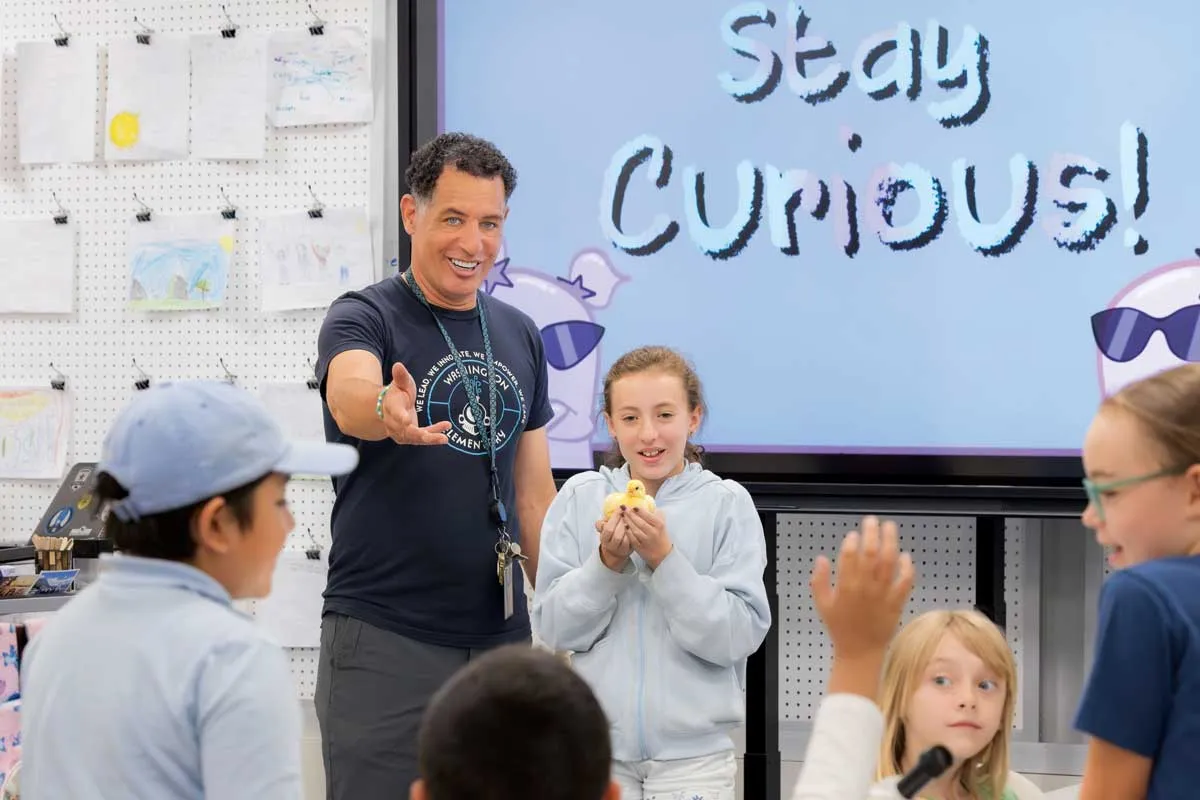
James McDaniel, a fifth-grade teacher at Washington Elementary School in Sacramento, Calif., brought an incubator into his classroom with 12 fertilized chicken eggs inside, so students could experience the wonder of the beginning of life.
“I wanted them to see in real time the life process in a way you can’t get from a textbook,” he says.
The students monitored the eggs for 21 days, taking turns logging the temperature and humidity of the incubator, turning the eggs to prevent the hatchlings from sticking to the shell’s membrane, and “candling” the eggs by shining a bright light on them to see the embryo as it grew.
“When the first chicken hatched, there was an overwhelming sense of awe among the students,” McDaniel says. “To see this baby chicken peck its way out of the egg—it was tremendous!”
He notes, “When [students] pay attention to the world happening around them, they can learn so much more than what’s in a regular two-dimensional lesson. Awe happens when you are paying attention.”
McDaniel also encourages his class to notice the plum tree in the school garden. They watch it through the seasons: From the vibrant leaves of autumn to the bare branches in winter to the tiny buds that form in late winter. The buds bloom into flowers, which bees pollinate. Then the leaves form, and plums grow and ripen, offering food for the wildlife. He has them pay attention to all of it.
“I go to my own senses of awe,” says McDaniel. “I like to be out in nature myself.
When I’m on a trail and I take in a panoramic view of my environment, I get a sense of awe as I witness all of these systems working together in harmony.”
Experiencing beauty in kindness
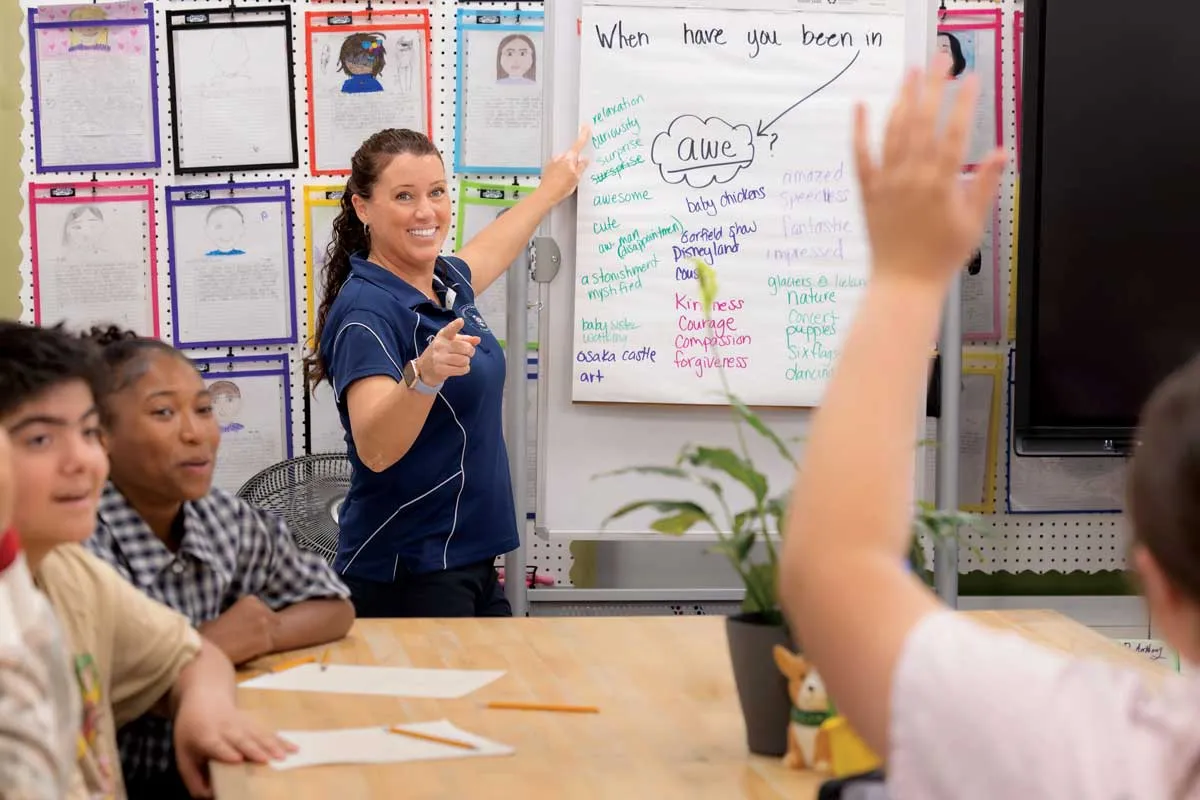
Down the hall from McDaniel, Nicole Quinn teaches her sixth graders a lesson on “moral beauty,” the first of the eight wonders of life identified by Keltner.

She shows a video of a man who lives in Bangkok, Thailand. The man performs acts of kindness each day on his walk to work. Under a leaky pipe, he places a nearby plant to catch the water. He stops to give money to a mother and her daughter, begging for education donations on a street corner. He helps a woman maneuver her food cart over a steep curb and then offers half of his meal to a hungry stray dog. He does this day after day. The plant grows into a flowering bush that attracts butterflies. He sees the daughter walking away from the street corner in a school uniform. A friendship flourishes with the woman with the cart, and the dog becomes the man’s loyal companion.
Before the students watch the video, Quinn asks them what beauty is. Most answers focused on appearances, but after the video, the discussion changed. They said there’s beauty in doing something for others. They began to realize that beauty isn’t superficial; it’s much deeper and more expansive than how things look on the outside.
“The kids started to have this really profound conversation about what beauty truly means and how they can bring it into their own communities,” Quinn says. “What really resonated with the class was the idea that there’s so much beauty around us if we stop and really look at what is truly beautiful.”
Creating ‘aha’ moments
Megan Donoghue was a theater major in college and worked as a character performer at Disney World. Now she teaches second grade at Citrus Cove Elementary School, in Boynton Beach, Fla., where she brings her theatrical energy to all of her lessons, like the ever-popular “Dino Days”! She “set designs” her classroom with dinosaur posters, pictures, stuffed animals, and costumes for her students.
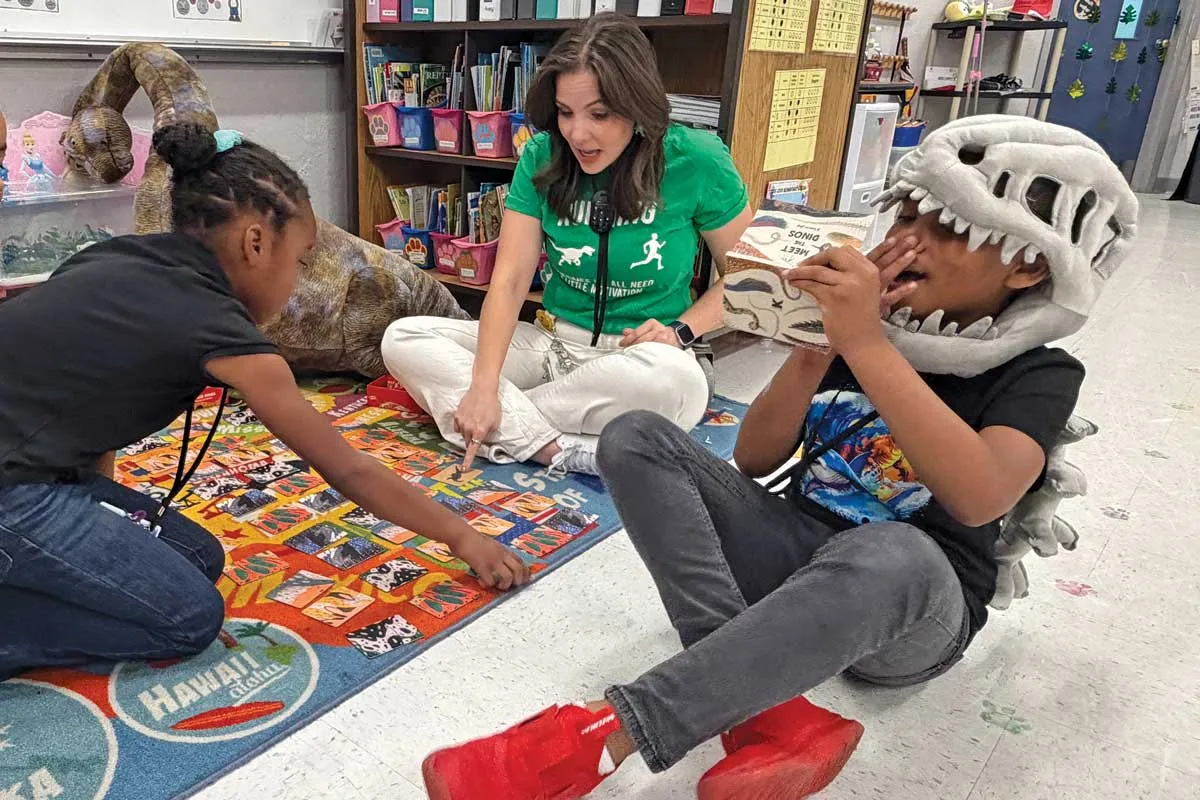
“Awe, to me, means finding a connection with a subject that my students didn’t know they had,” she says. “It’s the ‘aha’ moment.”
In her class, Donoghue regularly uses “KWL sheets,” divided into three columns, where students write what they know, what they wonder, and what they’ve learned.
Donoghue finds the know column useful to get a sense of what information the class is already aware of, but the wonder column is where the magic happens. “That’s where the students get to direct their own learning and develop the ability to question and think critically,” she says.
Quinn agrees self-directed learning and discovery is the foundation for sparking awe. “I want to present information in a way where every student can find themselves in it, and let them bring their joy and their curiosity in and activate who they are in learning,” Quinn says. “When that happens, then learning itself becomes awesome.”
Find Awe in Your Work and Personal Life
UC Berkeley’s Greater Good in Education is a free, research-based resource hub and professional learning community that helps educators bring more meaning and happiness to their life and their classrooms.