Key Takeaways
- Educators in Jefferson County, Florida, lost their union contracts in 2017 after the school board voted to make the county a charter-run district.
- The charter operator did a poor job of supporting students and raising achievement and left the district in 2022.
- In April, Jefferson County educators in Florida voted overwhelmingly to reclaim their collective bargaining rights and reestablish their teachers union.
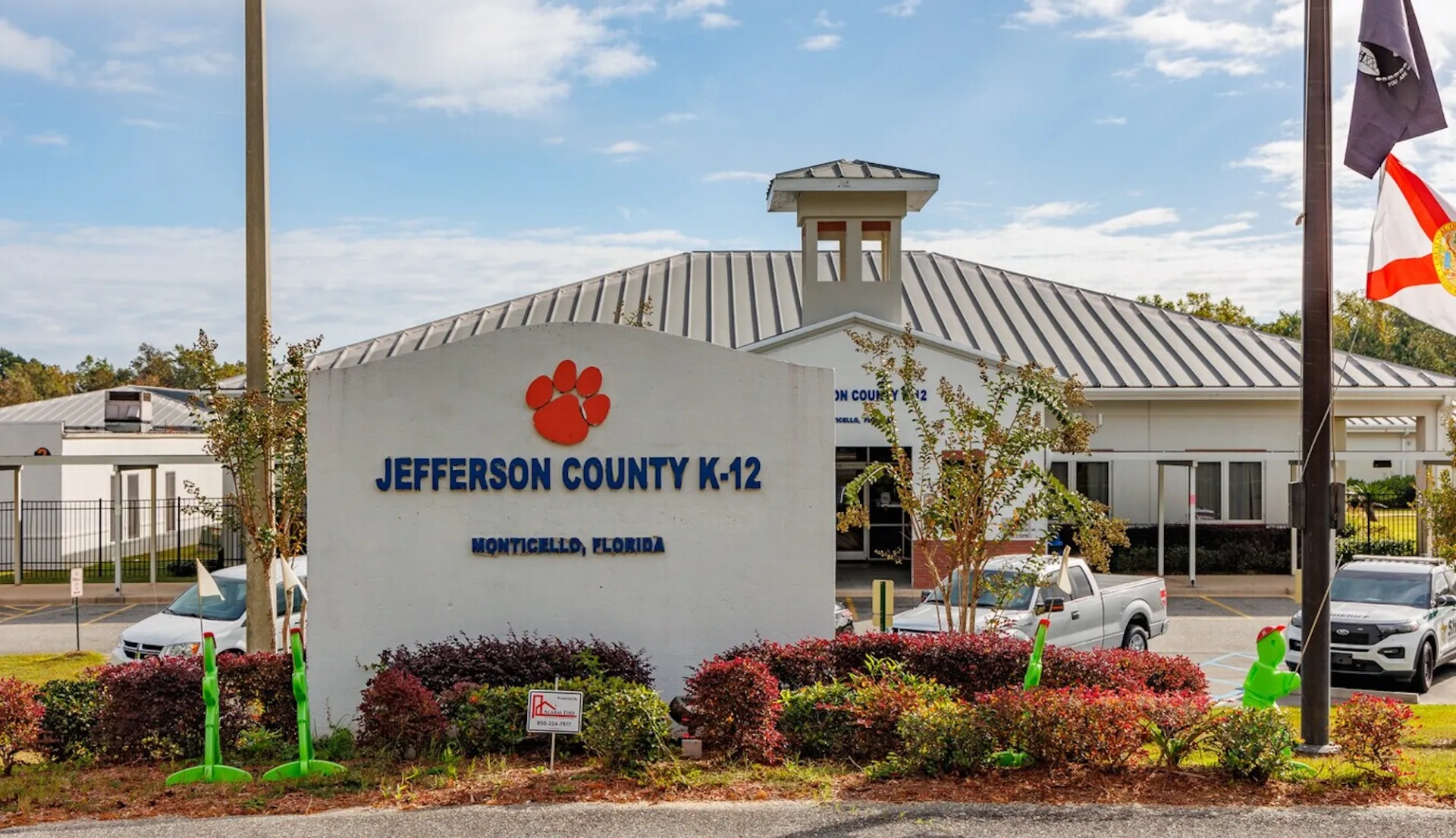
Teachers in one of Florida’s Panhandle counties lost their local union nine years ago, when a charter school company came to town to run its small schools. But today, the company, Somerset Academy, Inc., is gone, and the local union is back.
Somerset entered Jefferson County in 2017, and when its five-year contract expired in 2022, the state did not renew it. Teachers voted in April 2026 to reestablish their union, the Jefferson County Education Association (JCEA). They believe the vote sends a powerful message about the strength of workers’ rights and the value of public education at a time when politicians are passing laws that undermine both.
“This is a historic moment in our community as we work to bring back the rights that educators have to advocate for our profession, our students, and our community,” JCEA President Jennifer Redfern said, after the teachers’ vote.
Jeff Veilleux, vice president of the union, says making sure that educators’ expertise and autonomy are respected are key issues for the union. He points out that even without a contract, administrators and teachers recently worked well together to select a new English and Language Arts curriculum. But teachers want to make sure that continues, no matter who oversees the district or what changes may come.
“We have a good administration in place now and a good working relationship, but nothing stays the same,” Veilleux says. “We need structures and language that will protect our faculty.”
Somerset Academy Comes to Town
Given the experience with the charter takeover, teachers know firsthand that change can bring chaos and instability to students and families, especially when it is driven largely by a political agenda and profit motives.
The state’s Department of Education took over the county’s schools—an elementary school, a combined middle and high school, and an alternative high school—in February 2017, citing concerns about the district’s finances and ability to meet students’ academic needs.
At the time, says Michael Monroe, political specialist Florida Education Association (FEA), and former organizer in the Panhandle region, the Jefferson County union was “a visible local with strong teachers who were embedded in the community, but the tax base didn’t exist to support the students or to support the teachers.”
Generally, Florida’s school districts have several options for making improvements when the state determines they haven’t met the mark. One option is to create and implement a turnaround plan, subject to state approval. But the Commissioner of Education and Florida Board of Education at the time gave Jefferson County Schools only two: Either close the schools for the upcoming year or turn them over to a charter-school company.
The board members couldn’t stomach closing schools that served their low-income, historic, majority Black community—schools that in earlier times had been the pride of the county. They voted to keep the schools open, but that meant they were forced by the state to outsource the district to a charter company.
They had to quickly create selection criteria and solicit proposals; the 2017-18 academic year was set to begin in less than six months.
The county school board’s unanimous vote made Jefferson County Schools the first district in the country to be run by a charter company. Somerset Academy, Inc., a nonprofit that’s part of a for-profit corporation called Academica, was the only company to formally submit a proposal and received the five-year contract.
‘They Didn’t Know the Students or the Community’
“It wasn’t the will of the voters,” said a former Jefferson County teacher, quoted in a 2019 series of articles on the first-of-its-kind takeover. “How can a locally, democratically elected official not have any power?”
Many say that the multiple connections between former and current Florida politicians, Somerset, and Academica eased the way for the takeover in general, and the Somerset contract in particular.
For instance, Manny Diaz, Jr., was the Republican chair of the powerful K-12 budget committee in the Florida House of Representatives when the Jefferson County takeover occurred. At the same time, he was chief operating officer of Academica network’s Doral College, which Somerset Academy hired to provide college-level classes in the county. In 2022, he became Florida’s Commissioner of Education. He now is president of the University of West Florida.
Somerset also got major assistance from the “Schools of Hope” bill, shepherded through the state legislature by powerful Republicans in 2017.
The law made it easier for charter companies to take over public schools, and provided money to help them do it. Somerset Academy Jefferson became the first charter in the state to receive a $2.25 million “Schools of Hope” grant. The grant, for the 2018-19 year, accounted for 20% of the district’s budget.
But that wasn’t the only financial help Somerset Academy Jefferson received. The charter district also got a $2-million grant from the federal government, $2 million in short-term loans from Somerset, and $552,000 in special funding from the state legislature to pay out sick and vacation time owed to teachers and staff that Somerset fired.
Quote byJeff Veilleux, Vice President, Jefferson County Education Association
Lawmakers who maintained that “throwing money at schools” wouldn’t solve any problems seemed to have a change of heart when it came to Somerset.
“Everything Somerset proposed is what Jefferson County Schools had been seeking: smaller classes, mandatory parent involvement, new facilities, higher salaries,” Monroe says. “They had it all. But that’s not enough. They didn’t know the students or the community. And there is no quick fix.” He believes the company wanted to make its mark in Jefferson County, and market the same services to other rural counties with less of a tax base. “But they realized: It’s not that simple.”
Whatever gains Somerset Academy Jefferson made were temporary; the promised turnaround never manifested. Veilleux, who taught right next door in Madison County at the time, says Somerset’s tenure was widely viewed as “a disaster.”
“For the first year, it was OK,” says Veilleux, an ELA teacher. “The new teachers were excited, because the charter school company was paying much higher salaries” than the public schools had been able to afford. “But Somerset’s rules were arbitrary, teachers didn’t get the materials they needed, and the turnover was very high. And then the company just up and left. It was very demoralizing.”
Union Priorities
Today, Jefferson County Schools enroll about 700 students in grades K-12 in a “community partnership” model. The partners include Florida Agricultural and Mechanical University (FAMU), Florida State University, and the state’s Department of Health. Together, the entities provide counseling, mentoring, healthcare, clothing and food assistance, and other services to students and community members. As the schools stabilize, many educators believe enrollment—which dropped before and during the takeover—will grow.
The union’s priorities include ensuring that the district can recruit and retain qualified teachers and has the resources to address a variety of student needs. The union will also seek improvements in teachers’ health insurance.
“The local community and the dedicated professionals in Jefferson County were the ones who helped strengthen their public schools because they saw what the state and charter operators often refuse to see,” FEA President Andrew Spar said after Jefferson County Schools teachers voted to restart their union. “Supporting education requires a commitment to our communities that goes deeper than throwing money at the wall and viewing children as profits and bottom lines.”