
“Artificial Intelligence (AI) is like having a personal assistant that wants to help you. It thinks the world of you. In fact, you are its world.”
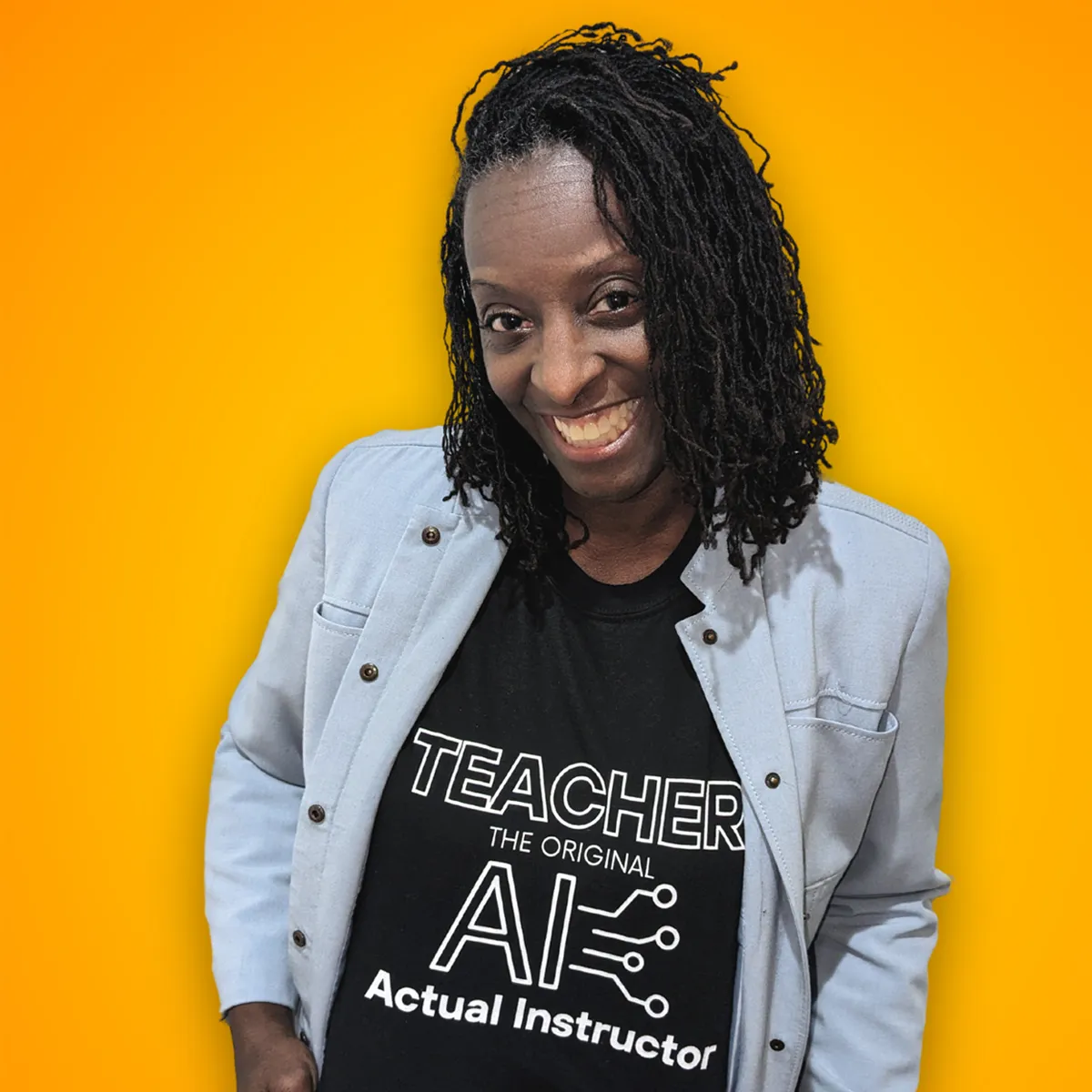
This is how computer science and media electives teacher Julie York explains artificial intelligence to her students at South Portland High School, in Maine. But, she continues, this is where it gets tricky:
So you have this biased assistant that thinks you can never be wrong or ask for something dangerous. Keep in mind this assistant only has a middle school education and lacks ethics, but is really fast at doing some things, but not all things. Sometimes, it will want to help you so much—
just to make you happy—that it will lie to you.
Still under review
While proponents may promise that AI will revolutionize education, it’s still being defined by humans.
For some, AI is a trusted tool, a helper, a thought-partner, and a guide that amplifies creativity and saves time. For others, it’s a shortcut that risks stripping away what matters most in learning: The human connection.
So how are educators using AI, and what’s a boundary they would never cross? Four educators—from California, Maine, Michigan, and Utah— are testing limits, setting expectations, and underscoring that the most important factor in using AI is the human one.
AI in elementary school
Two years ago, veteran high school educator Kecia Waddell switched to teaching elementary school. She was in unfamiliar territory.
Unsure if her teaching methods and style would transfer to second-grade students, Waddell turned to AI, a tool she had used previously with her high school students.
“I leveraged AI to help teach me how to better engage with students,” says Waddell, a special education teacher at Monfort Elementary School, in Shelby Township, Mich.
She has used the technology to personalize assignments as well as to analyze students’ individualized education program goals and align them with skill standards outlined in the district’s report card.
For example, Waddell used AI to connect language and student self-expression in a classroom coloring activity. Waddell had her students explain to her what kind of coloring sheet they wanted. She would prompt AI with their requests.
“I’m typing out the words, but [the students] have to use language … and expand their vocabulary,” Waddell says. “[AI] gives us superpowers for what we do for our young learners,” she adds.
For her students, she says the technology builds on transferable skills they need for socializing, expanding their vocabulary, and writing.
What doesn’t Waddell do with AI? Give students unsupervised access to it or input data with identifying information. Human oversight is needed, she cautions.
“I want to have control over how I use it, and I don’t want … people misusing technology,” she explains.
AI in middle school
Instructional coach Kristin van Brunt approaches AI as an extension of critical thinking. “It’s a helper, not a replacement for thought,” says van Brunt, who works at Mueller Park Junior High, in Davis County, Utah.
She explains that if students were reading Animal Farm, she would require them to think about some of the themes in the book before turning to technology. “They have to think about it first, come up with ideas, and then put those into AI, and ask which one would be a good topic to explore,” van Brunt explains.
Another approach is to have students find connections between a book and their own lives.
“Instead of saying, analyze the themes in Of Mice and Men, I would say, compare the theme in [the book] to a time that someone you know faced a difficult decision,” she says. “They could use AI to come up with a theme, but they have to tie it to themselves.”
This kind of personalization, she believes, keeps students from having AI do all the work.
Throughout the years, van Brunt has used AI to prepare lesson plans and student activities, differentiate assignments to ensure students can engage with the material, and work one-on-one with other educators.
Quote byKristin van Brunt, an instructional coach at Mueller Park Junior High, in Davis County, Utah.

What wouldn’t she do with it? Force hesitant educators to use it. “But showing them ways [AI] has helped me … might help some of them,” she says.
Weighing the risks
In San Diego, Calif., sixth-grade teacher Thomas Courtney isn’t quite convinced about AI being the world-changing force it’s hyped up to be. He describes his approach to the technology as “very careful.”
“I’m introducing it to students,” Courtney says. “But I also feel it’s being introduced to me.”
Students are allowed to use the technology as a first step to help generate ideas or pictures. But they’re also required to go beyond the screen.
Students must connect AI-generated work to the classroom by either talking or writing about what was produced, and what they want to do with the information.
“They’re the last filter,” Courtney says. “It helps them to understand that AI is not doing [the work] for them. It’s a tool that they used, and they still make final decisions.”
Courtney wants his students to understand pride and authorship and is concerned about what he calls the “fast and easy” mindset. He had one student who misused AI to generate and submit more than 40 poems.

“Some [students] are OK with their work being fast and easy, and I don’t think that’s a lesson I want students leaving my classroom with.”
Courtney tries to avoid letting AI replace accountability. “If students are using AI, a good teacher holds them accountable for how they use it, … because there’s an explicit explanation of expectations.”
What keeps Courtney grounded is the irreplaceable connection between educator and student.
“Kids need to be around other humans,” he says. “Friendships matter. There’s a physical thing that can’t be quantified by seeing your teacher’s lit-up face tell you that they’re proud of you, in person.”
That presence, he believes, is what makes learning real.
“The ultimate goal of education is that kids learn something they didn’t know before, and a tool doesn’t do that,” Courtney says. “A tool helps you get there. … But it takes the teacher to guide that process, and I just don’t ever see an AI program doing that as effectively as a human in a classroom.”
AI in high school
Back in Maine, York worked with a group of her students to learn scriptwriting and produce a short video. It was a Spanish soap opera (or telenovela) that, in true fashion, involved a crime scene. The script called for a corpse. York considered having a student play the part, but they didn’t have time for all that. So she asked AI to create it.
“All of the bodies were breathing,” York laughs. “I needed to use three models to just get a dead body horizontal with an ax to its head.”
After multiple AI prompts that generated various interpretations, York gave up. The final version was a barely-breathing body lying on the floor with an ax coming out of the person’s mouth like a flower.
“I was just like, you know what, we’re good. … This is the one we’re using. I’m walking away,” she says.
Turns out, AI can’t make dead bodies. The AI models York used—Veo, Sora, and Kling—have built-in safeguards to prevent misuse or harmful behavior. But AI would never have told you.
‘It’s impossible to avoid’
York says she uses AI a lot, and she’s been using it for a long time.
“AI has been a part of some [computer] programming for a long time,” she says, pointing to Bluetooth and facial recognition as examples. “But then all of a sudden, these large language models came out, and I started seeing [it] in all my software. It is impossible to avoid.”
AI is only getting better, York says, and compares it to the internet of yesteryear: “Using the internet meant your whole house couldn’t have a phone or you had to wait 20 minutes for a website to load, and God forbid it had graphics! If you think about it as a tool, the internet now is almost ubiquitous.”
She adds, “In five years, AI is going to look completely different, and … the babies being born today won’t know [anything different].”
York encourages educators to learn how to effectively use AI, model it for students, and talk about the pros and cons. Follow your district’s policy, if one exists, and don’t ignore the tools’ privacy policies.
“There are some AI programs that have really atrocious privacy settings,” she says. “Pay attention to where the data is going.”
Educators should not pretend AI doesn’t exist, York advises.
“You want your students to be successful … and be prepared to go on their own in the real world,” she adds. “And we can’t not talk about things because we think they’re bad. … Eventually, this is something they will have to face.”
Unions can lead the way on AI in schools
Propose NEA’s sample school board resolution at your next board meeting, as well as NEA’s sample school board policy to expand safe, inclusive, and future-focused learning environments.
Sample School Board Resolution
-
Create an educator-inclusive advisory committee to guide AI research, procurement, piloting, and evaluation.
-
Assess risks such as data privacy concerns, racial bias, misinformation, plagiarism, and threats to jobs.
-
Require districts to disclose what data AI tools collect and how it will be used, ensuring families and school staff are fully informed.
Sample School Board Policy
-
Protect educators with high-quality, multifaceted professional learning opportunities to help them increase their AI literacy and understand what specific AI tools are being used in their schools.
-
Ensure all students have equitable access to AI tools, including assistive AI technologies to support diverse learning needs.
-
Call for all vendors of AI tools and resources to meet district standards for transparency, equity, and ethical decision-making.
Empowering Educators in Age of AI
NEA’s AI in Education hub offers trusted guidance, tools, and professional learning opportunities to help educators navigate the evolving role of artificial intelligence in schools and classrooms. Grounded in equity, ethics, and educator voice, this website brings together policy resources, classroom strategies, and practical support to ensure AI serves all students and empowers the educators who teach them.