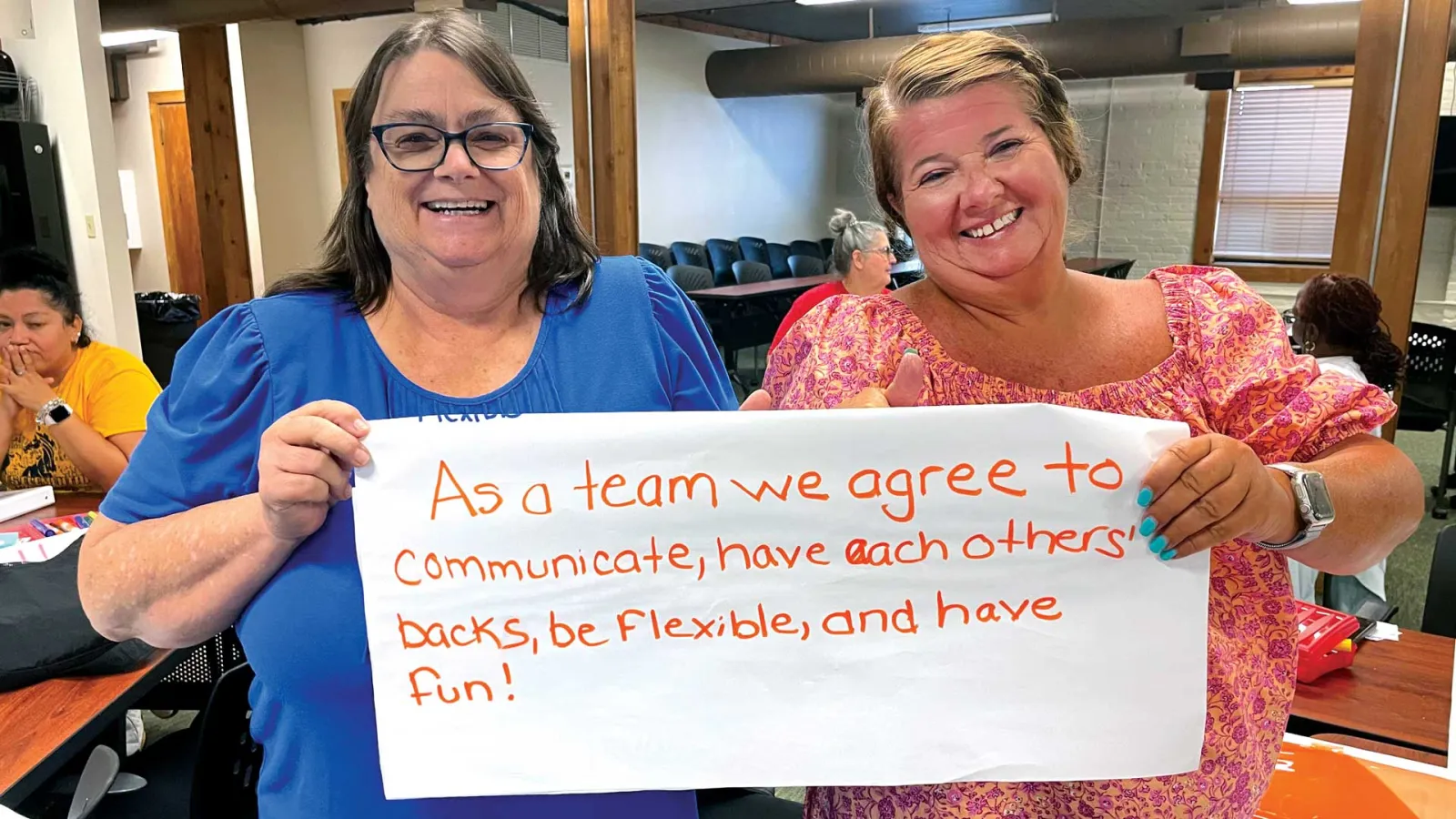
When Massachusetts paraeducator Jean Fay was starting out in her career, she walked into her new kindergarten classroom in a skirt and heels, carrying a big bucket of My Little Pony figurines. The classroom teacher who greeted her wore flannel, Converse high-tops, and an uneasy expression that seemed to say, “This is never going to work.”

But Fay maintained her confidence and told the teacher, “We’re going to be great partners.” In fact, they meshed after day one, Fay recalls, and became such good friends that they even vacationed together. They became known as the “dream team.”
In a school in New York City’s Harlem neighborhood, the superintendent and chancellor of the city’s public schools stopped by a classroom where paraeducator Margaret Dalton-Diakite and her partner teacher were working with students. The visitors couldn’t tell who was the paraeducator and who was the teacher.
Dalton-Diakite says, “We looked at each other like, ‘Yes!’ We moved simultaneously. We flowed. We were a team!”
The secret to successful partnerships

Fay and Dalton-Diakite’s classroom partnerships were so productive that they decided to share their success stories at last year’s NEA Education Support Professional National Conference.
Becoming a dream team isn’t always easy, acknowledges Sabrina Gates, an NEA member and union activist who leads the Hillsborough Consortium for Technology and Education (CTechEd)—a Tampa, Fla., nonprofit that provides professional development for educators.
She recognizes that paraeducator-teacher relationships can be difficult, so she jumped at the chance to lead an NEA training called “Building Winning Teams: Effective Paraeducator-Teacher Teams.” The series of eight trainings is designed to engage teams and includes topics such as communication, establishing a shared vision, problem-solving, and conflict resolution.
NEA Today spoke with paraeducators Dalton-Diakite and Fay, as well as CTechEd trainer Gates, who offered this advice about creating winning teams:
1. Respect yourself and each other.
Fay: We teach respect to students, but we need to model that respect, too. Often we, as paraeducators, don’t think about the talents we have and how we enhance the learning environment for students and colleagues.
Respecting yourself means valuing what you do and what you represent. Don’t minimize the importance of your accomplishments and contributions. Paraeducators bring a lot to the table and are critical to student success.
Dalton-Diakite: If a paraeducator has served for years in a school, the para might have more knowledge than the teacher about that community.
The para knows the families, the students, and the culture. That can
be tremendously helpful, especially for newer teachers. When there’s mutual respect, teachers can tap into that knowledge.
Gates: Respect also means understanding the roles and dynamic of a partnership. You can’t have a winning team if a teacher feels they are “the boss.” It doesn’t work if the paraeducator feels they’re being assigned tasks that aren’t their role or if they are relied on solely to clean up the classroom and organize bookshelves.
Set the tone of a true partnership based on mutual respect: The teacher is the leader of the team, but not a supervisor. Ask each other, “What are we going to do together to make this a great partnership?”
2. Nurture your relationship.
Gates: When you focus on building rapport, you can have honest conversations. In one training activity, I ask each team member, “What is it that you want?” and “What do you offer?”
I’ve noticed that paraeducators can be reticent about their wishes and skills. This exercise helps them speak up and say, hey, I have an idea, and here’s what I think we can do to accomplish it.
It’s also important to have the confidence to admit when you don’t know something and to say, “I don’t know how to do this, but you can help me to better our students.”
Your position entitles you to gain more knowledge. Grow that ownership by saying, ”This is my job, and I want to do it better, please help me get there.”
3. Refine lessons together.
Dalton-Diakite: A teacher can break down the lesson plan for the paraeducator, who is then better able to teach it to students in the most effective ways.
The paraeducator might have questions about the lessons, and the teacher might have questions about what works best when reinforcing the lessons to students who need more explanation.
The teacher should be giving outlines of lessons to the paraeducator, and then the pair should sit down together to go over it. The teacher could say something like, “Remember the science lesson I taught on Monday? I don’t think Sue, Johnny, and Mary got it. Can you sit down with them and go back through the lesson and try to see what they are missing?”
It’s wonderful when you work together as a team to make sure all students have a good understanding of the curriculum.
Try These Tips for Creating Effective Partnerships
Want to Strengthen Your Paraeducator-Teacher Team?
NEA offers a series of eight trainings, called “Building Winning Teams: Effective Paraeducator-Teacher Teams.”