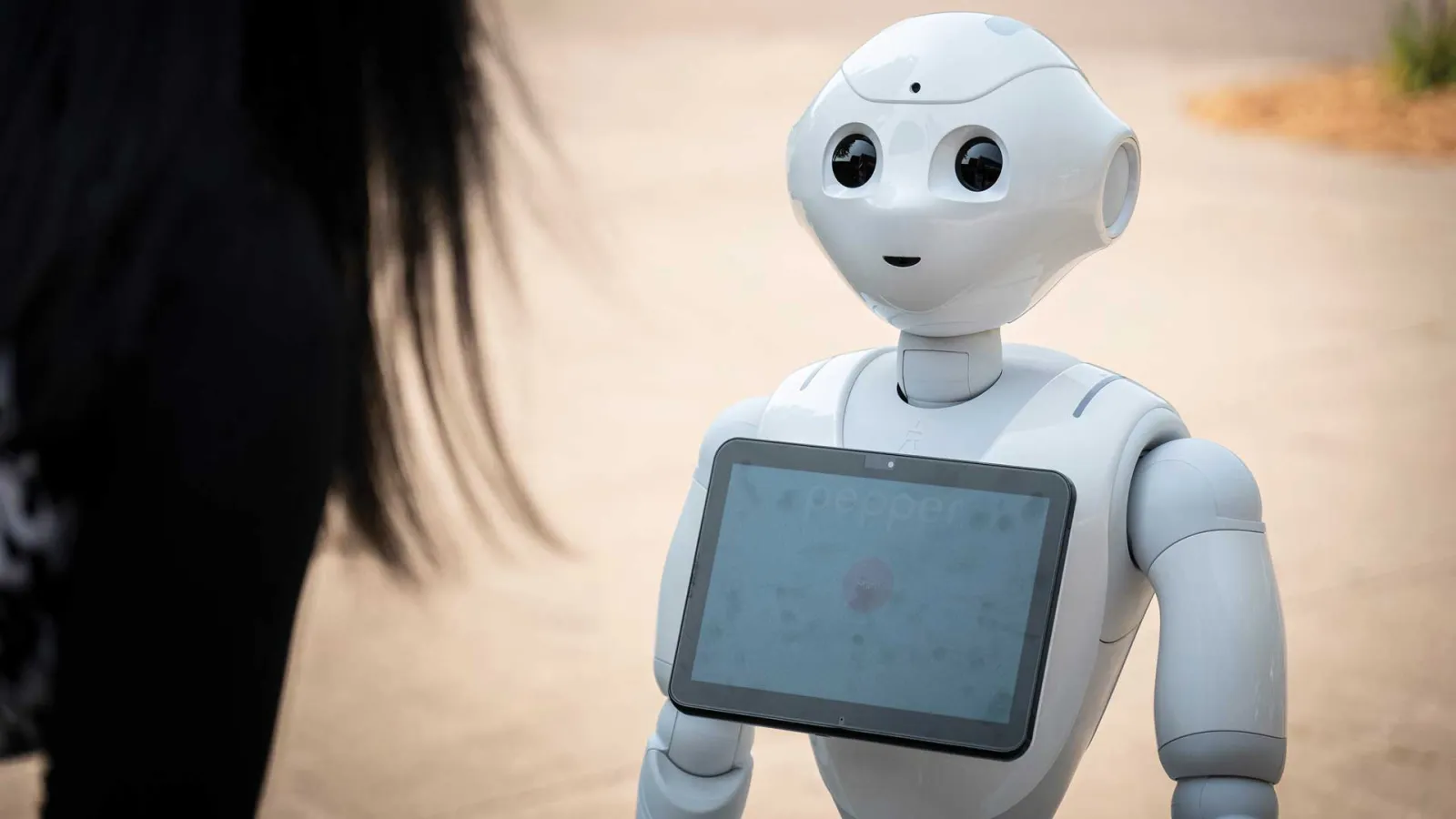
A couple of years ago, in a Minnesota nursing home, NEA Higher Ed member Arshia Khan asked a human-shaped robot named Pepper to demonstrate its usefulness to CBS Evening News.
As the television cameras rolled, Pepper held a screen between its glossy, articulated hands, showing old black-and-white family photos to a resident named Jill, who was 83 years old and living with Alzheimer’s disease. First an image of her brother as a child, holding their puppy. Then Jill’s old rodeo horse. “I loved my horse, Lucky Strike. … He took us to the different rodeos, and I always ran first,” Jill told reporters.
This is what “reminiscence therapy” can look like, when the robot is programmed by Khan and her team of students at the University of Minnesota Duluth (UMD). And it’s just one possible support that robots may someday provide to people living with dementia.
What can a robot do?
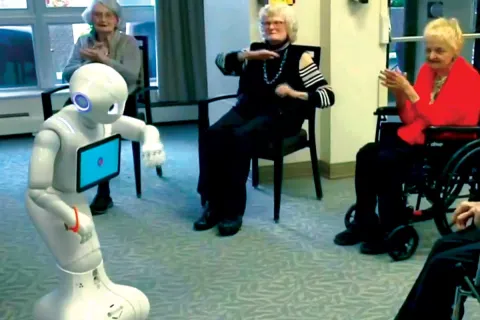
Khan is a professor of computer science at UMD and also the department’s director of graduate studies. Since 2022, she and her students have deployed humanoid robots to nursing homes and memory-care facilities across Minnesota, through a $2 million grant Khan won from the Minnesota Department of Human Services.
The robots are all Peppers, manufactured by a Taiwanese company and programmed by Khan and her students in their computer science lab. The 4-foot-tall humanoids look a little like children—with big eyes and soft featureless faces.
“They’re cute,” says Khan, which is the intent. “Have you heard of ‘uncanny valley’?” Khan asks. “Uncanny valley is a concept that the more a robot looks human, the more the creepiness factor increases.
“Pepper is a good balance, humanoid but cartoonish. When I’ve tried it with adults with mild and moderate and advanced dementia, I haven’t had a single one react negatively,” she says. “So, I’m pretty comfortable bringing these robots out to people with cognitive decline, to help improve their cognition, mood, quality of life, and daily living activities.”
Currently, Khan and her students have Peppers in 10 nursing homes, she says, where they lead bingo, karaoke, and dance activities, and even tell “Dad jokes.” Most important, the robots involve residents in 15- to 20-minute sessions involving mental and physical exercises. Their interactions are aimed at engaging and entertaining residents, and improving their mood and cognition, including their ability to focus, store, and retrieve information.
Indeed, in 2024, Khan completed a clinical trial that found her robots improved mood and cognition, specifically attention span, among nursing home residents with dementia. Khan’s findings depended partly on self-reported data by residents, but she also used electronic skin sensors that the patients wore during therapy.
“As an engineer, I feel I can’t rely on self-reported data,” Khan laughs. The electronic data also showed that participants’ attention is improving, she says, confounding the typical decline of dementia patients.
The future is near
Khan’s vision isn’t to create some kind of dystopian landscape, where armies of robots replace human caregivers. The robots are “just tools” for caregivers, she says. “Microwaves did not make all the cooks disappear!” she notes.
Robots can tell people with dementia when to take their statins and serve them up, on time, like an intelligent pillbox. They can lead classes of seated yoga or golden-oldies karaoke.
“Maybe you have a gardener who can’t remember to water her plants anymore. If you give them a robot plant, along with the living plant, the robot plant can say, ‘hey, it’s time to water us!’
“We are building that plant right now,” Khan says.
Since the pandemic, Khan’s use of robots in nursing homes has gained more “understanding,” she says. “People used to make fun of me, like I’m going to ‘unleash my robots’ on some poor vulnerable population,” she notes.
But the pandemic made two things clear to observers: 1) Nursing home staff and clinicians are exhausted and stressed; and, 2) older adults are often isolated and lonely. “And loneliness exacerbates cognitive decline,” Khan adds.
Looking ahead, the goal isn’t just to help people with dementia in nursing homes, Khan says. Eventually, if programmers can keep up with what people want and need, and manufacturers can make them affordable, robots could help people live at home independently for as long as possible.
“It’s all human-centered,” she says. “It all has to be human-centered.”
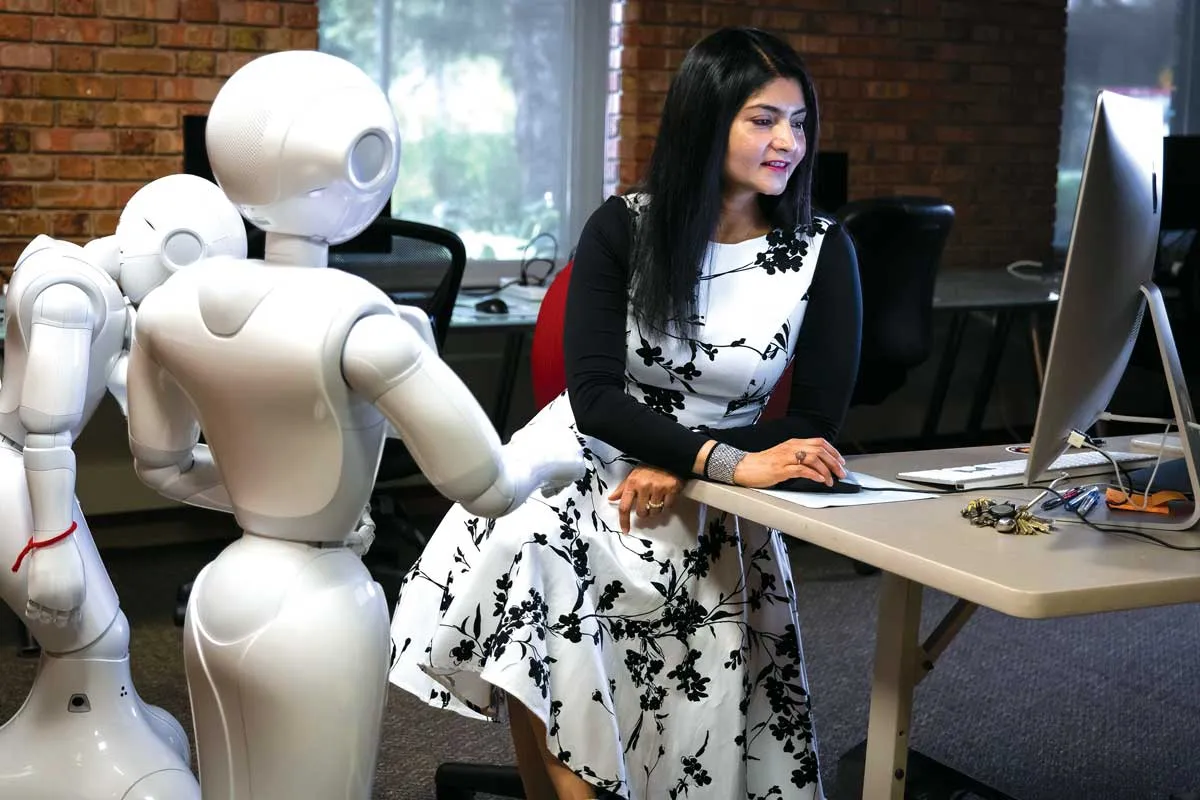
Who is Arshia Khan?
In addition to her lab work, Khan (above) is piloting a course on human-robot interaction this fall, as well as teaching a familiar (to her!) course on the Internet of Things, in which students build objects with sensors. A real example from one of Khan’s students? A litter box that signals when a pet cat has an infection. One of Khan’s favorite classes to teach is Digital Justice, which explores how technology “is unjust to certain populations,” she notes. “For example, say a person with a diverse background goes into the emergency room,” Khan explains. “This person is saying they have too much pain,” but an AI that has ingested racist ideas about pain will tell doctors that their patient’s pain “is insignificant.”