Key Takeaways
- Angel Givler-Viers is a beloved fifth-grade teacher and union leader in a Colorado Springs district where school officials sliced pages out of health textbooks.
- Two days before teachers held a one-day strike in 2025, Givler-Viers was removed from her classroom and not told why.
- Today, she’s back at work—thanks to her union’s representation—and union members are more determined than ever to get the district’s focus back on their students’ needs.
More than a year ago, award-winning Colorado Springs fifth-grade teacher Angel Givler-Viers was ordered by school officials to pack up her personal belongings, go home, and keep her mouth shut.
While Givler-Viers’ union fought for her job through the slow-moving administrative channels that Colorado provides, she waited.
In spring, according to state policy, her paychecks stopped. In summer, when she walked into Target and saw the back-to-school sales, she turned and fled. On the first day of school? Givler-Viers simply stayed in bed, “just too sad” that a new school year was starting without her, she says.
But today, her patience—and her union's advocacy—has finally paid off. Thanks to a judge’s formal recommendation, Givler-Viers has been retained as a Colorado Springs District 11 teacher. Her full salary has been restored (and with back pay!)
The one word used nine times in the judge’s examination of the superintendent’s case against Givler-Viers? “Trivial.” “Trivial.” “Trivial.” “Trivial.” “Trivial.” “Trivial.” “Trivial.” “Trivial.” “Trivial.”
“It’s a huge win,” said Givler-Viers. “I definitely feel very tired, but also very victorious.”
While Dr. G, as her students call her, goes back to work, the fight isn’t over in District 11. Parents and union members are still working to make this a place where students can get the education they deserve, where teachers can talk about important Black Americans like Frederick Douglass, and mentions of LGBTQ+ people aren’t literally sliced out of health textbooks.
Instead of terrorizing educators, they want the board to lower class sizes and hire more school counselors, social workers, and special education staff.
“The disconnect between [District 11’s superintendent and school board] and people who teach… it’s just ridiculous,” says Amanda Brown, a District 11 kindergarten teacher and parent whose daughter was in Dr. G’s classroom, in the middle of a literacy lesson, when her adored teacher was pulled out of the classroom. “That was terrifying in the moment. And it’s still terrifying today,” Brown says.
Elections Have Consequences
When Dr. G talks about what happened to her, she’s not sure where to begin. It’s a long, complicated story. It’s also not just about her.
The starting line is likely the school board elections in 2021, when “dark money” first began to pour into Colorado school board races, including El Paso County, home to District 11.
“You may have noticed a lot more digital advertising, mailers, and general election material,” local KOAA News told its viewers, in October 2021. The reason? A political action committee (PAC) called Springs Opportunity Fund was pumping $200,000 into El Paso County school board races, through a group called Colorado Springs Forward. Suddenly, the coffers of conservative candidates were stuffed with money.
In 2023, a group called Colorado Dawn poured another $400,000 into District 11 races. And it wasn’t just El Paso County. In 2023, in Denver, the school board election cost $2.2 million—including $1 million from a pro-charter political action group, funded by out-of-state billionaires. (And yes, their money paid off. All of the pro-charter group’s candidates won that year.)
District 11’s conservative board majority and the superintendent they had hired, Michael Gaal, locked into the culture wars of the day. Their focus? Banning books, passing policies against LGBTQ+ students, and silencing educators.
“It became a very us versus them culture,” says Brown. “And I want to be clear I’m not talking about building administration. My building administration is amazing. But district administration? It just feels very adversarial.”
Still, educators were stunned when, in December 2024, the school board voted to end the district’s 56-year-old master agreement with the Colorado Springs Education Association.
The contract guaranteed teachers’ planning time, gave them a voice in decisions about classroom curriculum, and also provided a process for them to challenge unfair treatment. It was “burdensome,” said Jill Haffley, one of the school board members swept into office in 2021. Instead, the superintendent would deploy a non-binding, employee handbook.
This vote would lead union members to plan and execute a one-day strike in 2025. In the midst of that, Dr. G would become the district’s target.
“H.R. is here.”
In 2025, Dr. G was a teacher with 17 years’ experience, a B.A. in education, an M.A. in literacy, a Ph.D. in reading literacy assessment and evaluation, and a 2023 Golden Apple Award for excellence in education. She loved her job and she loved her school. She and her co-workers even got matching tattoos of the school’s mascot—a comet!
Her Christa McAuliffe Elementary School classroom held more than 1,000 reading books, aimed at sparking a love of reading in every single student. “All genres, in all reading levels!” she says. It also featured rainbows, soft lighting, and cozy seating, including a reading loveseat and floor cushions for kids with sensory needs.
“I requested her,” says Brown, who also teaches at McAuliffe. “My daughter was always a reluctant reader—and Givler really, really gives that love.”
On October 6, 2025, Dr. G was getting ready for a writing project—her students would be making their own paper!—when her principal walked in. “He said, ‘Hey, can I talk to you in the hall for a minute?’” recalls Dr. G.
No problem. No alarm bells.
“Then he said, H.R. is here.”
The district’s H.R. representative told Dr. G that she was being put on administrative leave, effective immediately. “But what am I being put on leave for?” she asked. He told her: “We’re going to determine that through our investigation.”
“Okay, but what am I being investigated for?” she asked, again.
“We’re going to find that out,” he told her.
When Dr. G’s principal escorted her back to her classroom and told her to pack her personal items, she looked at her library, the loveseat, the lighting. “But they’re all my personal items,” she whispered. “I know,” he said. She grabbed her keys and phone, and at the door, paused to tell her students, “I’m being put on administrative leave. That means I can’t teach you anymore. I love you guys. I’ll be back.”
Then, the man from H.R. walked Dr. G to her car, reminding her that she was not allowed to talk with any District 11 employees, students, or parents, and was barred from any District 11 events or property.
Dr. G sat in her car, sobbing, and then picked up her phone and called her union office. When somebody answered, Dr. G cried to them: “I don’t know what to do. I don’t know where to go.”
Come here, they told her.
The Case Against
Two days after Dr. G was escorted to her car, on October 8, 2025, her union went on strike. Dr. G was there, flanked by union attorneys, wearing a sign that said, “I can’t talk to you or hug you, but I love you.”
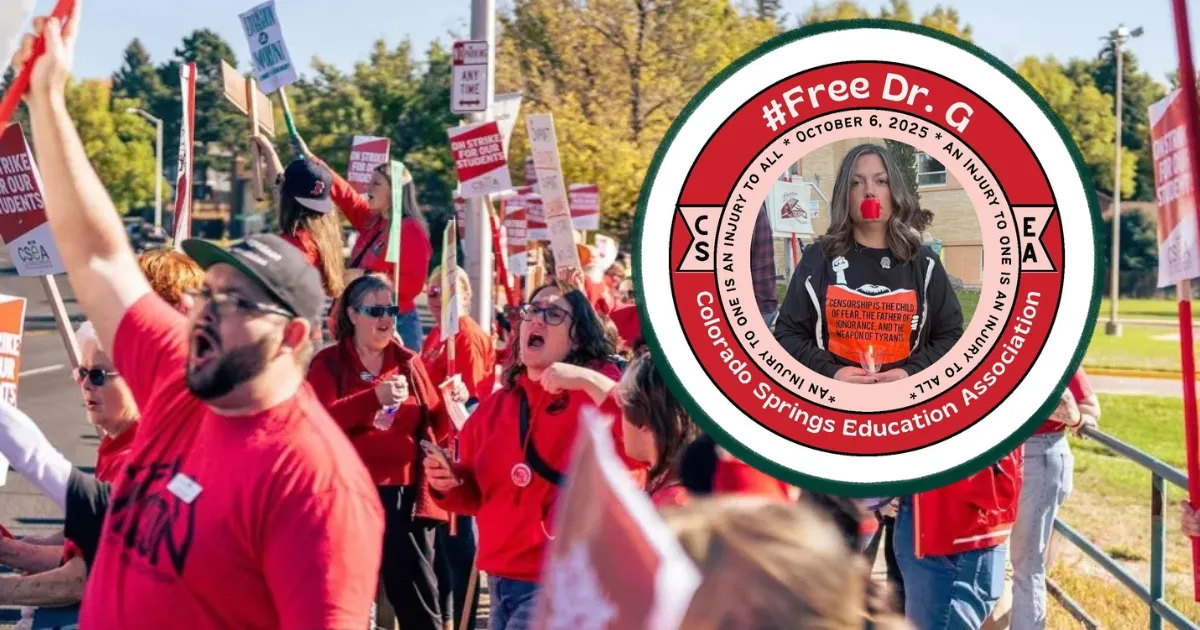
The strike was about the school board’s cancellation of the union contract, but also about the board’s wave of anti-diversity, anti-LGBTQ+ policies. Earlier that year, the board had banned the display of LGBTQ+ Pride flags in classrooms, banned library books with LGBTQ+ characters, and began requiring students to get permission from their parents to be called different names at school.
That fall, District 11 educators also discovered that, in an effort to censor students’ access to information on sexual orientation and gender identity, the district’s curriculum team had sliced seven pages out of health textbooks. “We removed those pages to ensure [classroom materials] matched approved curriculum and current standards,” school officials told Rocky Mountain PBS.
Around the same time, District 11 middle school teachers were told, by email, to skip the Frederick Douglass unit in their new curriculum.
Meanwhile, the district has real problems, notes Brown. Special education students have growing unmet needs. Class sizes are huge. “My high schooler is sitting in a classroom with 30 kids—in a school under construction,” she notes. They need more counselors, social workers, behavior specialists, and more special educators.
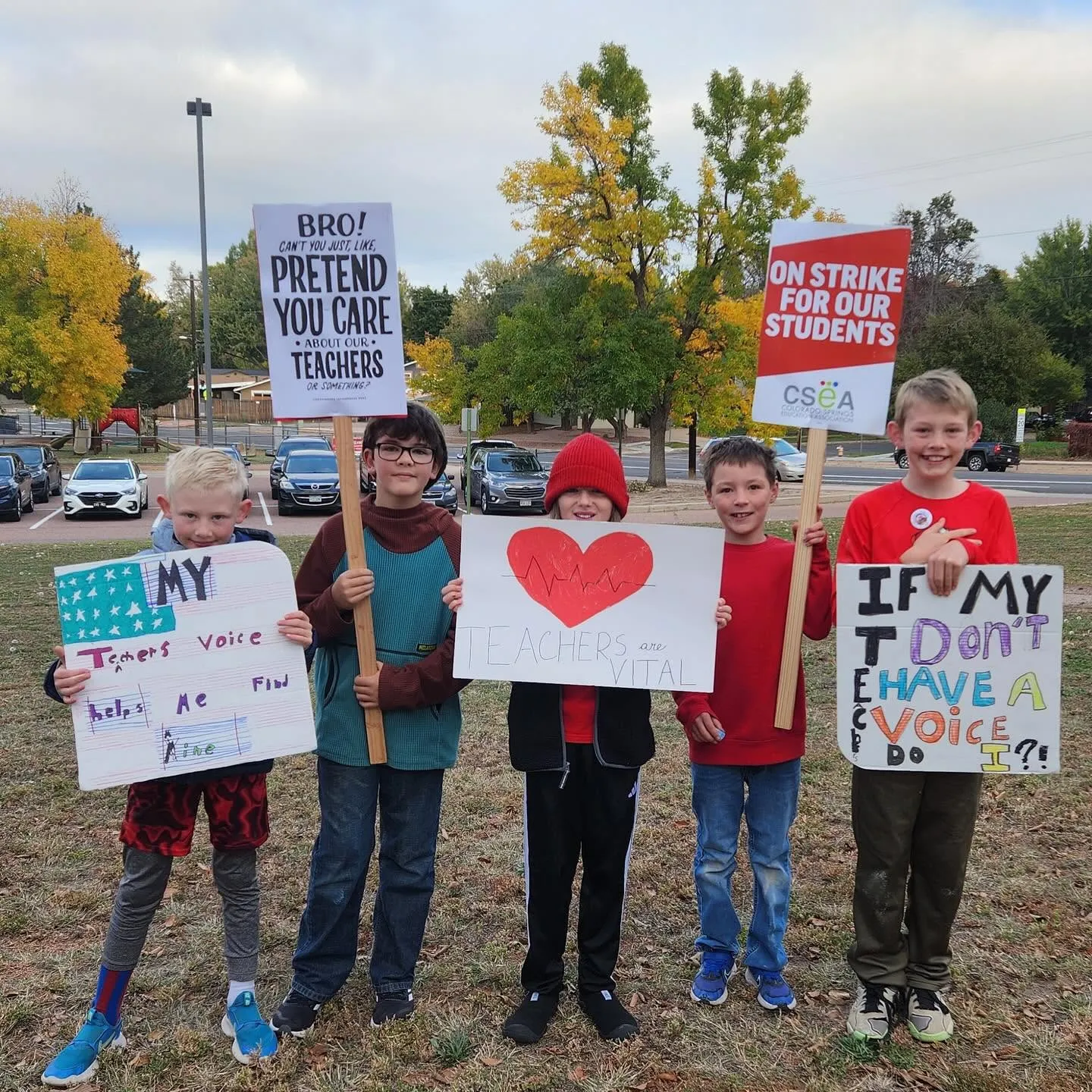
With all of this in mind, union members overwhelmingly supported a strike—and so did parents and community members. In the weeks leading up to the strike, local social media accounts lit up with parents and community members asking, “How can we support the striking teachers?”
Dr. G, who is the union vice president, had answers. Her social media accounts—today, she has 20,000-plus followers on TikTok—already were robust sites where Dr. G celebrated educators and unions and criticized book bans and educator censorship. She suggested parents not cross picket lines. With so many teachers on strike, schools would be chaotic, potentially unsafe places for students, she said.
The district’s charges against Dr. G eventually centered on these posts. In December, Gaal recommended Dr. G be fired for “insubordination.” He also claimed Dr. G violated her leave when she accidentally stepped backwards onto district property during the strike.
None of this stood up to the judge’s examination. Dr. G’s posts were in compliance with the district’s policies. And she was right about schools being potentially unsafe during the strike. School officials had provided substitutes with zero classroom experience a “guest staff toolkit” that advised them not to “furnish alcohol, drugs, or tobacco (this includes vape devises)” to students or “accept or offer massages.”
And Gaal’s claim that Dr. G—a decorated, well-respected, and tenured teacher—should be fired because she accidentally stepped backwards onto district property?
“This is the type of isolated technical and insignificant, trivial, or inconsequential behavior that does not warrant dismissal,” the judge chided, in his ruling.
What’s Next?
The judge’s order to reinstate Dr. G landed in September 2026, almost a year after she had been escorted to her car. It was too late for Brown’s daughter. For months, “every day she would wake up and be like, ‘Maybe it’s today. Maybe Dr. G will be back today,’” recalls Brown. Instead, she spent the year in a class with 32 fifth graders—and no Dr. G.
“It was tragic. And I mean that. I do not use that word lightly,” says Brown.
Following the judge’s ruling, in September, with more than 100 of Dr. G’s supporters in the audience, the school board voted to reinstate her, but on a one-year probationary period. In early November, Dr. G will report to work as a “teacher on special assignment,” taking and filling curriculum orders from the district’s warehouse. She and her union attorneys are continuing to fight for her to be back in the classroom through a complaint filed under the state’s Protection for Public Workers Act.
Meanwhile, Gaal and his deputy are now under investigation, following a lawsuit filed by the district’s ombudsman that accuses the deputy of breaking into her office and stealing confidential files upon Gaal’s orders. Unlike in Dr. G’s case, the men have neither been placed on administrative leave, nor escorted out of their offices.
The last year has been heartbreaking, says Dr. G—and so very, very stressful. She gained weight, cried often, and increased her mental health support as she navigated a year’s worth of lost opportunities. She wasn’t there to organize McAuliffe’s annual read-a-thon (which raised $20,000 in 2025). She wasn’t there for Read Across America in March. She wasn’t there for Field Day or the overnight trip to the science museum in May. Worst of all, she wasn’t there for fifth-grade graduation.
Yes, she won—but it’s hard to celebrate, she says. The real victory will be in 2027, when educators and parents work together to replace District 11’s extremist school board members. The other side might have money, “but we have people power,” she says—and those people are deeply motivated to get things right for their students.