“What do you want to be when you grow up?” We start answering this question as early as kindergarten, but no one asks us, “What do you want to be when you retire?” Maybe it’s time, as career coach Lateefah Scott advises, to be as intentional about retirement as we were about our professional growth.
Scott, a New Jersey Education Association member, draws on her expertise in career counseling, social and emotional learning, and leadership development to give workshops for NEA-Retired members. Her goal? To help participants rediscover their strengths, values, and purpose. Rather than asking, “What are you retiring from?” Scott encourages retirees to ask, “What am I moving toward?”
One of the biggest challenges retirees face isn’t financial, she says, it’s redefining their identity after decades of introducing themselves by their profession.
“Too often teachers and other school employees don’t realize how much they bring to the table. And when many teachers leave the classroom, they feel rudderless,” Scott says. “A clear path forward can be mapped out.”
Quote byIllinois retiree Terry Waldron
Flunking out of retirement
Retiree Joni Richman Watson admits, “I was completely flummoxed by retirement.” Having spent 35 years teaching art to elementary and middle school students in Dayton, Ohio, the combined weight of the pandemic and an early buyout offer pushed her to sign the departure papers, but the aftermath was unsettling.
“I felt a sense of panic, wondering who I was without my classroom. That first autumn was the hardest; seeing back-to-school ads … suddenly felt like a punch to the gut.”
Watson wasn’t one to succumb to the discomfort that gnawed at her. After two weeks, she says she was “failing” retirement. A turning point came when a friend nudged Watson toward a local organization that places older adults in internships that align with their experience. Watson’s work in education secured her an internship at a local literacy center—a move that blossomed into a paid, part-time role in community outreach.
“It was the perfect fit. I could still teach and connect with adult learners, which kept my passion alive while giving me the freedom I’d earned,” Watson says. This new balance allowed her to maintain her social life, contribute to meaningful causes—including serving on the board of Dayton’s International Peace Museum—and still have time to binge on her favorite reality TV shows.
While Watson’s transition began in a state of flux, she reclaimed her narrative by adopting many of the strategies Scott champions: Identify transferable skills and align them with meaningful opportunities, rather than simply replacing a job.
Watson began by peeling back the layers of her career to identify not only her strongest skills gained from the classroom and her union work, but also those that truly energized her, she explains. High on her list were mentoring, advocacy, and community organizing—passions that became the blueprint for her next act. Her professional “repositioning,” which includes consulting with her former school district as a coordinator for new art teachers, became as impactful as her years in the classroom.
Audit your impact
Rather than focusing on job titles, Scott encourages retirees to create an “impact inventory”—a record of the moments when they solved problems, mentored others, led initiatives, built relationships, advocated for colleagues or students, or inspired change.
“Don’t just audit your resume—audit your impact,” Scott says. “Start by reflecting on the ‘thank-yous’ you’ve collected over the years. Were you calm in the eye of the storm? The strategist who turned chaos into clarity? The creative spark that revived a stale project? Identify the talents that people consistently relied on. If they still energize you today, you may have discovered your North Star for life’s next chapter.”
Expect the unexpected
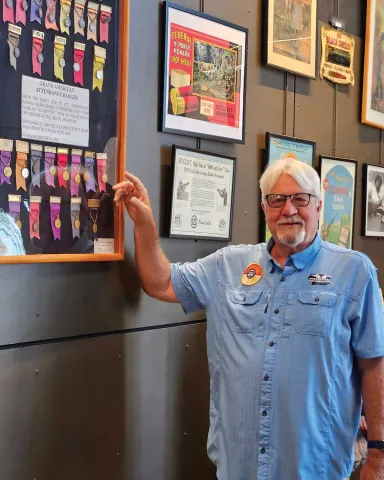
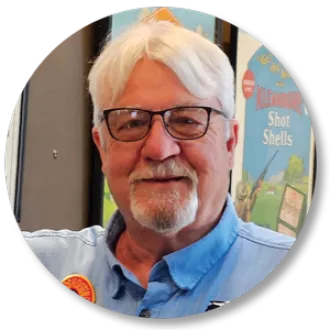
A guiding light was not something Terry Waldron thought he needed as his days as a high school art teacher in Sparta, Ill., came to a close, in 2010. After 36 years of teaching, his dream for retirement was simple: settle into a cozy studio in the home he and his wife shared, and create art. But when surprising opportunities came his way, he embraced them with open arms.
Waldron had never even tried the sport of trapshooting—shooting clay pigeons. So he finds it “weird” that, about a decade ago, he became the director of the Trapshooting Hall of Fame, located in his hometown.
Visitors can see historical artifacts, including guns owned by famed sharpshooter Annie Oakley and John Philip Souza, who wrote “The Stars and Stripes Forever” and was a champion trapshooter.
Waldron may have lacked shooting prowess, but he knew he could do the sport proud when he was offered the directorship. He has a talent for curation, having previously designed exhibits for a local art museum. And his commitment to the community runs deep; he had already established a scholarship program for art students at his former high school.
While he never could have predicted that the world of trapshooting would become the focal point of his retirement, Waldron has found the work fulfilling. He discovered that the skills he used to inspire students—storytelling, organization, and a keen eye for detail—were exactly what the Hall of Fame needed to thrive.
“Many of my experiences in the classroom were transferable to a completely different setting,” Waldron says. “Those of us who have worked in schools know how to juggle projects and work on a tight budget.”
The new role was a perfect match for his extroverted personality as well. As someone who thrives on connection, he realized that a solitary retirement probably would not suit him.
And, as it turns out, the team of employees he assembled at the Trapshooting Hall of Fame were largely from his old school district. “I know what teachers are capable of and how much we, as educators and union activists, bring to the table,” Waldron says.
Take stock of your talents
“Waldron’s transition likely was successful because he is tapping into his talent for creativity, his adeptness at team building, and storytelling,” Scott says. “He also seems to be fully aware of his personality—what makes him tick, including how he makes decisions.”
She notes, “Not everyone is as sure about their strengths and weaknesses, and some find it difficult to see themselves in a whole new light. That’s why I encourage retired members to find an accountability partner, someone you can share ideas with and who will remind you of your goals.”
Scott also advocates for using personality assessments as one of several tools to help retirees better understand the types of work, volunteer experiences, and leadership opportunities that best align with their natural preferences.
She recommends taking the Myers-Briggs Personality Test—even if they’ve taken it before. “Personalities do change over a lifetime, so it’s beneficial to revisit the assessment at different stages of life,” she says.
Finding that alignment isn’t limited to professional pivots. For some, it’s about prioritizing family in a new way.
‘That was fun, and now we’re done’
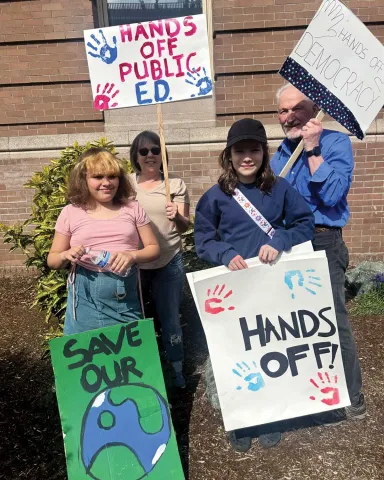
When Janis Swanson finally closed the door on her 37-year teaching career, in 2017, she recalled the phrase she used to transition younger students from one activity to another: “That was fun, and now we’re done.”
While she cherished the years she spent teaching health, social studies, and physical education to seventh graders in Mount Vernon, Wash., the classroom landscape had shifted. The joy of teaching was increasingly overshadowed by mandatory professional development—that she found irrelevant—shrinking support for the humanities, stifling micromanagement of teaching methods, and, of course, the reliance on standardized assessments.
“I was ready to retire and explore things that a lot of educators want to do—traveling to places near and far and volunteering to support political and social movements that fight unfair and dangerous social and economic policies,” Swanson says. “Fortunately, my husband and I were able to enjoy those things together, and we still do, but my relationship with my two granddaughters proved tremendously influential.”
Driven by a desire to support her granddaughters and their peers, she began volunteering at their elementary school. Swanson enjoyed going back to the classroom. Its collaborative tables, vibrant bulletin boards, and stacks of books, felt like home—yet a new role was about to push Swanson well beyond her comfort zone.
Find your helpers
The pandemic was a season of isolation for everyone, but for children and their parents, it presented a unique set of challenges. Important activities like sports and after-school programs—including the Girl Scouts—declined significantly. One obstacle? A sudden, sharp decline in adult volunteers due to concerns about the coronavirus.
This was the roadblock Swanson’s then-5-year-old granddaughter hit when she dreamed of becoming a “Daisy,” the youngest of Girl Scouts. With the nearest active troop located a staggering 70 miles away, Swanson didn’t hesitate. She stepped into scouting, uncertain of the path but ready for the challenge.
“Leading a troop wasn’t something I felt entirely comfortable doing, but I knew my teaching toolkit would serve me well,” she recalls.
She followed the advice of beloved children’s TV icon Mr. Rogers, who often advised young viewers who felt lost or overwhelmed to “find the helpers.” And that’s exactly what Swanson did when she stepped into the role as Girl Scout leader. She recruited fellow retired educators to lead troop activities, ranging from home economics to scientific undertakings. Swanson’s master class in collaboration earns high praise from Scott.
“Teachers and union members have an innate ability to spark excitement and foster inclusivity, so tapping into that collective expertise is wonderful,” Scott notes.
Clearly, an educator’s impact doesn’t end with retirement. Whether through community advocacy, leadership, mentoring, consulting, volunteering, or pursuing new passions, the knowledge, skills, and relationships built throughout a career in education can continue to make a difference. As Scott notes, “You are not retired from impact; you are repositioned for it.”
How to Translate Your Education Experience Into Other Leadership Roles
| Education Language | Broader Leadership Language |
|---|---|
| Managed a classroom of 30 students | Directed a high-stakes, multi-stakeholder environment |
| Served as a union representative | Led labor advocacy and stakeholder negotiations |
| Communicated with students, families, colleagues and community members | Managed community relations and facilitated effective communication across diverse groups |
| Prioritized student and staff safety | Led crisis response, risk response, and safety planning |
| Created and presented lessons | Engaged in persuasive and informative public speaking |
| Purchased and acquired classroom materials | Created an engaging workplace environment on a limited budget |