
Key Takeaways
- Shuffling critical special education services from agency to agency will be costly, chaotic, and put students with disabilities at risk.
- Moving services out of the Education Department without Congressional approval is unprecedented and illegal.
- Students with disabilities need the legal and policy experts who have made it their life's work to implement the Individuals with Disabilities Education Act (IDEA), not to be an after thought in agencies whose focus is elsewhere.
Parents of students with disabilities face potential delays, uncertainty, and apprehension as the Trump administration begins shifting special education programs and civil rights enforcement to agencies with no experience managing education policy and protecting students’ civil rights.
“It makes us feel like no one cares,” says Kim Pinckney, a New Jersey mom whose son has autism, ADHD, and expressive and receptive speech disorders.
The Office of Special Education and Rehabilitative Services (OSERS) will be moved from the Education Department (ED) to the already behemoth Department of Health and Human Services. OSERS is one of the biggest responsibilities carried out by ED by administering programs for students with disabilities. It was created by Congress to oversee the Individuals with Disabilities Education Act (IDEA), which provides a free appropriate public education to students with disabilities. It is the operational backbone for protecting the educational rights of millions of students with disabilities.
The Office for Civil Rights, another major function of ED that is responsible for safeguarding student rights, is now being moved to the Department of Justice (DOJ). ED's Office for Civil Rights (OCR) enforces civil rights laws, including Section 504 of the Rehabilitation Act, and the Americans with Disabilities Act (ADA), ensuring equal educational opportunities for students with disabilities.
Without the expertise of ED professionals who oversee these protections, millions of students are at risk of increased challenges in accessing the education they are legally entitled to receive.
“Fifty years ago, with the passage of IDEA, America made a promise to students with disabilities and their families: that they would have full access to education and every opportunity to reach their full potential. Unprecedented upheaval to this program will be costly, chaotic, and put students at risk of falling through the cracks,” says NEA President Becky Pringle.
Secretary of Education Shrugs Off Legal Responsibilities
The move without Congressional support is unprecedented and illegal.
"This is an outright illegal effort to continue dismantling the Department of Education, and it is students and families who will suffer the consequences as key programs that help students learn to read or that strengthen ties between schools and families are spun off to agencies with little to no relevant expertise and are gravely weakened—or even completely broken—in the process," U.S. Senator Patty Murray, D-Wash., a senior member of the Senate education committee, said in a statement.
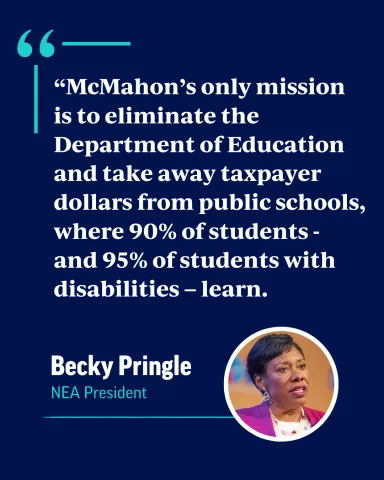
IDEA clearly designates the Secretary of Education as the only agency head responsible for ensuring states and agencies meet the conditions and requirements in IDEA.
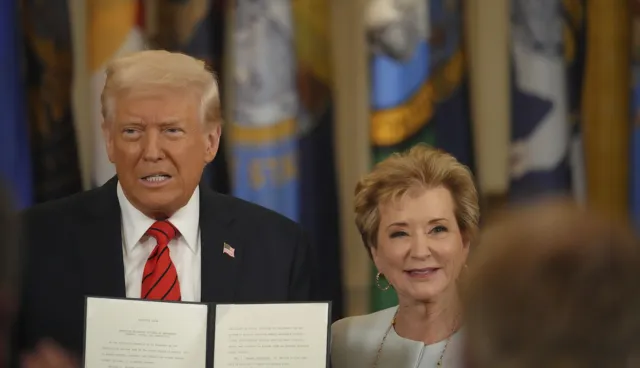
As Secretary of Education, McMahon offloads that responsibility, the message she is sending to students with disabilities and their families is that their rights don’t matter. The message is that they don’t need attorneys and policy experts who made it their life’s work to properly implement the complexities of the law to meet the unique, individual needs of students with disabilities.
“IDEA exists because of families and advocates raising their voices together to affirm that all children deserve an education,” says Pringle.
Now, she adds, we must raise our voices to protect the promise of IDEA, that guarantees a free and appropriate education for public school students.
NEA and supporters of public schools across America are urging people to speak out against these efforts to weaken public schools. Contacting lawmakers is a critical first step. But face-to-face conversations with family, friends, and neighbors can make a profound impact. Here’s a tip sheet you can use to answer the questions friends and family might have about why this is so important.
1. The new changes to IDEA oversight put all of public education at risk.
This isn't just about students with disabilities. It's about the foundation of public education as we know it. If we allow one part of the system to be dismantled in silence, the rest won't be far behind. When the infrastructure that protects the 7.5 million kids with disabilities is targeted, it doesn’t just weaken special education, it weakens public education as a whole. When rights shrink for just a few, protections shrink for everybody.
2. Shuffling student supports is a strategy to weaken public education.
The greatest threat to public education is not loud. It happens quietly and looks like layoffs. It's a strategic shrinking of responsibility and accountability. Students with disabilities are the canary in the coal mine. When their rights are under attack, it's a warning sign for the entire system.
Unless we speak up very loudly in uniform and together, this will continue.
The Individuals with Disabilities Education Act (IDEA) exists because disabled children were once shut out of public schools—turned away at the door, warehoused in institutions, or denied any education at all. Section 504 of the Rehabilitation Act of 1973 and the Americans with Disabilities Act exist because disabled people organized and refused to accept exclusion. These laws were not granted easily. They were fought for and won. The same advocacy is needed to protect them now.
3. The cracks are already starting to show.
IDEA guarantees children with disabilities a free appropriate public education in the “least restrictive environment” possible, while Section 504 prohibits disability discrimination and safeguards access to education itself. Traditionally, OSERS has gathered data and offered valuable guidance to schools on IDEA, while OCR has fielded complaints from parents and attorneys about 504 violations.
Last December, Secretary McMahon called back Office for Civil Rights (OCR) attorneys who were let go to address a backlog of cases. One department source who spoke on the condition of anonymity for fear of retribution by the Trump administration, told NPR late last year that OCR had about 25,000 pending complaints, including roughly 7,000 open investigations.
OCR is still down to roughly half of the staff it had at the beginning of the Trump Administration.
Parents with complaints about discrimination against their children who have disabilities have been left completely in the dark, their calls mostly unanswered.
Placing enforcement of student disability rights in the DOJ has been called the final nail in the coffin as DOJ resources currently focus on other Trump administration priorities.
“Disabled students should not have to piece together their rights from different corners of the federal government. When enforcement is dispersed, families are left chasing answers between agencies while students lose valuable time, support, and opportunities,” said Michelle Uzeta, Executive Director of Disability Rights Education & Defense Fund. “The law promises equal access to education, and that promise requires coordinated and accountable enforcement.”
Moving OCR to DOJ does not erase the rights of students with disabilities, but it guts the systems that make those rights real.
4. Students with disabilities need effective, experienced federal oversight of IDEA.
Before IDEA was passed in 1975, only one in five children with disabilities was educated. More than 1.8 million children with disabilities were excluded from public schools. Children with disabilities were often institutionalized, where they received little to no education. Parents who kept their children with disabilities at home had no support and few options for education. States were legally allowed to deny access to students with disabilities because they couldn’t accommodate them. IDEA required schools to provide equal access to education for all students with disabilities and provided federal assistance to make necessary accommodations.
5. Health and Human Services (HHS) is not designed for education services.
Health and education systems speak in entirely different languages – they have different areas of expertise and training. It would be like moving the leadership of a public school from a superintendent’s office to the office of a hospital CEO, or asking a pediatrician to educate a child.
HHS is a large agency that oversees public health and social services but has limited expertise in the complex education and civil rights laws of IDEA. What’s more, the current Secretary of HHS, Robert F. Kennedy, Jr., has very concerning ideas about the healthcare of children, such as his views on vaccinations and autism.
Education law specialists, program officers, and data analysts within the Office of Special Education Programs are uniquely trained. Transferring these functions to an agency that lacks this institutional knowledge and expertise undermines the promise of IDEA—that every student with a disability is guaranteed a free appropriate public education. The rights and protections of students with disabilities and their families are put at risk unnecessarily.
Students with disabilities like ADHD, autism, sensory or mobility differences are not medical problems awaiting cures. Our children are humans who deserve to navigate a world prepared to educate and accommodate them so that they're empowered to live lives of dignity and limitless opportunity.
Framing students with disabilities through this medical model risks increased stigmatization, segregation, and isolation away from their peers. It would undermine the last decades of progress that we've made.
6. Students who have disabilities could face segregation.
There is a very real possibility that students with disabilities will once again be separated from their peers in general education classrooms.
Breaking apart the K–12 oversight, funding, and technical assistance will fracture the integrated systems that are designed to serve all children in our nation’s schools, including children with disabilities. The administration’s actions work against a core principle of IDEA—the integration of special education with general education.
Approximately 67% of students with disabilities spend 80% or more of their time in general education classrooms. That’s called inclusion, and it helps all students.
7. Inclusion is an American value we must uphold.
Americans with disabilities are woven into the fabric of our communities. They are our neighbors, our colleagues, and, for 50 years, students in our classrooms because of IDEA. The law says that students who get special education services should learn in the least restrictive environment. That means they should spend as much time as possible with students who don’t receive special education services.
Research shows that inclusive education has positive effects for all students.
Kids with special education needs who are in inclusive classes are absent less often, have higher academic skills, and are more likely to have jobs and pursue education after high school.
The same research shows that their peers benefit, too. They’re more comfortable with and more accepting of differences, have diverse, caring friendships, and are better prepared to enter a world where they will regularly encounter people with different abilities.
8. States are not equipped to take on the federal role of special education.
ED offers supports that state officials rely on to implement these laws and that families rely on to ensure the law is implemented to meet their specific needs. Our states simply aren't equipped to take full responsibility without the support, the oversight, and the funding distribution from ED.
Another major problem is that we could end up with 50 different approaches to serving students with disabilities with wide variation across states. The purpose of IDEA was to ensure that no matter where a student with a disability lives, they are guaranteed a free appropriate public education.
Without a single department responsible for monitoring compliance, students in well-resourced districts may maintain services while students in underfunded or rural districts lose support. The predictability that IDEA was designed to provide would be replaced by uncertainty.
9. Every voice counts.
IDEA was established because of parents of kids with disabilities, everyday Americans from communities like yours, raising their voices together about the need to have their children educated. And the law was reauthorized multiple times because of voices joining together every time. Not just parents of kids with disabilities, but their families, friends, educators, and other people from across the community who believed in the promise of IDEA.
You're just one person, with one voice, but your voice is one of millions that we need to be in unison saying the same thing.