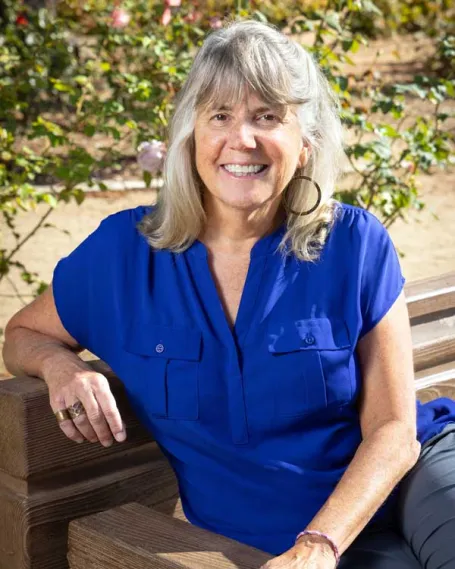
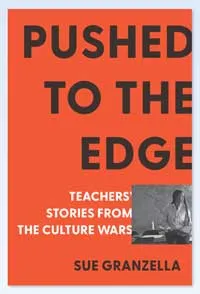
From book bans to firings to personal attacks on educators, America’s culture wars are sweeping through public schools, turning teachers and librarians into targets. In the provocative new book, Pushed to the Edge: Teachers’ Stories from the Culture Wars, NEA-Retired member Sue Granzella reveals how overreach by politicians and parents is creating a chilling effect on educators across her home state of California.
Granzella, who retired in 2021, traveled across the state, meeting with dozens of educators, librarians, and students to document how extremists are now waging war on classrooms. Her book won accolades from Publishers Weekly and acclaimed author Dave Eggers, who writes, “These teachers, and their resilience, compassion, and craftiness, will give you hope in bleak times as they find ways to look out for their most vulnerable students.”
NEA Today for NEA-Retired spoke with Granzella about her journey in bringing these compelling stories to light, and how NEA-Retired members can help ensure that teachers are valued and respected, students feel safe, and history is taught honestly.
NEA Today for NEA-Retired: What prompted you to tell the personal stories behind today’s threats to public education and educators?
Sue Granzella: Back in June 2022, the Proud Boys stormed the Drag Story Hour at the San Lorenzo Library. That was just a few blocks from where I was a third-grade teacher. I had to act.
I didn’t realize how terrifying the attack was until I interviewed the librarians who were there that day. The news clips only showed a few men milling about, but the reality was far more sinister. One librarian called 911, expecting to hear gunshots at any moment. The men wore T-shirts that said things like “Kill Your Local Pedophile” and displayed pictures of assault rifles. On social media, supporters of the raid claimed the men were "protecting children." It wasn't about protecting children; it was about upholding dominance for a specific demographic: straight, white, and cisgender.
Why did you limit the interviews to Californians?
SG: I limited my interviews to Californians because many people falsely believe that the state is uniformly liberal, and that Texas and Florida are the far-right outliers. But I know people who live in areas of California so conservative that people want to secede from our state. I knew that limiting myself to my home state would still allow me to reach teachers in areas ranging from very progressive to far on the right.
The pandemic seemed to create a sudden and drastic shift in the environment for teachers. How did you observe that change?
SG: It was surreal. In the first few months, teachers were heralded as heroes. But by the summer of 2020, when it became clear schools wouldn’t reopen in the fall, we became the enemy. The narrative shifted dramatically toward “parental rights.” It was kindling for a wildfire; the far right seized on that language as an opportunity to mobilize people. One teacher told me of a board meeting where parents demanded location trackers for teachers. A talking head from PragerU—which is not a university—insisted that because parents pay taxes that pay teachers’ salaries, parents get to dictate exactly what is taught.
How did Temecula’s ban on so-called critical race theory come about and how did it impact educators who live there?
SG: A pastor with a huge social media following formed a political action committee that funded Christian nationalist candidates in their quest to flip several school boards in the area. When Temecula’s board was flipped, their first agenda item was to redefine “racism,” and then to ban “critical race theory.” They claimed that teaching about racism in history was racist against white people. Educators spent months knocking on doors to get the new board president recalled, and a lawsuit was filed against the district, claiming that the ban censored teachers and violated students’ right to receive information. Two and a half years after the ban was enacted, a California appeals court overturned the ban. It was a first in California history.
Your book highlights that while all teachers are under attack to some degree, LGBTQ+ educators face particularly appalling challenges. Could you explain more about that?
SG: It is truly distressing. One lesbian teacher was accused of being a groomer because she wrote a note assuring her troubled student that “it gets better.” Another educator received death threats after telling her middle school students that she was going on a vacation with her girlfriend. After an LGBTQ+ teacher was doxxed on social media by a pastor, a parishioner urged others to join him and confront the teacher at her home. Death threats came to a queer high school teacher after they said teachers should not have to out students to their parents. Yet another educator was harassed by students for being a lesbian; they doxxed her and discussed her body on social media. Her administrator simply told her to grow thicker skin. It’s a level of discrimination that I, as a straight, white, cisgender woman, can only imagine.
Non-LGBTQ+ educators who openly support queer students face harassment, too. Twice, I met straight teachers who called the FBI after receiving death threats. One teacher, an LGBTQ+ ally, was so terrified that she fled her home in the middle of the night. A pastor wrote a letter to one straight cisgender educator who publicly supported LGBTQ+ people, telling her that she was like the sinners who need to be weighed down with heavy objects and cast into the sea.
As educators told me these stories, I kept thinking about how hard each of them had worked during the pandemic, and how wildly public opinion had swung.
How would you describe the importance of unions to educators today?
SG: First, unions provide essential job protection. Several teachers who were unfairly harassed and/or disciplined told me they still have jobs only because of our union, the CTA and NEA. For instance, when Christian nationalists tried to revoke one teacher’s credential, she was able to keep it due to the staunch support of a union-provided attorney. The second prong is that unions are a voice for justice and standing up for students. I attended a union-run human rights and equity conference in March that was incredibly inspiring—a conference of activism focused on equitable, inclusive education and fighting issues like book bans.
How can NEA-Retired members help push back against these attacks and speak out for public education?
SG: Retired educators are vital activists! We can run for school board. We can write op-eds and articles that discuss why it’s essential to support public education and the people who deliver that education. We can share teachers’ and librarians’ stories with legislators, and demand that our representatives write bills that support public education and deny support to the voucher movement. In our everyday life, we can refuse to be silent when teachers are denigrated.
I’ve heard you use the word “interpreter” when discussing your book. What do you mean by that?
SG: As the narrator of the book, I am not an impartial observer merely recording facts. At my core, I am a teacher with 32 years of experience, so my pro-public education bias is expressed in my narrator’s voice. And I think most people—including many who want to muzzle teachers and ban books—don’t really understand what happens in a classroom. It’s easy to say things like, “Teachers should never mention sexuality at school,” and “No school library should have those books on its shelves.” But when a person hears stories about what happens when children are in a real-life classroom, it becomes a lot more difficult to be so cavalier about making such proclamations. So, in addition to relating the stories the educators told me, I’m also interpreting the world of public education by weaving in my own real-life experiences of teaching in public school.
Were there any interviews with educators that really stand out in your mind?
SG: One teacher made a comment that still pierces me. She had suffered tremendously, having received death threats and nationwide harassment for teaching children that LGBTQ+ people are just part of the spectrum of humanity. I felt so bad for her that I told her about a fellow educator hundreds of miles to the north, someone who taught the same grade as she did and who was also striving to teach her young students that everyone has the right to be their authentic self. The tormented teacher looked stunned, whispering that she thought she was the only one. At that moment, I wondered if the most powerful gift of this book might be to let educators know that they are not alone.