The year was 1965. President Lyndon B. Johnson had just signed the Elementary and Secondary Education Act into law, creating the landmark Title 1 framework.
In a small town in southwestern Iowa, high school band director Fred Stark boarded a passenger train and crossed the nation, arriving in New York City to attend his very first NEA Representative Assembly.
Johnson showed up, too.
“It was a different era,” Stark recalled this summer, as he attended yet another NEA Representative Assembly, this time in Denver. Even in the Swinging Sixties, NEA delegates dressed for business. “The men all wore suitcoats and ties. Women were dressed in finery. And everything was very serious.”
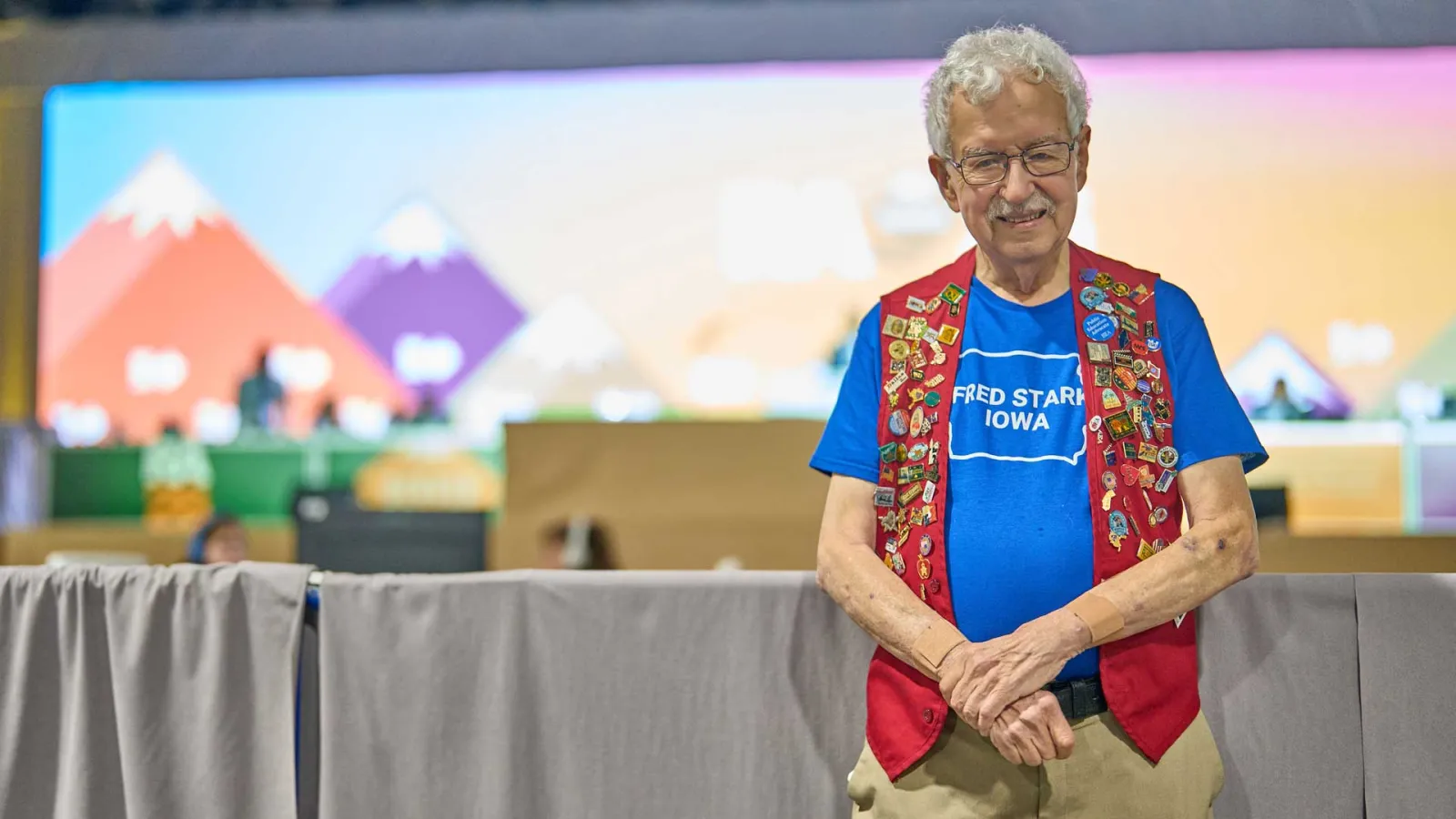
Today, Stark wears a blue t-shirt that says “Fred Stark,” commemorating his legendary status as NEA’s current, longest-serving RA delegate. Indeed, across the history of the union, NEA has hosted 105 RAs and Stark has attended at least 59, or more than half. His first was the 1965 meeting, held at Madison Square Garden. Since then, Stark has missed no more than two, he says.
“Who Else Has That?”
Over his shirt, Stark wears a red canvas vest, covered in dozens of small union pins that he has traded and collected at NEA RAs. Stark is a collector—not just of NEA memorabilia, but of Iowa State Education Association (ISEA) and NEA history.
Three storage units and a whole room inside his retirement apartment is dedicated to Stark’s union memorabilia. Among his most prized possessions? A beribboned pin from NEA’s 1892 convention in Toronto, when NEA charged a “Committee of Ten” to establish the first-ever curriculum standards for high school students.
“Who else has that?” he asks.
Stark also has a letter from an Iowa teacher, which she wrote from jail during the historic Keokuk, Iowa, teachers’ strike of 1970. At that time, Iowa teachers didn’t have collective-bargaining rights. The Keokuk superintendent was attempting to replace their experience-based salary schedule with a merit pay plan. In protest, teachers went on strike, and eventually four were jailed for refusing to return to work.
“The legislature basically said, ‘hey, we don’t want to see this happen again,” recalls Stark. Not only did the Keokuk teachers’ persistence and solidarity lead the school board to maintain their salary schedule, it also led to Iowa’s Public Employment Relations Act, of 1974, which gave teachers the right to collectively bargain.
Some of Stark’s oldest artifacts come from the 1921 NEA annual meeting, held in Des Moines, Iowa, where NEA members addressed the high level of illiteracy among World War I veterans. Their response? An approved resolution creating “an educational week… observed in all communities,” or American Education Week, which is still celebrated across the U.S., more than a century later.
In his will, Stark leaves this entire collection to ISEA, he says.
“Make Friends”
Stark began his teaching career in 1959, in Mt. Ayr, a rural community in southwestern Iowa. In 1962, he married his late wife of 61 years, Nancy (“Nan”). In 1973, the Starks moved to the town of Washington, Iowa, where Stark taught for nearly 30 years and once served as a city commissioner.
In 2001, he retired from teaching: “I [retired] in a good mood!” he says. Two years later, he was honored with ISEA’s Charles F. Martin Award, a top honor for a union member who has made a significant contribution to the teaching profession through union involvement.
Over the years, Stark has served in numerous union roles, including on NEA’s Resolutions Committee, which sets the national union’s legislative priorities. He also ran numerous, effective campaigns for colleagues seeking ISEA and NEA elected positions.
His advice to new union members, and especially to new RA delegates? “Make friends and learn parliamentary procedures,” says Stark, who has served as parliamentarian, not just for NEA and ISEA decision-making bodies, but also for his city commission, on which he served for many years, as well as Washington County committees, his local Lions Club, and the Iowa Bandmasters Association.
Although he has scaled back some activities in recent years, Stark still volunteers as a city ambassador, in Washington, performs trombone with small groups, and stays active in his church community.
“When Are We Going Dancing?”
Over the 61 years that Stark has been attending NEA RA, a few stand out, he says. At the top of the list? The 1965 convention, the first Stark attended.
Held just two years after President Kennedy’s assassination, with Vietnam War protests raging in the Manhattan streets, Stark recalls seeing armed, uniformed police officers inside the convention, “in every single aisle,” when Johnson arrived. He spoke to delegates, describing his transformative “Great Society” plans to NEA members, Stark recalls. “And I thought, well, this is very interesting!”
Of course, Stark grabbed a brochure from that meeting, which says, “NEA Welcomes President Lyndon B. Johnson.“ In other words, Stark was hooked from the start—not just on participating in his union, but also preserving its history.
In 1969, in Philadelphia, Stark recalls that every delegate received beautiful flowers—and that the best, most raucous parties were hosted by the New Jersey delegates. “The hotel gave us three warnings, and then shut it down,” Fred laughs. In 1972, they went to Atlantic City, and heard from then-Senator George McGovern, who told delegates that a separate Cabinet-level department of education should be created. But what Stark specifically remembers is NEA delegates’ attention to NEA’s new constitution, which gave more power to teachers (rather than administrators), he says.
San Francisco in the 1970s was beautiful, Stark recalls. Chicago in 1974 was interesting: Mayor Richard M. Daley, an AFT man, canceled NEA’s buses. “People couldn’t get back to their hotels…that was not a happy situation,” he says. But when NEA returned to Chicago in 2000, of course Stark was there, and he enjoyed it. “We had a boat cruise on Lake Michigan, with some great bands playing!”
Indeed, Stark learned to dance at union events, he says. At the recent NEA RA in Denver, he nudges ISEA President Josh Brown and says, “When are we going dancing?”