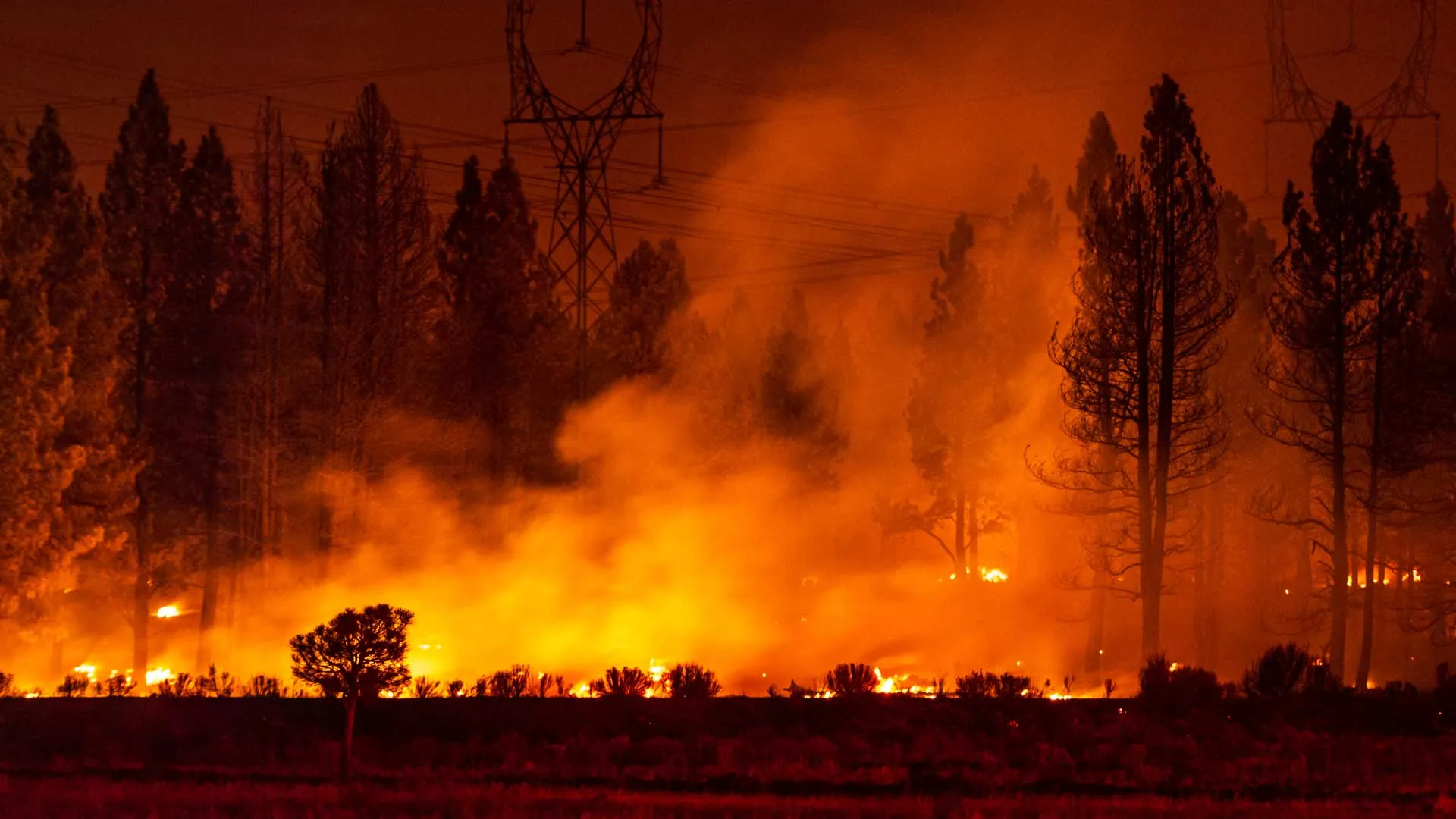
As flames torched the woods and hills surrounding them and thick plumes of black smoke turned day into night, a bus driver and two teachers evacuated 23 school children to safety during the 2018 Camp Fire that destroyed thousands of acres in Northern California.
The fast-moving wildfire popped and raged unpredictably, suddenly blocking their path and forcing them to change course repeatedly. The 30-mile journey to safety lasted five hours.
“We were terrified,” recalls second grade teacher Mary Ludwig, one of the brave educators who evacuated the students from Ponderosa Elementary School in Butte County. “We didn’t have much information, and the communication system was failing. We’d turn a corner and it was pitch black. The children thought it was midnight. There was a lot of noise on the bus for the first hour but then it settled into this extreme quiet fear.”
Ludwig, along with bus driver Kevin McKay and teacher Abbie Davis, did what educators always do: they remained calm and focused on protecting the students. At one point, smoke filled the bus and Ludwig and Davis used ripped pieces of McKay's shirt doused in water to help the students breathe.
McKay gave Ludwig his notepad and she went row by row to write down every student’s first and last name so they could radio them to the school where parents were waiting.
“My hands were trembling,” Ludwig said. “I had to write the names three times to be clear enough to read because my hands were shaking so badly. But we got the list out right before we lost communication.”
Looking back, Ludwig says she is most proud of the resolve and teamwork of the educators, not only of the three on the bus that day, but across the district. Staff who packed kids into their own cars, who made sure every classroom was evacuated, and who, in the days and months after the disaster, advocated for more student mental health support while they tried to offer the security and consistency schools always provide.
In the aftermath, educators developed their own responses and best practices.
“The challenge was that our students were displaced with almost every one of them having no home to return to after the evacuations were lifted, and an entire town having been taken off the map in the middle of a school year,” said Butte County Office of Education trustee Mike Walsh. “That meant that every school…was in crisis and we chose to serve them all.”
Wildfires have become much more frequent in the western United States, and they have become much larger and more destructive.
Two explosive wildfires ravaged the Los Angeles area last year. In all, 19 school districts closed and a dozen schools were destroyed in the Palisades and Eaton fires. The California Teachers Association (CTS) mobilized immediately, with local education associations in the impacted areas supporting members on the ground and CTA coordinating relief efforts to help support those in need.
“During this challenging time, I’ve been so proud of our union,” CTA President David Goldberg said in the wake of the disasters. “I’ve been so moved by how we’ve carried on together, wrapped our arms around each other for support, reached out to check on our colleagues, students and neighbors, and helped raise money and provide mutual aid.”
Schools and Educators: Backbone of Disaster Relief and Response
Public schools are the heart of communities around the country, and during times of disaster, they act as shelters, donation sites, feeding centers, and sanctuaries offering emotional support for students and their families.
“Educators are on the frontlines during disasters because we’re already rooted in our communities, trusted by families, and committed to our students far beyond the school day,” says Shanna Peele, president of the Buncombe County Association of Educators in western North Carolina, an area ravaged by Hurricane Helene in September 2024.
“We know our students’ lives—their housing situations, their food insecurity, their medical needs—long before a disaster makes them visible to the rest of the world. That knowledge turns into action when systems are overwhelmed. After surviving Hurricane Helene, I saw this firsthand. Even while dealing with damage to our own homes, educators were checking on students, organizing supplies, and making sure families weren’t forgotten.”
Art teacher Amy Chambers set up an art table at one of the community hubs at a school so that children could create art as a way to cope with the trauma of the hurricane.
Educator Andy Erikson helped the union organize a "recess" day at a local church for children in that community to have some playtime when school was still out.
And many educators, like Katie Wilson and Suzie Pruett, both of whom had devastating damage to their own homes, returned to school as soon as they opened to teach and offer support and a sense of normalcy for their students.
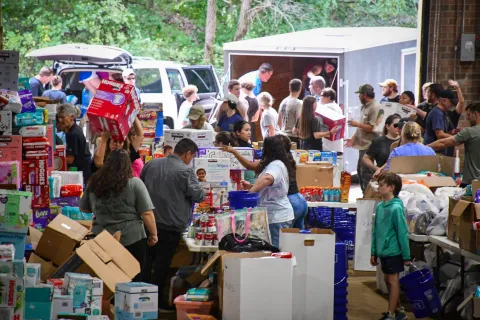
Florida was also hard hit by Hurricane Helene. Kristin Hollingsworth, an English and Reading instructor at Citrus County High School, came up with the idea for a county donation drive to collect essential items. She said because so many students at her school were impacted by the storm, they needed to do something.
“It really has brought everyone close together and I think see the bigger picture that at the end of the day, you know, we do need to be together as a community because otherwise, we kind of fall,” Hollingsworth said.
According to Tampa Bay Times, students and staff members in Pasco County, Florida, collected and distributed clothing, cleaning supplies, and other essential items to families impacted by the storm.
Across Florida, Georgia, North and South Carolina, and Tennessee, educators and schools rallied to respond to the hurricane.
“Public schools are the heart of our communities. They are often the most stable, accessible, and trusted public institutions families have—especially during a disaster,” says Peele. “After Hurricane Helene, I watched our schools become lifelines. They became shelters, food distribution sites, communication hubs, and spaces of safety and reassurance for children and families who need familiarity in the middle of chaos.”
In fact, approximately one-third of U.S. public K-12 schools are identified by the Federal Emergency Management Association (FEMA) as shelters.
FEMA Cuts Threaten Disaster Prone Communities
Students are increasingly impacted by disasters. Weather-related FEMA disaster declarations have more than tripled since 1990, and between 2017–2019 alone, two-thirds of U.S. students lived in counties that experienced a federally declared disaster.
In the meantime, FEMA’s role helping states and communities recover from disasters has changed dramatically. Communities in states hard hit by disasters, like California and North Carolina, are still waiting for FEMA aid. A bottleneck of disaster aid owed to states has surpassed $17 billion, according to documents reviewed by The New York Times.
According to The Hill, a court filing by unions and public interest groups said the Department of Homeland Security (DHS), which oversees FEMA, could eliminate more than 10,000 positions in the months ahead.
On New Year’s Eve, agency officials eliminated about 65 positions that were part of FEMA’s largest workforce, known as the Cadre of On-Call Response and Recovery (CORE) — staffers who are among the first on the ground after a disaster and often stick around for years to help communities recover.
Though FEMA did respond to the recent deadly winter storm that crippled southern states with snow and ice, its ability to respond to future disasters remains unclear.
But, as California teacher Mary Ludwig says, “fate favors the prepared mind.” Ludwig and educators across the country have learned that they are often the first responders for students in a disaster.
“There are so many people that step up and take care of the children,” she says. “My story is just one, but I represent countless others.”