
Key Takeaways
- In Florida, the new state-approved Introduction to Sociology textbook for university students has had more than 400 pages cut out of it, including chapters on race, gender, sexuality, media and technology, and global inequality.
- New Florida laws aim to dictate exactly what sociologists teach, and discourage students from taking their courses.
- Elsewhere, sociology teachers are watching what’s happening in Florida with concern and empathy. But, they add, student interest in their classes is only growing.
What’s it like teaching sociology in Florida today? Not easy. Indeed, sometimes it’s terrifying; other times, it feels like a painful exercise in integrity, educators say.
Over the past several years, Florida politicians have passed laws aimed at dictating exactly what sociologists can say and teach in their classroom, in an effort to limit discussion of race and racism, gender and sexuality, and even income inequality. In 2026, these politicians’ efforts culminated in a new, censored textbook; a state-approved “course framework” with a list of nine forbidden topics; and a striking blow to discourage Florida’s college students from taking the class at all.
“It’s clear they want to shrink us to the point where we’ll drown in a bathtub,” says Florida International University associate professor Zachary Levenson.
As a result, one Florida professor who taught a “Sociology of Gender” course for years has stopped offering it to her university’s students. “It just got to be too much,” she told NEA Today. Too much headache. Too much anxiety. Too much feeling like faculty are on trial in a shape-shifting, Alice in Wonderland kind of courtroom.
Meanwhile, other Florida sociologists aren’t changing a thing that they teach or talk about, they say, because what they teach is fully appropriate and also fully necessary to fulfill faculty’s professional responsibility to students.
“My syllabi are compliant with the law, and I’m not going to pre-emptively change what I do because some politician somewhere doesn’t like what I teach,” says Levenson “I’d be fine having Ron DeSantis himself observe me in the classroom. I certainly don’t advocate a political line in the classroom.”
Elsewhere, sociology teachers are watching what’s happening with a mix of apprehension, compassion, and curiosity. “We live in an insulated bubble,” says Minnesota sociologist Sadie Pendaz-Foster. “But it’s not like we’re just happily tripping along. Everybody is on edge, thinking about it.”
But while sociologists worry about the future, current students are showing up, more than ever.
What Is Sociology?
“Sociologists act like detectives of the social world,” says University of California, Berkeley, sociology professor Raka Ray, in her "Sociology Explained" video. “They don’t have to examine a dead body in a dark alley, but they have sociological mysteries to uncover, questions like ‘why are women still paid less than men?’ ... We look at numbers, we look at evidence, we put things together and say, ‘That’s a pattern.’”
How does a person’s social class or race impact their health? How do cultural norms affect the way we parent? Why are some people more likely to commit crimes and then return to prison after release? These are questions that might be explored in a sociology classroom, using qualitative and quantitative data.
Despite what some politicians might think, “telling the truth about racism or history is not ideological. Historical facts are not opinions,” says Pendaz-Foster, who teaches at Inver Hills Community College, in the suburbs of Minnesota’s Twin Cities (where the state requires future police officers to take a sociology course.)
Her goal isn’t political indoctrination—far from it. “I just want students to walk out and remember how culture and socialization impacts people … to just question their assumptions and not take things at face value,” says Pendaz-Foster.
“It sort of feels like [politicians] didn’t do the research. Like they don’t even understand what we’re teaching,” says Levenson, about Florida’s politicians. “They’re interpreting almost anything as ‘woke,’ even African or Latin-American history.
“Most of sociology is saying, if we spend more on this, what’s the outcome? If we spend more on that, what’s the outcome?” says Levenson. “It’s boring!”
“I didn’t know I didn’t know this!”
Politicians’ issues with sociology may not be because of what it says about race and racism, but rather what it says about power. “A lot of sociology is about revealing where power is, and people in power don’t want us to see that,” says University of Southern Maine (USM) assistant professor Julianne Siegfriedt.
In her classes, which include a lot of USM’s many nursing students, students investigate class, race, and gender through the lens of the healthcare system. “There’s always a lot of, ‘I didn’t know that I didn’t know this!’” she says.
Siegfriedt’s students, who are mostly working-class, first-generation college students who grew up in the whitest state in the nation, have a growing awareness of inequalities in the U.S., Seigfriedt says. “They’re getting madder and madder about society, and focused on wanting change,” she says.
“In short, [sociology students] are positioned to be engaged citizens, armed with the power to destabilize right-wing policy makers’ agendas—and this is the threat these [politicians] seek to neutralize,” wrote Florida State University sociologist Anne Barrett, for NEA Today, in 2024.
For many students, whether in Maine, Minnesota, or Florida, college is the first chance they get to study sociology. They often encounter it by accident, because it happened to fit into their class schedule and fulfilled a graduation requirement (the kind of requirement that Florida politicians have ensured sociology will no longer fulfill.)
That’s how Pendaz-Foster came to the subject, and also Levenson. “I was a math major in college,” Levenson recalls. “I’d never heard of sociology! My schedule got screwed up, I took an intro to sociology course on a whim, really liked it, and switched my major.”
Of course, many U.S. high schools do offer sociology, and often in conjunction with local colleges so that students can concurrently earn college credits. This option is growing in popularity, teachers say.
Our Eyes on Florida
In Florida, the new state-approved "Introduction to Sociology" textbook has had 400 pages cut out of it, including whole chapters on racism, sexuality, media and technology, and global inequalities. This spring, state authorities handed down a "course framework" that bans nine discussion points. For example, it forbids faculty from discussing whether the longstanding gap between men and women's pay stems from institutional discrimination.
But Florida isn’t the only state where politicians are threatening the academic freedom of educators—and it’s not just sociologists. Last year, Texas politicians passed a law giving the people they appoint to university boards—and not the faculty who have studied their subjects for decades—more control over what’s taught in classrooms.
As a result, at Texas Tech, English professors have been forbidden from teaching books written by gay authors, NPR reported. And, in February, University of Houston professors were asked to sign a three-page memo, promising “not to indoctrinate” students.
In Indiana, public universities are cutting and merging 600 degrees. At Purdue University-Fort Worth, students will no longer be able to earn degrees in sociology, anthropology and political science. The state’s 2024 “intellectual diversity” law is vague, says faculty, and means they are constantly looking over their shoulder.
In just the first half of 2025, 22 states—from Arkansas to Ohio— passed laws censoring higher ed, according to PEN America. Often these laws are so vague that educators don’t really know what they can or can’t teach, PEN notes. “Out of caution, people avoid talking about any issues or ideas that could possibly be covered [by the law].”
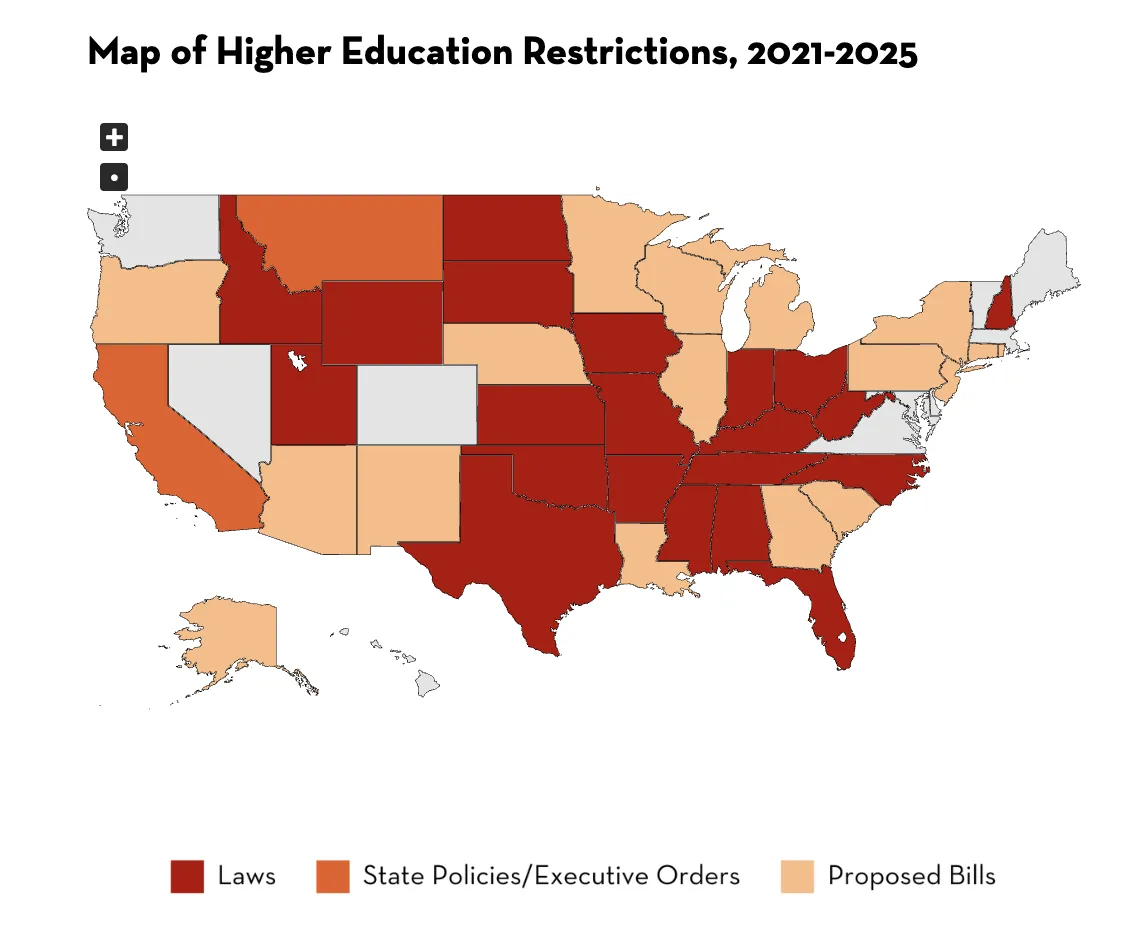
[Check out PEN's online map to learn about legislation in your state.]
Maine doesn’t have laws like these, notes Seigfriedt. She chooses her classroom texts based on her own professional expertise. Likewise, in Minnesota, Pendaz-Foster relies on what she has learned about her field over the past 30 years. Both feel protected by legally binding, union contracts that guarantee their academic freedom—but that doesn’t mean they’re not watching what’s happening, especially in Florida, with concern.
“I think what people are worried about is: How do you maintain your academic integrity [when the state is telling you what to teach],” says Pendaz-Foster. “I’ve thought about it myself. What if that political agenda comes here? What’s my line that I won’t cross, where I can’t teach sociology anymore? When your back is against the wall and you have a mortgage and your partner has cancer, your line changes, right?”
In Defense of Sociology
Pendaz-Foster is a leader in the American Sociological Association (ASA) and appreciates the resources that they’re providing to secondary and college educators, such as talking points for threatened departments, and the forums that ASA hosts for faculty to get together and strategize. As a local union president, she also points to her collective bargaining agreement as a first line of defense.
In Maine, Siegfriedt agrees. “We have a really strong union—and I have great colleagues doing great work across the university,” she says. “The more of us doing great work, and making it known, is one of our best defenses.”
Florida professors also have union protection, even as politicians are working hard to weaken those unions. But they’re still leery of being named and shamed in public, or even being fired quietly through a post-tenure review process that can be influenced by political appointees on university boards. As a result, many self-censor, afraid of crossing a line that they can’t even really see.
Recently, Levenson asked his provost to put in writing what he must teach and what he can’t teach. She told him she couldn’t answer, he says.