
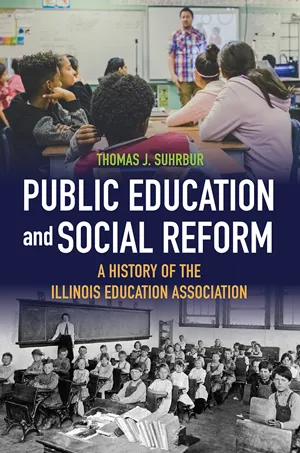
In 1980, Tom Suhrbur attended his first Illinois Education Association (IEA) Representative Assembly (RA) as an alternate delegate. Then a high school social studies teacher in the western Chicago suburbs, Suhrbur wasn’t sure what to expect. But after witnessing the business of the RA, Suhrbur was impressed: “Here was a union that was democratic and not top-down,” he remembers thinking. At the RA’s final day, the dynamic Reg Weaver took the stage after being elected to his first term as IEA president and gave an inspiring speech. At that point, Suhrbur says, “I was hooked.”
Suhrbur later went on to work for the IEA as a full-time organizer for twenty-six years. After his 2011 retirement, he embarked on researching and writing an ambitious history of the IEA – from its founding in 1853 to the present-day. The University of Illinois Press recently published Suhrbur’s Public Education and Social Reform: A History of the Illinois Education Association.
In a conversation with NEA Today, Suhrbur offered five lessons gleaned from his decades of research and on-the-ground experiences.
1. From the very beginning, the IEA fought against school privatization.
“When the IEA started in the 1850s, it backed a ‘common school’ for all children, regardless of race, sex, religion, ethnicity, or social class. Common school advocates wanted all the kids together to learn from each other. Public schools were designed to provide a broadly liberal education and not to teach narrow ideological or religious values.
Many of the key leaders of IEA were very outspoken abolitionists, and they wanted the common school. They were looking at the South, where you had a private system. There were no public school systems in any of the slave states prior to the Civil War. The wealthy slaveowning planters, who controlled Southern politics, sent their children to private schools or hired tutors. They not only outlawed the education of the enslaved black people but also saw no need to tax themselves to educate lower class whites.
The Association has always opposed privatization. In the 1850s, it successfully lobbied for the creation of a public university system rather than relying on the existing private, mostly religious, colleges to educate teachers for the newly created public system."
Quote byTom Suhrbur

2. The IEA has led countless efforts for better and more equitable funding for Illinois schools.
“One of the key issues for the IEA over the years has been taxation. How are you going to fund the public school system? Throughout the last 200 years, that's been an issue in Illinois and elsewhere. The [Illinois] Free School Act of 1825 had a tax. But shortly after, the taxation language was removed from the law. The state legislature said, ‘If you want to pay a tax, you have to write a letter to the Secretary of State saying you'll pay for the education tax.’ Well, that was the end of that.
It took another thirty years for the state legislature to enact a law that funded the creation of public schools across the State. That was the Free School Act of 1855, which funded schools with a two-mill property tax. But in 1873, the two-mill tax was removed for a flat rate tax that was frozen until the early 1900s. The reason that’s important is because if you have a high statewide tax to fund education, the people that have the most property pay the highest taxes, and they, in effect, are funding schools in lower-income areas.
Reliance on a state property tax was opposed by conservative politicians. They supported funding public schools with local property taxes. These politicians had no problem with having public schools, but they only wanted to fund schools in the wealthy areas where they lived. So by the 1920s, 94 percent of all the funding for public education [in Illinois] was based on local property tax. So you had some very well-funded districts and you had some that were just shacks. Many rural school houses provided minimal educational opportunity.
Taxation has remained an issue up to this day, and to the IEA’s credit they always fought for increasing the state funding in various ways. In the 1970s the legislature passed a flat rate tax, but the IEA has never been able to get a graduated income tax.”
3. The IEA has long fought against racism and for civil rights.
“Illinois’ Free School Acts of 1825 and 1855 said that schools were only open to ‘white citizens.’ The Association did everything they could to remove that racist provision. It was finally removed when they redrew the Illinois Constitution in 1870s which said ‘all children’ should receive public education.
After Plessy vs. Ferguson was decided [editor’s note: this was the 1896 U.S. Supreme Court case that established the ‘separate but equal’ doctrine], many school districts in central and southern Illinois had legally segregated schools until the Brown v. Board case. Edwardsville, which is in southern Illinois, had two high schools - one for white students, which was a 4-year high school, and one for Black students, which was a 3-year high school. That continued right up into the 1950s. In the meantime, in other cities in northern Illinois, there was housing segregation. If you have neighborhood schools, if the housing is segregated, then the schools are segregated too.
Up until 1970, IEA was controlled by school officials. It was an all-inclusive professional organization. When teachers took over the organization in 1970, they took a very positive position on racial inclusion. Prior to that the IEA was always for civil rights and equality, but many school districts in Illinois practiced racial discrimination and the IEA had no control over local school boards.”
4. The IEA wrote the first draft of what would become the Illinois Educational Labor Relations Act (IELRA). The 1983 law was transformative, especially for smaller IEA locals and for Educational Support Personnel (ESPs).
“[Before IELRA], some districts were pressured into bargaining. I taught in Geneva, and they were bargaining back in the early seventies without a law.
But it depended on the school board and the local politics. Some superintendents said, ‘I'll bargain over my dead body.’ There were teacher firings. There was no requirement for school boards to recognize the local organization and bargain with them – even if you had 100% membership. This was especially a problem in the smaller districts.
After passage of the law, in the smaller districts, teachers started bargaining. And everyone was covered by the law, so support staff said, ‘Hey, I want to have a voice too,’ and so a lot of them organized. In 1983, before the passage of the law, IEA had just over 1,000 ESP members. By 2010, there were 29,000 [ESP members].”
5. Public education and unionism are a bulwark of democracy.
“To me, the most important thing about public education and collective bargaining is that it's all about democracy. Who's going to make decisions? How are these decisions going to be made? If you have collective bargaining, you have collective participation in decision-making.
The election of President Trump signaled an all out attack on democratic institutions. Public education is a key target of these efforts. Unionism and public education are so important, because they contribute to make this a more fair and democratic society.”