
For Shari Merola, it was often a fix for the smaller problems—parking or student pick-up issues, school calendar glitches, a bloated activity permission packet, or even concerns about school announcements.
On these everyday issues for her members, labor-management collaboration (LMC) paid off.
LMC is an intentional and ongoing partnership between the local union and district administrators, built on agreed-upon collaborative structures and norms. It is a strategy to increase educators’ voice in decision-making on issues big and small.
“If our collaboration with the administration helps make the individual school run more smoothly and make the staff happy and improves the atmosphere for our students to learn, that’s important,” Merola says. “But it paid off in big ways too.”
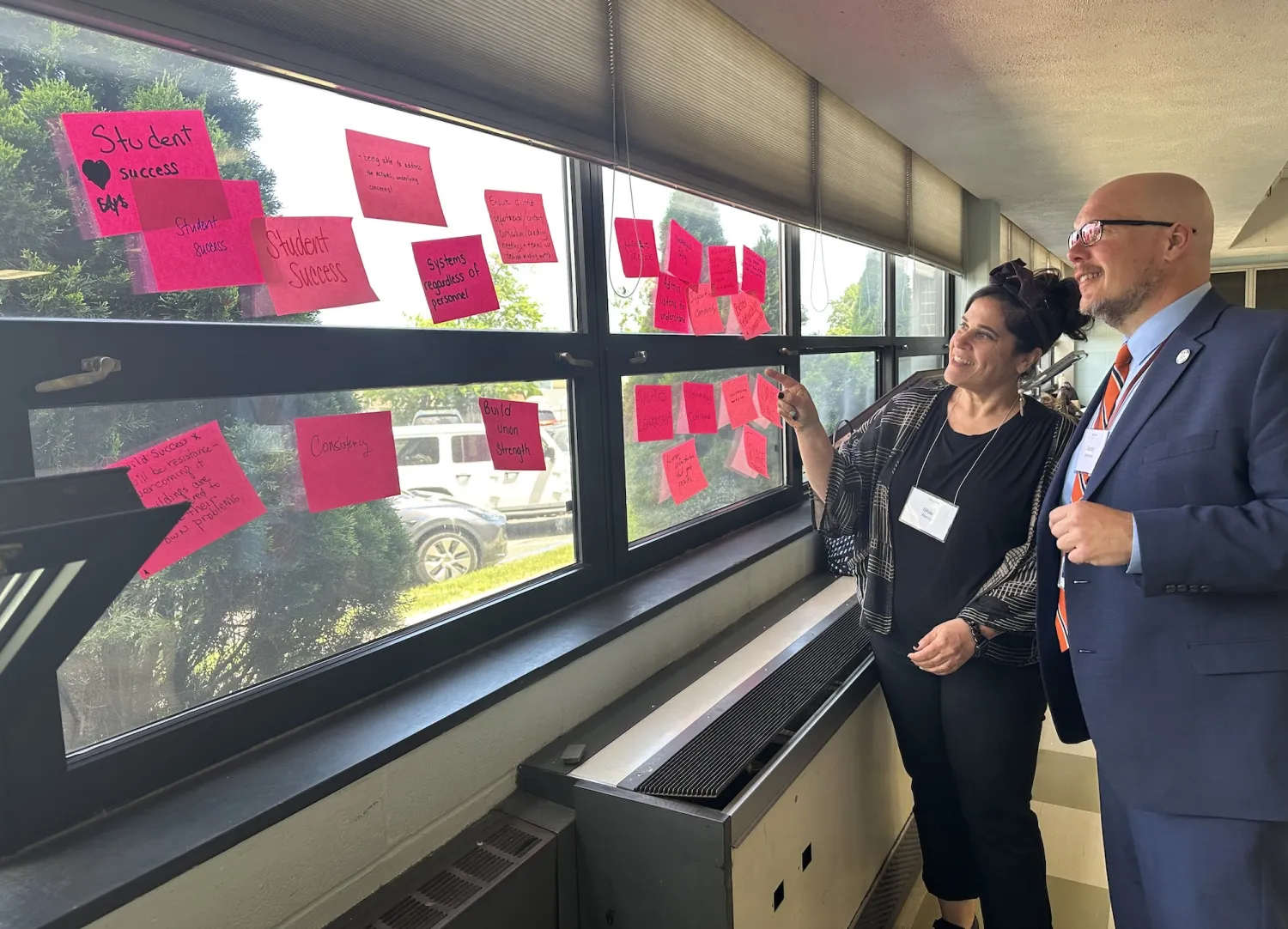
Merola is president of the Clifton Education Association (CEA), representing educators in the Clifton, NJ, Public Schools, a northern New Jersey district with about 11,500 students, where collaborative efforts have been a priority since about 2019.
It’s an effort that’s been bolstered by NEA’s partnership with Educators Thriving, an organization focused on helping educators succeed and now working with CEA and other NEA affiliates throughout the country to better understand the connection between LMC and educator well-being, and then improve union-district collaborative structures that foster educator success.
“We looked at labor management collaboration and key outcomes, including our educator well-being scale and things like retention, job stress and satisfaction and job advocacy,” said Dr. Hallie Fox, co-founder and head of research at Educators Thriving. “It was pretty remarkable to see the extent to which collaboration has significant consequences for how people are experiencing their workplace overall.”
Fox said that public education needs to invest in collaboration at the district and school levels, building a sense of “personal connection and trust with an understanding of the shared desired outcome—student success.”
Collaboration Leads to Educator Well-Being
In its exhaustive research on both collaboration and teacher well-being (data from more than 7,500 educators) Educators Thriving found that stronger collaboration resulted in
- Better leadership experiences
- Stronger supports
- Higher levels of well being
- Lower levels of stress
- Greater willingness to stay in their position and recommend their worksite to others
In fact, in those districts where Educators Thriving measured high levels of labor-management collaboration, respondents were five times more likely to report a higher level of well-being, four times more likely recommend working in their district and more than three times more likely to report high job satisfaction and plans to stay in their district.

“So, it’s often organizational and structural conditions more than individual dispositional traits alone that determine teacher satisfaction and well-being,” Fox says.
The Clifton Education Association is a longtime participant in the New Jersey Labor-Management Collaborative, an NEA-sponsored initiative that fosters collaborative structures, processes, and mindsets among education stakeholders. Merola notes that because of the collaborative mindset in Clifton, teams meet regularly at the school and district level to work on some of these easy wins which can make or break the educator’s experience. That translates to better outcomes with bigger issues because the structure is in place; the atmosphere and relationships are better and, often, when contract negotiations take place many of the thornier issues have been resolved.
“I think there's been lower level and very large, higher-level gains that we were able to make thanks to the interactions and trust that continues to be built,” Clifton Assistant Superintendent Janina Kusielewicz said during an Educators Thriving webinar on the effort. She notes that recent contract talks took place during two relatively collaborative meetings, for instance
“It has been very transformational in the evolution of our district and hopefully laying foundations for moving forward,” she said.
Embracing Shared Problem-Solving is the First Step
For three years, Maite Iturri has been superintendent of Cotati-Rohnert Park Unified School District in California’s wine country just north of San Francisco, serving about 6,200 students. The district administration had been through contentious negotiations and a strike the year prior to her arrival.
“We had to do a lot of repairs and recognized that this work is hard enough, especially now, and no one is coming to save us,” she said. “So, it is up to all of us—and why make the work any harder. Collaborating benefits everyone, especially our kids.”
She and Lisa Bauman, president of the Rohnert Park Cotati Educators Association, said that a key to collaboration is building a relationship and both said they benefited from each being new to their positions at the same time.
“Trust is essential, or at least a willingness to take a leap of faith,” Bauman said, noting that she felt there was “zero trust and respect” in the relationship with the prior administration.
“During our first meeting, Dr. Iturri genuinely listened to what we had gone through and acknowledged the lack of trust between our union and management. She also made a distinction between collaborating and building a partnership. That really stuck with me. There has to be a willingness on everyone's part to do things differently, to build a partnership.”
Iturri said they worked on repairing the relationship with restorative conversations and explored ways to use interest-based bargaining. The work resulted in a vastly improved relationship between the administration and the union.
“It’s a relationship where Lisa can call and I’ll pick up the phone,” Iturri says. “We don’t always agree initially on a course of action, but we have a system for resolving problems and that pays off when we sit down to talk about bigger issues. We aren’t just passing slips of paper back and forth with numbers on them.”
“We have embraced shared problem solving,” Bauman says. “We can listen respectfully, disagree at times, and still find agreeable solutions.”
Iturri said one of her major concerns that has been addressed was the district loss of valuable educators at a rapid rate. “We needed the bleeding to stop, and now our retention is much better,” she said. “That’s evidence of how much better our teachers are feeling about their workplace.”
The Positive Results Speak for Themselves
Bauman notes that such collaboration can seem time consuming and unproductive, but she says participants have to be patient and recognize the benefits for the administration, staff and the students.
She also says it is important to include others in collaborative sessions to support the effort and inform others.
“Every single person who has come to a LMC or IBB meeting is blown away by how collaborative we are. You can't pay for that kind of positive publicity,” she said. “When so few people are actual members of the committee, it can seem like a leadership thing that doesn't involve all of our staff. But when colleagues come back and share their experience, perceptions begin to shift.”
Tiffany Dittrich. president of White Bear Lake (Minn.) Area Educators, says union and district leadership in the district used labor-management collaboration to address the many challenges that emerged during the pandemic.

The success of that work laid a foundation for a focused, ongoing effort to address educator depletion following the pandemic and has since grown into a multi-year commitment to support continuous systems improvement in White Bear Lake Area Schools, a suburban district serving about 8,000 students just northeast of the Minneapolis-St. Paul Metro area.
“The Educator Thriving’s Well-Being Measure came to our attention at a fortuitous time when the leadership survey we were preparing to launch had major technical difficulties. Not only was the survey Educators Thriving had developed useful, but the research behind its development was also compelling. The ability to customize through partnership with the Educators Thriving team was a perk”
Dittrich said the survey questions “resonated with both union and district officials” and helped reveal how they could continuously gauge the experience of the educators in the system and be able to use that well-being measure as a framework for systems improvement
Dittrich added that both sides realized that “while we might be coming to the problems that we face with slightly different vantage points or using different lenses, everyone benefits when we tackle the problems together.”
Since 2023, the Educators Thriving yearly survey data helps the district more effectively address issues impacting educators with a shared goal of improving outcomes for students. For instance, last spring’s results revealed that while 81 percent of educators were motivated to learn new things at work, only 25 percent believed the professional development they’re offered met their needs. She said that prompted discussions among union and district leadership as well as among site level principals and teacher leaders throughout the past year.
“Systems change is slow and challenging work that is often difficult to gauge,” Dittrich said pointing to the value of the year-over-year data the survey offers. “This spring’s results will allow us to see whether this needle has moved and where there are changes. We know where to continue to lean in or return to the table to explore new ideas.”
She said fostering strong, productive labor-management collaboration takes “mutual commitment, intentionality, and a lot of hard work. She and her superintendent have regularly scheduled meetings where they discuss issues that have cropped up at various schools and then determine how they can support the building reps and administrators.
Itturi says there will always be conversations on both sides that detract from the collaborative work, but leaders have to commit to working together and resolving looking at bigger picture of staff satisfaction—and student gains.
Dittrich agrees and says despite challenges—including some who want to perpetuate what she calls an “us vs. them” mindset—everyone involved has to remain focused on bigger goals.
“We live in a society where lots of things are combative right now, and that feels like the default sometimes,” she says. “At the end of the day, coming back to what we can do together for our students matters most - we have so much more in common in education than we have differences.”
For more information about labor-management collaboration, head to NLMP Guidebook and Toolkit. LLT Cohort program. NJ LMC blog (lmcpartnership.org).