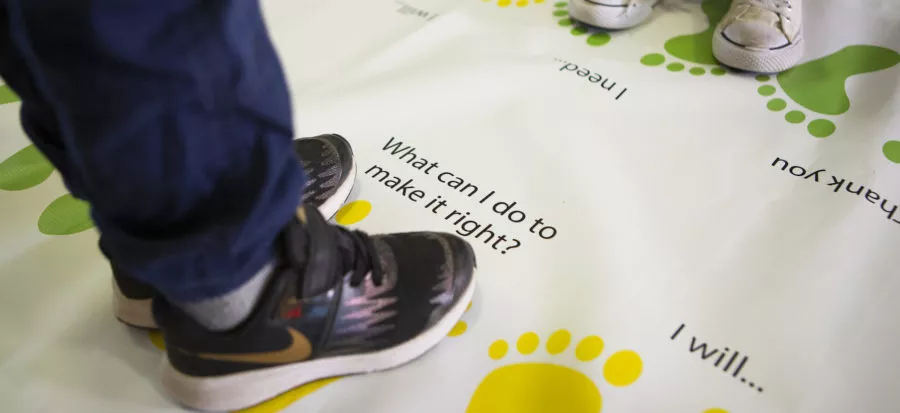
Research suggests that restorative justice practices play a positive role in school environments and are viewed favorably by educators. The goals of restorative practices are to build community and strengthen and repair relationships. However, successful implementation requires the kind of time and resources that many teachers just don't have.
In 2024, EdWeek Research Center found that 48 percent of educators said their schools or districts were using restorative practices. But a 2025 Stanford study raises a critical question: what happens when those practices aren't implemented with adequate support?
The result may be an increase in the use of what the researchers at Stanford call “informal exclusionary discipline practices.” The qualitative study found that early childhood settings in the San Francisco United School District (SFUSD) may be lowering their exclusionary discipline numbers by informally excluding students from learning time and failing to document it.
The authors define informal exclusionary discipline practices as “within-classroom, within-school, and out-of-school practices beyond formal discipline (e.g., suspensions, expulsions) that limit students' access to classroom learning opportunities in PreK-12 settings.” Basically, any time a student is excluded from learning without being formally disciplined and the exclusion being recorded. Think of sending a student into the hallway unsupervised or home from school early.
Dr. Lily Steyer, the lead author of the study, explains that this increase followed the state of California formally sanctioning SFUSD for “high rates of suspension and expulsion for Black students.”
Drawing on interviews with 63 parents, teachers, administrators, and behavior specialists, the study concludes that, “These practices occur when mandates”—like the one California gave to SFUSD—“to reduce formal discipline are not paired with resources for more restorative and developmentally appropriate behavior management approaches.”
Failure to Break the Cycle
As these informal practices are not documented, it’s hard to know how often they’re really happening. Additionally, the lines between exclusionary discipline and inclusive efforts to manage classroom behavior can blur. One example the Stanford researchers give is sending a student to the hallway, the nurse’s office, or to a “calm-down corner” if they need a moment.
On the surface, this is responsive classroom management. However, when used repeatedly and for an extended length of time, these practices exclude students from critical learning opportunities.
Steyer says that this kind of informal exclusion can “happen as a cascade over time. So initially, the child is still in the classroom, and then slowly the child is moving further and further out of the learning environment, to the point where they are no longer at school at all.”
While teachers are often forced to navigate these situations on their own, the responsibility for creating the environment that makes restorative practices possible lies in the hands of school administrators.
Additionally, the Stanford contingency found that these informal practices may disproportionately affect racially, ethnically, and economically marginalized students—exactly what exclusionary discipline bans sought to combat.
Looking Forward
With these findings in mind, the team from Stanford offers three suggestions for policymakers:
- Mandate schools to track and report informal exclusionary discipline practices.
- Adequately staff and implement high-quality non-punitive alternatives to informal and formal exclusionary discipline. Good intentions and formal discipline bans are not enough.
- Sustained, ongoing training to help educators prevent and respond to students’ behavioral needs.
Right now, data assessing how common informal disciplinary practices are used is virtually nonexistent. Without systematic data, Steyer says, “you can’t understand how severe a problem is” and then find solutions.
Additionally, staffing and training measures are especially urgent given that teachers, already stretched thin, rarely have the time or bandwidth to implement more thoughtful disciplinary approaches on their own.
On the ground level, Steyer acknowledges that educators are stuck “between a rock and a hard place,” as they “are not being provided with the resources and support, including their own mental health support, that would enable them to implement more restorative practices holistically.”
For teachers seeking to do a self-audit, Steyer recommends reviewing the different models of inclusionary and exclusionary disciplinary practices identified in the study and considering “to what extent do these types of categories or experiences resonate?”
A key piece of the puzzle is school administrators stepping up to create the conditions that ensure restorative practices can work.
However, until schools and teachers are given the data collection, staffing, training, and mental health support to properly implement restorative practices, informal exclusion—which Steyer and her colleagues describe as “adverse childhood experiences in and of themselves”—are likely to continue.