
Key Takeaways
- The cost of healthcare in the U.S. is rising dramatically, putting it out of reach for too many Americans, including educators and students.
- It’s also eating up school district budgets, making it difficult for school boards to spend money on class-size reductions, educator salaries, etc.
- The answer, many NEA members believe, is a single-payer healthcare system that would operate without CEO bonuses and huge overhead costs, putting more money into actual healthcare.
There are so many reasons that educators and their unions support single-payer healthcare systems. But chief among them? It would make students healthier and school districts wealthier.
In America today, everybody knows somebody who has seen or donated to a tragic GoFundMe to help a sister or cousin pay for their expensive Stage IV cancer treatments or their $650,000 hospital bill, notes Santa Monica, Calif., middle school teacher Shelly Ehrke. Everybody knows somebody who has hesitated to call an ambulance or cut their medication in half because of the cost.

In California, where the California Teachers Association supports a single-payer system, 1 in 3 educators report delaying or skipping healthcare procedures because of the cost. (And they have insurance!)
What’s less understood by the general public, but well known among educators and school board members, is how much the rising cost of health insurance is making students sick and unable to learn and also eating up school district budgets. Across the nation, it’s frequently why school boards can’t afford to cap class sizes, or hire more social workers or school psychologists, or even pay educators a living wage.
In Los Angeles, the school district pays $1.1 billion on healthcare premiums for its employees and their dependents. Imagine if just half of that could be spent in classrooms, educators say.
“[Single payer] just makes sense—from an educator perspective and a labor perspective,” says Ehrke, a member of California’s Educators for Single-Payer.
Labor Support for Single-Payer
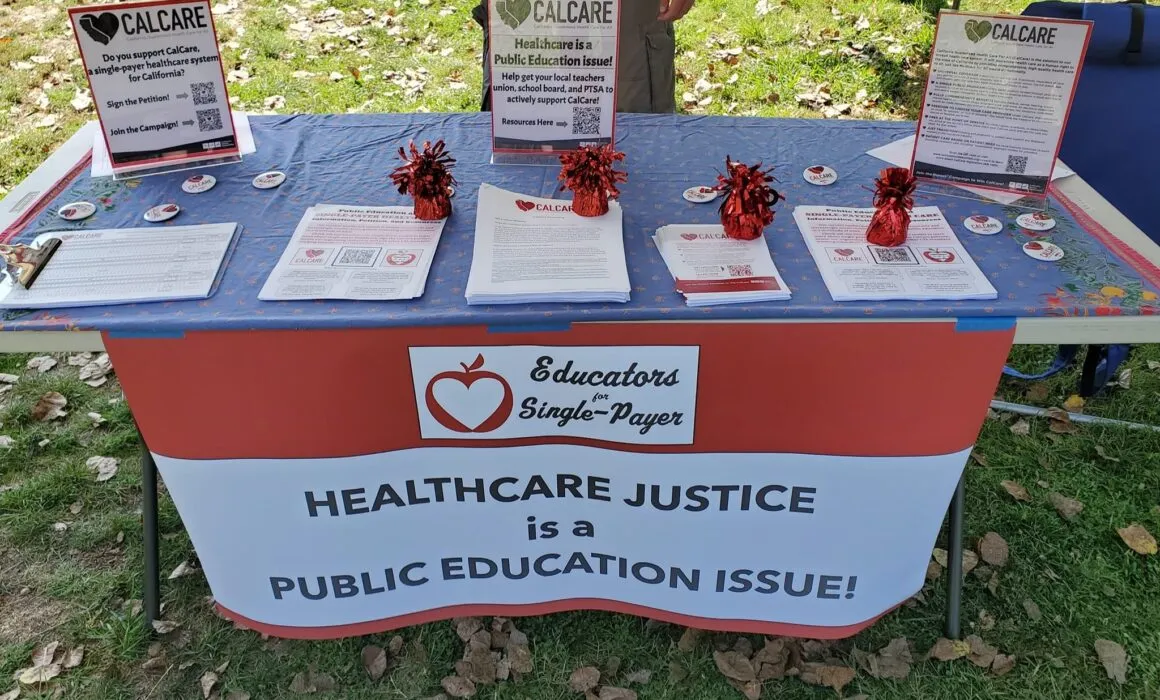
In California, the proposed single-payer system is known as “CalCare,” and it has become a litmus test among candidates for governor. If it were to pass, the nation’s most populous state would get a single-payer system — but it wouldn’t be the biggest in North America. Canada introduced a single-payer systems in 1984 and Mexico has pledged to have its up and running by 2027.
In other states, like Massachusetts, where proposed legislation has the support of the Massachusetts Teachers Association (MTA), these programs are known as “Medicare for All” plans. They aim to replace for-profit health insurance systems with more efficient, government-funded systems that provide universal care.
Since 2011, NEA has been a part of the Labor Campaign for Single Payer, at the direction of the NEA Representative Assembly, the union’s primary decision-making body.
For educators, the goals are complex. Yes, it’s about putting more money into their school systems. It’s also about the health of their students and families.
More Money on the Table
In late 2025, the members of the Burbank Teachers Association (BTA), in Southern California, passed a resolution endorsing CalCare. “Even when we get [pay] raises, they’re eaten up by healthcare increases,” says Sarah Schwartz, third-grade teacher and BTA president.
Under the current system, Schwartz pays $1,375 a month for her HMO plan, which covers her, her husband, and her daughter. Many of her Burbank colleagues pay $1800 a month for a PPO plan—plus the costs of co-pays and deductibles.
“What compelled us [to pass the resolution] really was that this is a broken system,” says Schwartz. “These insurance companies are making all of this money, but we’re not getting raises and we’re continuing to pay more out of pocket.”
In 2024, United HealthCare’s revenues grew to $400.3 billion and its CEO was paid more than $25 million. And much of what we pay to these companies in premiums—about $2,500, on average, per person—goes toward administrative overhead, according to a 2020 study. That’s more than four times the cost per person in Canada for their single-payer system.
Meanwhile, Medicare—the United States’ single-payer system for the elderly—is remarkably efficient, advocates note. Only about 1 to 2 cents of every $1 in Medicare funds goes to administrative overhead.
If school districts weren’t pouring all this money into corporate profits and CEO pay, notes Schwartz, “we could have competitive salaries and the programs that our community wants and deserves.”
In Ehrke’s small district, Santa Monica-Malibu Unified, the school board spent $24 million on healthcare benefits last year. It amounted to about 30 cents of every dollar spent by the district, she notes.
“[These companies] are basically stealing from our students,” she says.
Single-Payer, By the Numbers
Many NEA members come to support single-payer systems after traveling abroad (and paying pennies for high-quality emergency care in, say, Australia) or after some personal experience with American healthcare. Ehrke, for example, woke up after surgery with an $18,000 bill, after her in-network surgeon called in an out-of-network colleague to consult over Ehrke’s unconscious body.
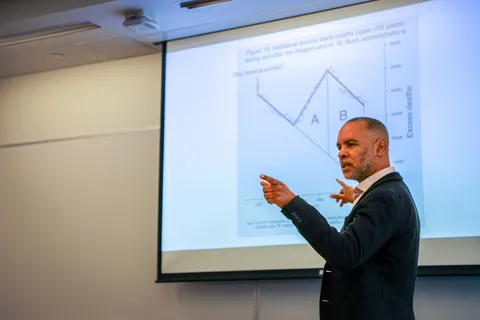
But Dean Robinson, a political science professor at University of Massachusetts Amherst who serves on the state’s Group Insurance Commission, came to be a supporter through his academic study of the issue. For more than 20 years, the focus of Robinson’s teaching and research has been health policy, including single-payer systems.
Recently, he has seen a crisis mounting. “And definitely there is interest in doing something about it.”
For people on state marketplace plans, which the White House stopped subsidizing this year, premiums are likely to increase by 26 percent in 2026, according to Kaiser. For people on employer-sponsored plans, the estimated increase is around 10 percent.
The current “Medicare for All” bill in Massachusetts, which has MTA’s support, would fund a single-payer system through a payroll tax. It has the potential to transform school districts’ budgets, says Robinson.
In urban Springfield, Mass., which spends $65 million on healthcare premiums, a switch to “Medicare for All” would save $9.6 million, Robinson estimates—and fund 128 new educator positions.
In suburban Brockton, it would pay for 87 educators.
“These are real values, based on real data,” says Robinson.
For individual taxpayers, it additionally would mean about $9,255 in savings, per year, for a household with a $75,000 income, he calculates.
Across the nation, the U.S. spends more than twice as much on healthcare, per person, as Canada, notes Robinson, “and they’re providing universal healthcare!”
“Just imagine what we could do this money,” says Robinson. “In Canada, they have better-paid family leave, much cheaper higher education, heavily subsidized childcare. It’s not a perfect system, but ours is so costly.”
Supporting Single-Payer, Supporting Students
Los Angeles social studies teacher Bryant Odega knows the numbers—he also sees the faces in his classroom. “Our students get sick and they still come to school. Their parents get sick and they still go to work,” says Odega, a social-studies teacher in Los Angeles.

In his community, where families work multiple low-wage jobs and often go without insurance, the “emergency room is our healthcare plan,” he says. Research shows that low-income and people of color are more likely to have asthma, to be diabetic, to have chronic illnesses and it’s not because their bodies are different—“this is the result of policy choices,” says Odega. These choices have consequences in his classroom, where “it’s hard to be imaginative when you’re in pain. It’s hard to be a critical thinker when your nose is congested and you feel miserable,” he notes.
Odega’s support for single-payer systems is inextricable from his support for his students. “This is definitely an education issue,” he promises. “My students aren’t just bodies on the seat, but actual human beings who live in a society that claims, on surface, to care about children, but in practice really [doesn’t]. Because if [society] did, [it] would make sure they’d have universal access to healthcare.”