
Key Takeaways
- Across the country, more than 314,000 minors were legally married between 2000 and 2021. Most were 16 or older, but some were just 10 years old.
- Child marriage--which is considered human trafficking by the United Nations and the National Education Association--makes minors incredibly vulnerable because they do not have the same legal rights as an adult.
- Educators from NEA's Women's Caucus are speaking out to educate others about the dangers of child marriage and what we can do about it.
More than 20 years ago, Carol Yanity was a freshly minted teacher working with 8th-graders at a junior high school in Harrisburg, Pennsylvania. The school year was humming along until the third quarter, when one of her strongest students started racking up absences and her grades started to slip.
“We reached out to her family, and they told us that her grades didn’t matter because she was going to get married soon and more than likely withdraw from school,” Yanity recalls. “To me, it was heart-wrenching because she was so intelligent and such a leader in the class.”
“And she was only 14 or 15 years old.”
The girl’s grades were so strong, she qualified to move on to 9th grade even though she missed the final weeks of 8th grade. But when Yanity checked the following year, the girl was not enrolled in high school.
This wouldn’t be the last time that Yanity and her husband, also a teacher, would see young teen girls drop out of school to get married. Across the country, more than 314,000 minors were legally married between 2000 and 2021. Some of them were just 10 years old, according to research conducted by Unchained at Last, a nonprofit dedicated to ending forced and child marriage in the United States.
The vast majority of minors who marry are girls—86 percent, says Unchained at Last—and most were wed to adult men an average of four years their senior.
“In many cases the marriage legitimizes what would otherwise be considered statutory rape,” says Debra Sheehan, a retired educator from California. “I think of California as having a lot of progressive laws, but I was horrified to learn that it is one of the four worst states in terms of child marriage—there is no minimum age for marriage here,” she says.
Sheehan and Yanity are both members of the NEA Women’s Caucus, where they learned about the realities of child marriage in the United States.
“We want our fellow educators to know that this is going on right here in America,” says Sheehan. “As educators, we can’t turn our heads and ignore it.”
Dangerous Conditions Ahead
Youth under the age of 18 enter a perilous situation when they are wed.
In fact, child marriage is considered a human rights violation because the child is legally under the age of consent, explains Maureen N. Eke, an English professor at Central Michigan University and a member of NEA’s Women’s Caucus.
“Child marriage is a traumatic experience that robs the child of human rights, dignity, education, and future well-being,” says Eke.
“Moreover, the child has no legal protection. For instance, if the child tries to escape or flee from the marriage, they are often returned to the adult spouse.”
Minors do not have all the legal rights of an adult—including the right to enter a legal contract on their own. That means they cannot obtain a credit card, sign a contract, consent to medical treatment, engage a lawyer, or get divorced.
Even if a minor is suffering abuse from a spouse, she often cannot access any community resources for help. An unaccompanied minor would typically be turned away from a domestic violence shelter, for example. Minors who leave home are considered runaways—they can be charged with an offense, but most often they are simply returned to their abusers.
The child’s parents no longer have legal custody of a married child, meaning they no longer have the right to decide where the child lives and can’t make decisions about the child’s education or medical care—all of those rights lie in the hands of the spouse.
Often, child marriage leads to forced parenthood that child brides are not ready for, which can harm their physical and mental health.
And there is no question that early marriage puts a child’s education at risk.
50%
Females who marry before age nineteen are fifty percent more likely to drop out of high school than their unmarried counterparts, and four times less likely to complete college, according to a 2020 study from the International Center for Research on Women.
Those who marry before age 16 are also more than 30 percent more likely to live in poverty, the research shows.
“A lot of people think child marriage is really only a problem in developing nations or places far from here, but that’s not true at all,” says Debra Sheehan, who raised this issue with delegates to the 2025 NEA Representative Assembly in Portland, Oreg.
“We aren’t going to be able to change any of this if we are in denial that it is a problem in the United States, too.”
Progress in Ending Child Marriage
Carol Yanity still wonders what happened to the promising young girl who vanished from her classroom decades ago. But at least she knows that same scenario won’t play out again.
Pennsylvania banned child marriage in 2020 with no exceptions. That means that no one under the age of 18 can get married in the state. The bill passed the Pennsylvania House and Senate unanimously and then-Gov. Wolf promptly signed it into law, making Pennsylvania the third state to ban child marriage, following Delaware and New Jersey.
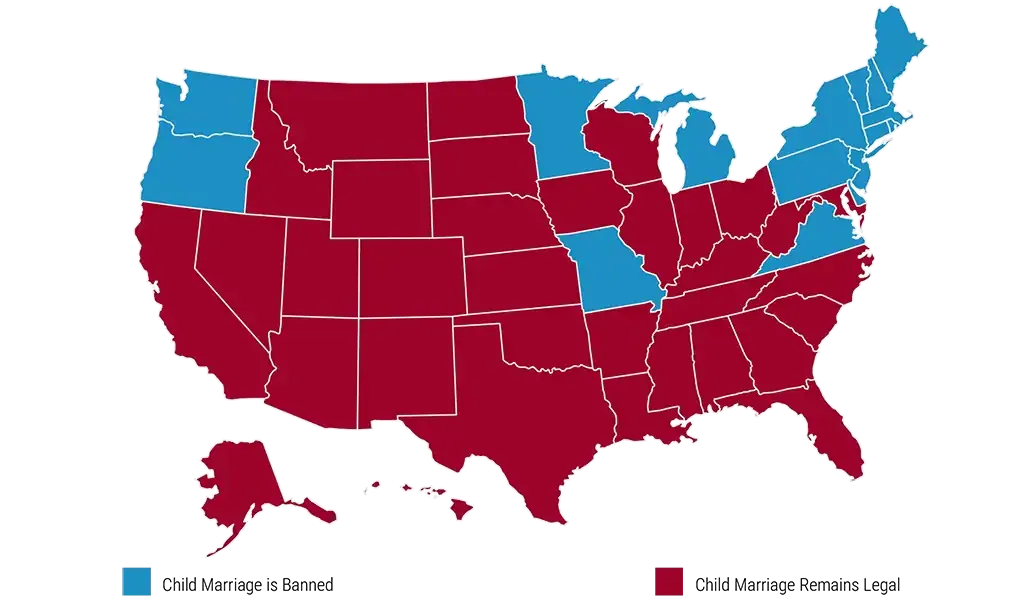
There is no federal law banning child marriage, and only 16 states plus the District of Columbia have passed laws that prohibit child marriage.
The U.S. signed on to a global effort spearheaded by the United Nations to end child marriage by 2030. But it is extremely unlikely that the remaining 34 states will introduce and pass laws to end child marriage in America in the next four years.
Researchers have found that Americans don’t have a common understanding of what child marriage is, and the majority of those who participated in the 2020 survey believe it has already been banned nationwide, which is not the case.
Educators who live in states that still allow child marriage can take important steps to raise awareness and advocate for change. Speaking to your union colleagues about the issue and reaching out to the people who represent you in the state legislature is the place to start.
And if you currently teach a student who is soon to be married, “one of the best things you can do is advocate for her to finish school or get a GED before her they become wives and mothers,” says Carol Yannity. “It will always benefit these girls to have a diploma.”