Years ago, University of Tennessee at Martin (UT Martin) Professor Clinton Smith was presenting at a conference on principles of behavior and illustrating those facts and findings with his colorful experiences as a middle-school teacher. Conference participants told him, “We want more Clinton stories!”
Today, Smith is NEA’s 2026 Higher Educator of the Year, an annual award presented to a NEA Higher Ed member whose outstanding, student-based professional practice, labor-based advocacy, and community participation sets them apart. The $10,000 award, funded by the NEA Foundation, will be presented to Smith at the NEA Representative Assembly in Denver in early July.
Recently, Smith sat down with NEA Today. Here are some facts—and “Clinton stories”—about NEA’s Higher Educator of the Year.
Fact #1: As a professor of special education, Smith's UT students are the state’s future special-ed teachers, and they learn from him “how to change outcomes for the most vulnerable students,” notes Amanda Batts, a UT Martin associate professor who recommended Smith for NEA's award. Before Smith came to higher education, he taught students with disabilities—kids who had been mostly written off—at Shadowlawn Middle School, in Arlington, Tenn., a small town in southwestern Tennessee.
Story #1: “In October 2011, when I was wrapping up my doctorate, UT Martin contacted me and said, ‘hey, we got your vitae through the honor society.’” The university was looking for a professor of special education. Smith interviewed and, 24 hours later, got offered and accepted the job. “That usually doesn’t happen in higher ed!” Smith was still teaching middle school—and committed to seeing his students through the school year—so he started teaching college students on Saturdays. Smith’s real-life stories from his K12 classroom became a regular feature of his college classes. “I still use my stories to make connections, build relationships.” Regardless of the level, “[Relationships] are what teaching is all about,” he says.
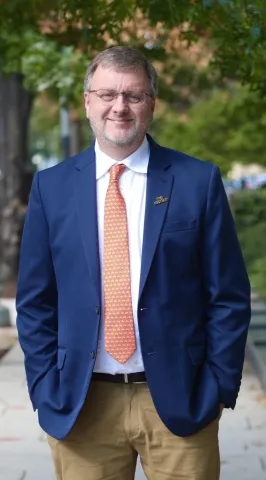
Fact #2: The life of a professor is a mix of teaching, research, and “service.” Smith has been a teacher and mentor for decades, “cultivating a learning environment that is both rigorous and deeply supportive,” notes Tennessee Education Association President Tanya T. Coats. He’s also an accomplished education researcher with 19 journal articles, four book chapters, and more than five dozen international and national peer-reviewed presentations to his name. (His research into students with disabilities during the COVID pandemic gave voice to students who were being left behind in the chaos.)
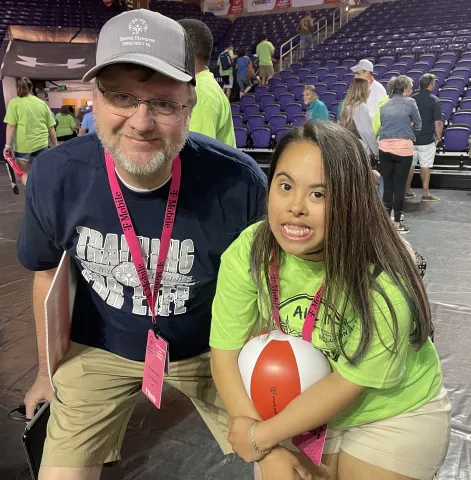
But it’s Smith’s service to his colleagues and community that runs exceptionally deep and is “woven into everything he does,” writes Batts. Consider his work with Special Olympics, which has spanned on-the-field and behind-the-scenes volunteer work for more than 30 years and includes two stints as the Team Tennessee coach at the National Games for Special Olympics. (And he still coaches middle-school basketball, too!)
Story #2: “I had a student with autism, didn’t talk a whole lot, sat in class and made little paper people,” recalls Smith. “I got him engaged in Special Olympics and, in 2010, he got chosen for USA Games in track and field. His parents were going too and wanted him to stay with them in the hotel, but I said, ‘why don’t you let him stay for a few nights in the dorm and see how it goes?’ Five hours later, he’s walking up and down the dorm hallway, talking to everybody — and he hasn’t stopped since! He grew so much socially during that time. He ended up on his high school football team and made all-district, second team.” What Smith loves most about Special Olympics is this: “It focuses on kids’ strengths, not their challenges.”
Fact #3: Smith’s academic specialty? It’s the study of student behavior and the practice of improving it. “Behavior isn’t defiance, it’s communication,” he says. In 2011, Smith became a board-certified behavior analyst. Today, in addition to his teaching and scholarship, he consults with four rural Tennessee school districts that can’t afford behavior specialists, advising exhausted educators on how to develop functional behavior plans. Meanwhile, the most popular course he teaches at UT Martin is “Behavior Interventions,” a 400-level course that almost always has a waiting list. Smith taught two packed sections this spring and he’ll teach two more maxed-out classes this summer.
Story #3: “If you understand the principles of behavior, you can do pretty much anything in your classroom,” says Smith. The key to “how” is understanding the “why,” he says. “It’s as simple as A, B, C. The A is the antecedent, or trigger—what happens before the behavior. B is the behavior itself, and C is the consequence, which doesn’t mean punishment, but what the student gets as a result of the behavior. When you understand this, you can address it.” Smith loves seeing his former college students, working as teachers today. “They’ll say, ‘We talked about this in class and now I’m doing it, and it’s working!”
Fact #4: In 2025, Smith won a three-year, $387,751 “Tennessee Believes” grant from the Tennessee Department of Disability & Aging to create a post-secondary inclusion program for students with disabilities. It’s called SAIL, or Skyhawks Achieving in Life (the UT Martin mascot is the Skyhawk), and it provides a college experience to students with intellectual and developmental disabilities. Participants audit classes and intern on campus, gaining job and social skills. Too often, says Smith, students with these kinds of disabilities—the participants read at a third- or fourth-grade level—graduate from high school and have nowhere to go and nothing to do.
Story #4: “This program has been a dream of mine for like 10 years,” says Smith. “One of our students, he’s Mr. FFA [Future Farmers of America]. He’s got his own chickens, his own egg business. We’re connecting him with the ag department. Another student is a total sports nut—he’ll be interning with our sports information office and doing some social-media work in our communications department. Then we’ve got one girl who is an I-don’t-know-what-I-want-to-do, so we’ll do some inventory assessments with her… The great thing is that we have buy-in across campus.” With that kind of enthusiastic support and intervention, the program has the potential to transform lives, Smith acknowledges.
Quote byClinton Smith, NEA Higher Educator of the Year
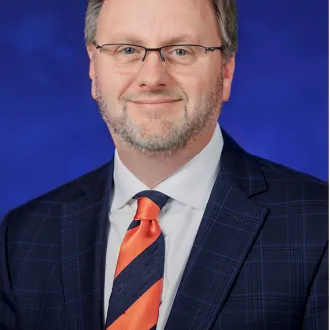
Fact #5: Twenty-three years ago, during his first days at Shadowlawn Middle, Smith went to an orientation event. The first person he ran into was Barbara Gray, who eventually became the TEA president in the mid-2010s. She asked him to join. He said yes. Since then, Smith has served in numerous association roles, including building rep, newsletter editor and more. Today, among other duties, he serves on the NEA Legislative Committee and as a member of the NEA Board of Directors and TEA Board of Directors, while also chairing NEA’s Caucus for Educators of Exceptional Children and volunteering as a trainer for NEA’s Disability Rights Resource Training Cadre. “[Smith] believes the union is strongest when every member has a voice and knows how to use it, and he has spent his career doing exactly that,” says Batts.
Story #5: “I tell people, don’t just be a member, be a leader!” says Smith. With all of the challenges facing higher education today, faculty and staff—and their students—the future of education depends on educators understanding their power, he says. In Tennessee and elsewhere, the biggest issues are growing threats to “academic freedom and tenure,” says Smith. But, among his peers, including NEA’s National Council for Higher Education President Alec Thomson, Smith is especially recognized as “being a voice for contingent faculty,” says Thomson. Early in his career, Smith worked as a part-time faculty member, earning $2,400 a course. He sees many of his colleagues doing the same today, for the same, poverty-level wages. “Some of these people are teaching 10 or 12 courses and barely able to make a living, with no access to benefits. We need to make sure they’re getting a fair wage!” As Smith suggests, “You can’t truly fight for students without also fighting for the people who teach them.”
Quote byTanya T. Coats, President, Tennessee Education Association