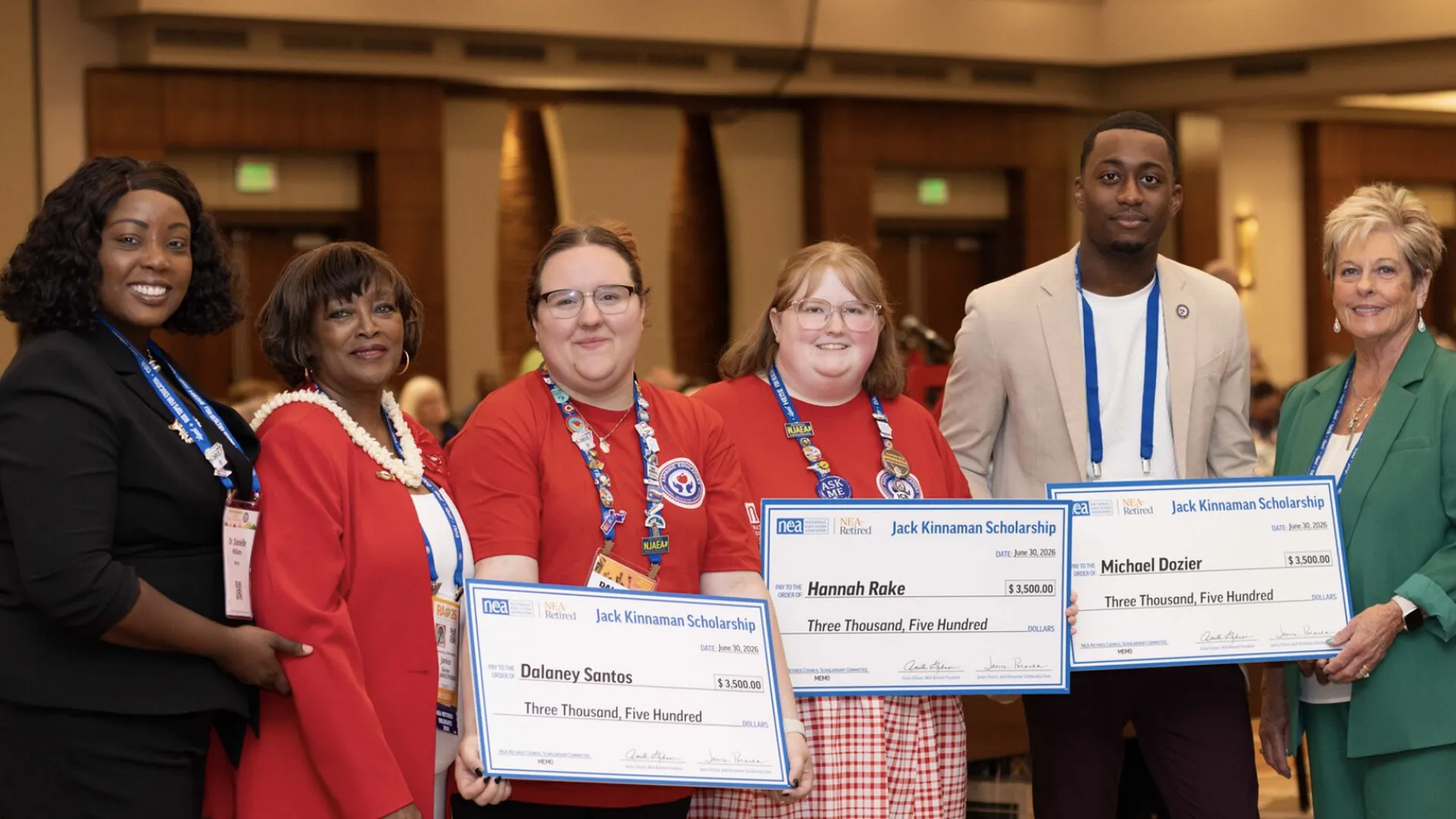
As most members of the NEA Aspiring Educators (AE) program can attest, the cost of college goes far beyond tuition. Textbooks, rent, food, transportation, and other expenses can add financial stress while aspiring teachers work toward earning their degrees. NEA-Retired members have long recognized these challenges and continued to provide support through the Jack Kinnaman Scholarship, which assists college students preparing for careers in education. Let’s meet this year’s winners!
Michael Dozier
History major with a concentration in social studies, Grambling State University, Louisiana

“Many students enter the classroom with vastly different levels of access to resources, support systems, and opportunities. …[Being] a part of the NEA Aspiring Educators program has given me the knowledge, skills, and point of view I need to…make the education system fairer and more open to everyone,” says Dozier, who serves as president of the Louisiana Association of Educators Aspiring Educators.
In this role, Dozier has engaged in national discussions on education policy and educator advocacy. Additionally, Dozier leads Grambling’s Call Me Mister program, which works toward recruiting, retaining, and mentoring men of color, especially Black men, to teach in elementary and middle schools.
Kamryn McCutcheon
Elementary Education with a concentration in Pre-Kindergarten to 3rd Grade and 3rd Grade to 6th Grade, University of Michigan, Dearborn

To collaborate with others who care deeply about equity can take many forms. For McCutcheon, that came to life when she helped secure a grant for her campus chapter—Aspiring Educators of Michigan (AEM) chapter at the University of Michigan, Dearborn— which allowed the group to partner with a local elementary school and purchase over $1,200 worth of books.
“That project opened my eyes to how something as simple as access to books can shape a child’s relationship with reading. It also showed me that educators have the power to make tangible change when we work together and stay focused on what students need,” says McCutcheon, who serves as vice president of the AEM at her university.
Hannah Rake
Early Childhood and Elementary Education major, Pennsylvania Western University, Clarion

Before even stepping into her first classroom, Rake is already thinking about one of education’s biggest challenges: The teacher shortages and what they mean for educators, students, and the future of public education. Her involvement in the AE program, particularly her leadership within Student Pennsylvania State Education Association, has prepared her to address these challenges. Rake, for example, collaborated with multiple universities and over twenty school districts to introduce high school students to the teaching profession and encourage the development of Educators Rising chapters.
“Witnessing students become excited about the possibility of becoming educators reaffirmed my belief in the importance of Grow Your Own initiatives as a sustainable solution to the shortage.
Delaney Santos
Elementary education major, with a concentration in ELED certification and minor in political science, Northeastern State University, Tahlequah, Oklahoma

“Because teaching has become…much more than delivering content, advocacy is more important now than ever,” says Santos, adding that some educators are supporting students who are at times in a system that lacks the resources needed to fully support them—and as a result, teachers are stretched thin. This is why Santos pairs her college course work with the NEA AE program.
“My involvement in Aspiring Educators has helped prepare me for this reality in ways my coursework alone could not. …There is something deeply comforting about being surrounded by people who just get it. They understand the pressure, the uncertainty, and the heart that come with preparing to become an educator,” she says.
Alyssa Svoboda
Early Childhood Education major, with a concentration in Intervention Specialist, John Carroll University, University Heights, Ohio
Like most educators, Svoboda believes that all children, regardless of their ability, should be able to learn in a collaborative, supportive, and inclusive environment. However, she understands that this is not always the case. Her dedication to identifying and addressing these gaps is evident both inside and outside her college coursework. As president of her campus AE chapter, Svoboda connects with academic researchers, advocates, and education leaders at professional conferences who share her passion for this topic.
“These interactions and discussions have helped me strengthen my understanding of cooperation, planning, and ongoing professional development for a successful inclusion environment,” says Svoboda. “I consider myself a growing educator and participant in these conversations.”
How to Apply
Complete the NEA-Retired Jack Kinnaman Memorial Scholarship application online at nea.org/Kinnaman. Make sure you meet all requirements and submit a complete packet. Applications open December 1, 2026, and close April 15, 2027 at 5 p.m. EST.
