
Retired special education teacher KC Walsh started thinking about her pension a few years into her teaching career. “I might have been one of the few who did,” recalls Walsh, who lives in Oak Grove, Calif. “Teaching is an extremely hard job. You have other things on your mind, especially when you are young. But knowing that there was some security at the end my career helped keep me in the profession.”
Walsh has been a longtime advocate for the California State Teachers Retirement System (CalSTRS)—a defined benefit pensions (DB) plan and the second largest pension system in the United States. She and other California public school educators, current and retired, know their pension benefits are superior in value and security to what they would receive under a 401(k)-style plan.
But if some politicians and private interests have their way, these plans could be diluted, if not altogether abolished.
“Those attacks will continue,” Walsh says. “But the data about what defined benefits provide doesn’t lie.”
The pension money that you and other retirees spend generated $1.5 trillion in total economic activity, in 2022, and supported 7.1 million jobs across the nation, according to the 2025 Pensionomics report from the National Institute on Retirement Security (NIRS).
“Pensions are important to the financial security of retirees, but it doesn’t stop there,” says Dan Doonan, NIRS executive director and co-author of the report. “Spending of pension income by retirees has a giant-sized economic footprint that benefits virtually every community across the country.”
A Lifetime of Retirement Security
In a defined benefit pension plan, employers and employees contribute to a pool of funds that is invested on behalf of employees. They currently provide a critical source of secure, reliable income for 26.3 million retired Americans, and they are available to public school educators in all 49 states, save for Alaska.
Danielle Specht taught in Kodiak, Alaska, for almost 20 years until she moved to Kentucky this year. “I loved teaching in Kodiak, but my family didn’t have a secure retirement,” she says.
Specht and Alaska-NEA have been strong advocates for returning to a defined benefits system, which the state abandoned in favor of a defined contribution plan more than 20 years ago. “But nothing has changed,” Specht says. “So we really had no choice but to move.” Specht hopes to remain in education in some capacity in Kentucky.
West Virginia made the same switch away from a DB plan. But evidence mounted that many school workers faced an impoverished retirement. In a huge victory for educators, the state switched back to defined benefits in 2007.
Pensions Boost Tax Revenue
Retirees with a pension can count on steady income every month, even in volatile economic times.
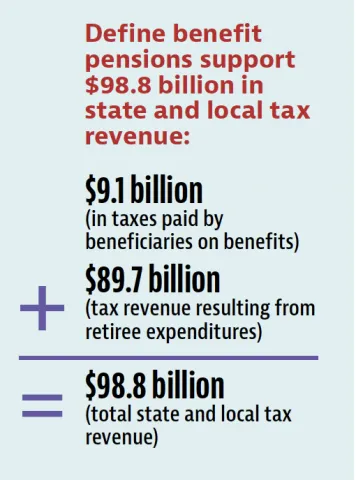
“The spending of their pension income is critical for sustaining and stabilizing consumer spending,” Doonan says. And that boosts tax revenue.
According to the Pensionomics report, pension spending added $125.5 billion in federal tax revenue and $98.8 billion in state and local tax revenue.
According to the National Conference on Public Employee Retirement Systems (NCPERS), public pensions are far from a burden for taxpayers. In fact, they are a strong revenue generator.
A 2025 report by NCPERS found that in 2023, 43 states saw a revenue gain from public pensions, a trend that has grown steadily since 2016.
“Dismantling public pensions would not reduce costs; it would impose new ones,” the authors write. “The cost of delivering the same level of public services could rise, shifting a greater burden onto taxpayers.”
Pensions Create Jobs
When you make a purchase, the money spent translates into business revenues, and that creates job opportunities in local communities and across the state and nation.
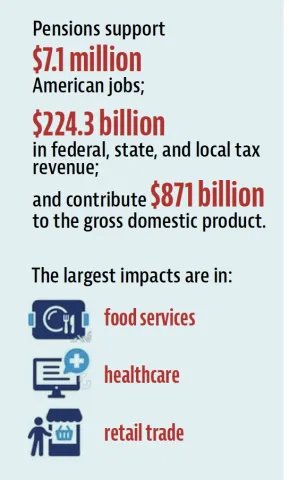
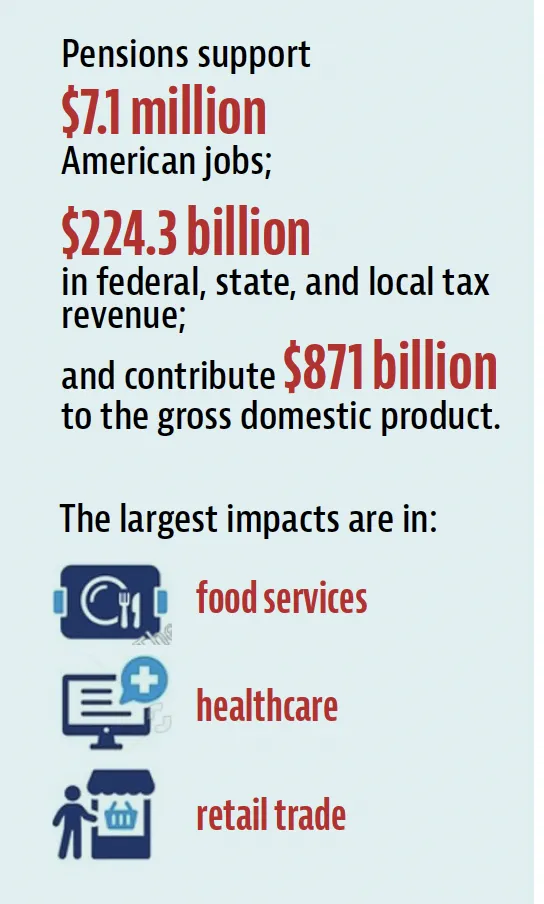
More than half of these jobs—nearly 3.9 million— were supported by state and local pension benefit expenditures. One million of these jobs were generated by federal pension expenditures.
In the private sector, single-employer plans—maintained by one company or affiliated companies, and usually negotiated with a union—supported 1.7 million jobs.
Together, jobs supported by private and public sector pensions paid out an estimated $466.2 billion in labor income (wages, salaries, and employee benefits).
For example, in California, where KC Walsh lives, state and local pension expenditures supported 397,000 jobs that paid out $28 billion in income.
The positive impact on job creation is also evident in smaller states. In Virginia, pensions supported 46,000 jobs with $2.6 billion in income.
Pensions Help Keep Educators in the Classroom
Some lawmakers and politicians argue that many teachers— younger ones especially—would prefer putting their money in a 401(k)- style program. But many states that experimented with shifting workers into these defined contribution plans found it harder to attract and retain qualified educators.
Sue Lemmo, a retired art teacher in Clearfield, Pa., says it is no coincidence that after her state legislature approved cuts to pension benefits for teachers hired after 2019 and introduced 401(k)-style offerings, the state saw a drop-off in the number of individuals seeking teaching certificates and teaching positions.
“As soon as they started moving newer teachers toward a more hybrid plan, we saw that decline,” says Lemmo, who also serves on the Pennsylvania Public School Employees’ Retirement System Board.
“Defined benefit pensions are significant and successful tools for teacher recruitment and retention.”
And this helps school districts, which are saddled with the costs of high turnover.
And it especially helps students, who benefit from more experienced and effective teachers.
Voters Support Pensions!
The American people overwhelmingly favor the secure retirement provided by pensions—especially as “affordability” has become a top concern among voters.
According to a 2024 NIRS survey, 86 percent of Americans ages 25 and older believe all workers should have access to a defined benefit pension.
The results were the same across political party lines— more than 80 percent of Democrats, Republicans, and independents voiced their support.
Respondents also strongly agreed that pensions were effective recruitment and retention tools for teachers and other public sector employees.
More than three-fourths of Americans said pensions for teachers make sense because these benefits compensate for educators’ lower pay.
A separate NIRS survey, also conducted in 2024, found that 79 percent of adults agree that there is a “retirement crisis,” and 77 percent agree that the disappearance of pensions makes it harder to achieve the American dream.
Despite this popularity and the proven positive impact that pensions have on the economy and communities, threats to defined benefit plans persists.
“Every state is different,” Lemmo says. “Some are battling bad legislation, or interference in the autonomy of pension boards, telling them they can’t invest in any companies with DEI principles.”
In her state, the focus is on getting a cost-of-living increase—the first one since 2001. In Alaska, members are advocating to return to defined benefits.
The common thread is that advocacy of current and retired educators is critical to protecting pensions.
“The first step for any member is to get in touch with your local and state organization,” Lemmo suggests. “Work with their political advocacy teams and find out what the issues are and what the threats are to your pension and retirement security.”