A New Union Voice in Maine
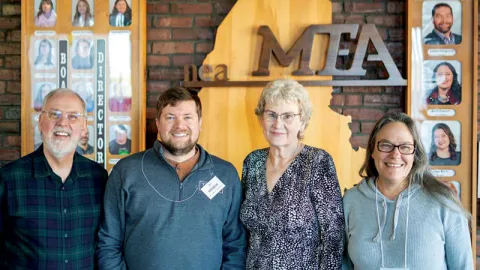
Among the latest to join our growing NEA Higher Ed family are the faculty of Thomas College, in Waterville, Maine—the first Maine Education Association members from a private college.
Their goal? To strengthen their voice in decisions impacting faculty and students.
The faculty’s unionization efforts kicked off in 2025, after college administrators began making unilateral changes to academic offerings—including changing what programs are offered to students and whether courses should be online or in-person—without consulting faculty, the people who know students best.
“We thought the faculty senate would be at least co-creating these programs,” says Jono Anzalone, a member of the faculty organizing committee. “It was like, ‘Wait a second, this doesn’t feel like a partnership!’”
Like a lot of non-unionized campuses, Thomas operated with a faculty handbook, but there was no penalty when the administration disregarded it—which they did, repeatedly, Anzalone adds.
After a vote of no-confidence in the college president, faculty moved decisively to unionize. Now their goal is to bargain a legally binding contract that protects their voices.
NEW NEA RESEARCH: How Does Your Salary Stack Up?
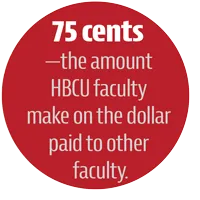
Do unionized faculty get paid more than non-union faculty? Of course! And NEA’s newly released salary report proves it.
Learn what the “HBCU pay penalty” is—for working at historically Black colleges and universities—and if
it’s growing. Find out which public university pays the most (hint: it’s in California) and how your salary stacks up against average salaries at every public institution in the U.S.
Check it out at nea.org/HEpay2026.
Standing Together: A 30% pay increase at FAMU
Grad assistants are among the worst paid employees on any campus—and the fiercest fighters for better workplace conditions. Recently, Florida A&M University-Graduate Assistants United (FAMU-GAU), a chapter of the United Faculty of Florida, bargained a new contract with a 30 percent increase to their minimum annual pay. The raise boosted their wages from $12,480 to $16,380, or from $16 to $21 per hour. They also secured $2,000 bonuses.

“It’s still not really a livable wage, but I’m happy about the changes we were able to make,” says FAMU-GAU President Sarah Reed (left). “We’re going to keep growing and getting stronger—and fighting for better pay and better rights.”
Harrisburg’s Union Lands the Plane
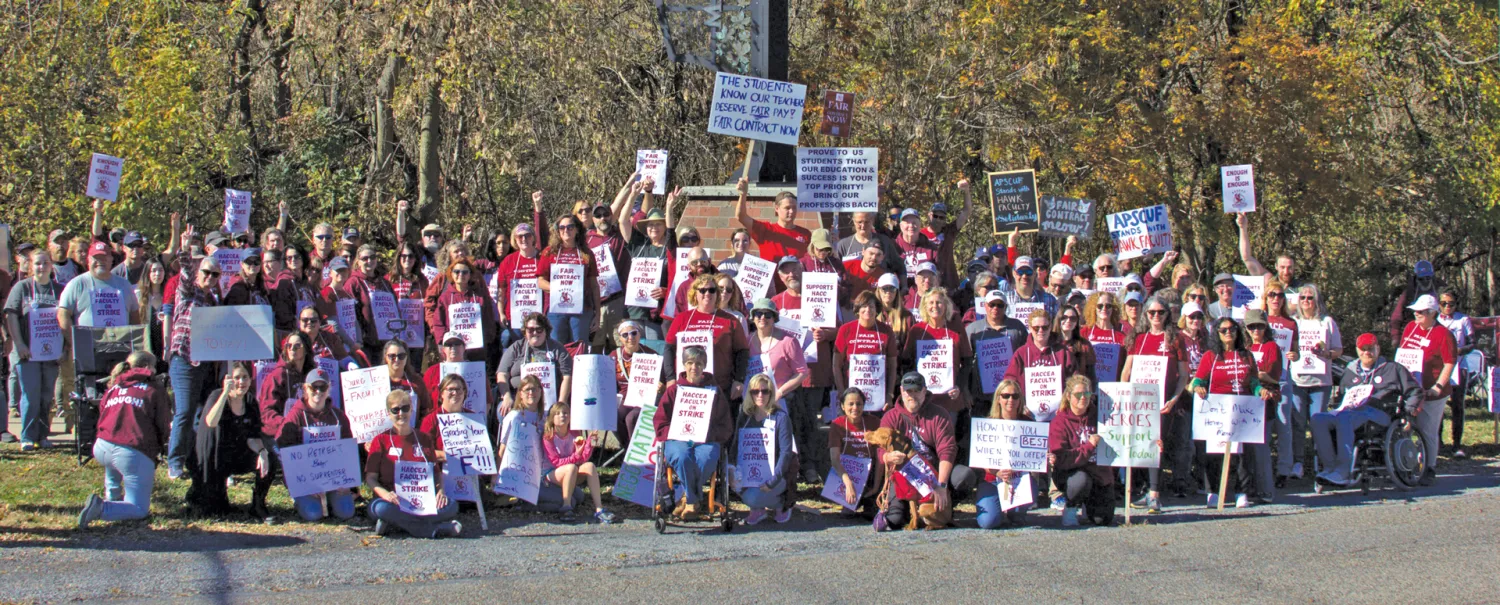
It’s been a long, hard trip, but faculty at Pennsylvania’s Harrisburg Area Community College (HACC) finally have a contract!
After unionizing in 2022, HACC faculty worked for more than three years to get a contract. Over those years, union members learned some hard truths, says union president Christine Nowik. The chief lesson? Higher education is part of the corporate landscape, Nowik says, “and we [faculty] are the Starbucks baristas.”
For too long, HACC administrators have ignored the principles of shared governance, refusing to collaborate with faculty, union leaders said.
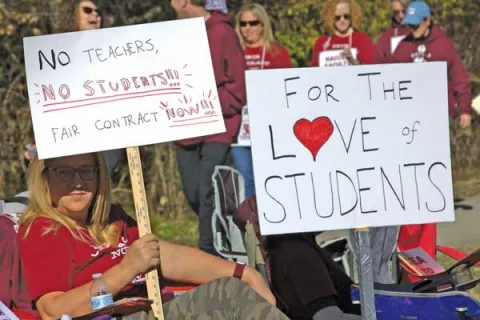
Why unionize?
The final straw that pushed HACC faculty to unionize occurred in 2019, when HACC administrators suddenly terminated 20 mental health counselors without clear reasons.
“Even though we had a shared governance policy at that time, the policy was a little too vague,” says Amy Withrow, the union’s chief negotiator. “We could point to the policy, and [administration] was like, ‘Okay, thanks for pointing that out—now, we’ll do what we want to do.’” Without a legally binding contract, faculty had no means to protect their colleagues.
At the bargaining table, the union’s priority was to secure a clear, fair process for faculty retrenchment. While administrators pushed for language that would have enabled them to fire union members for vague “good-faith reasons,” the union held firm. “What exactly are ‘good faith reasons?’” Withrow questions.
Negotiations dragged. Nowik recalls: “I told Amy, ‘We’re going to land this plane someday. There might be vomit on the seats, but we’re going to land it!”
In the end, the union won “very clear language and nine months’ notice,” Withrow says. “We just wanted fairness—and it’s fair for management, too,” she adds.
Additionally, the union secured a salary schedule and course caps, making them predictable..
HACC faculty and staff went from having a “foundation of sand,” Withrow says, “to a firm foundation that we can use to build the next phase of HACC.”
How We Fight Back
For NEA Higher Ed members who experience adversarial negotiations, Christine Nowik, union president at Pennsylvania’s Harrisburg Area Community College (HACC), offers this advice:
- Understand your unique strength. If you’re an educator, be an educator and explain your issues to constituents, including students. HACC’s union made use of informational, online videos.
- Recognize that all workers, including faculty, are up against the same ubiquitous forces. “Understand that we’re fighting corporate power, and we need to understand corporate logic and mindset,” Nowik says.
- In the current political climate, Nowik adds, “organizing is the only power we have right now to preserve our public entities. Collective power is the only power.” Reach out to other unions, including local K–12 unions, she urges.