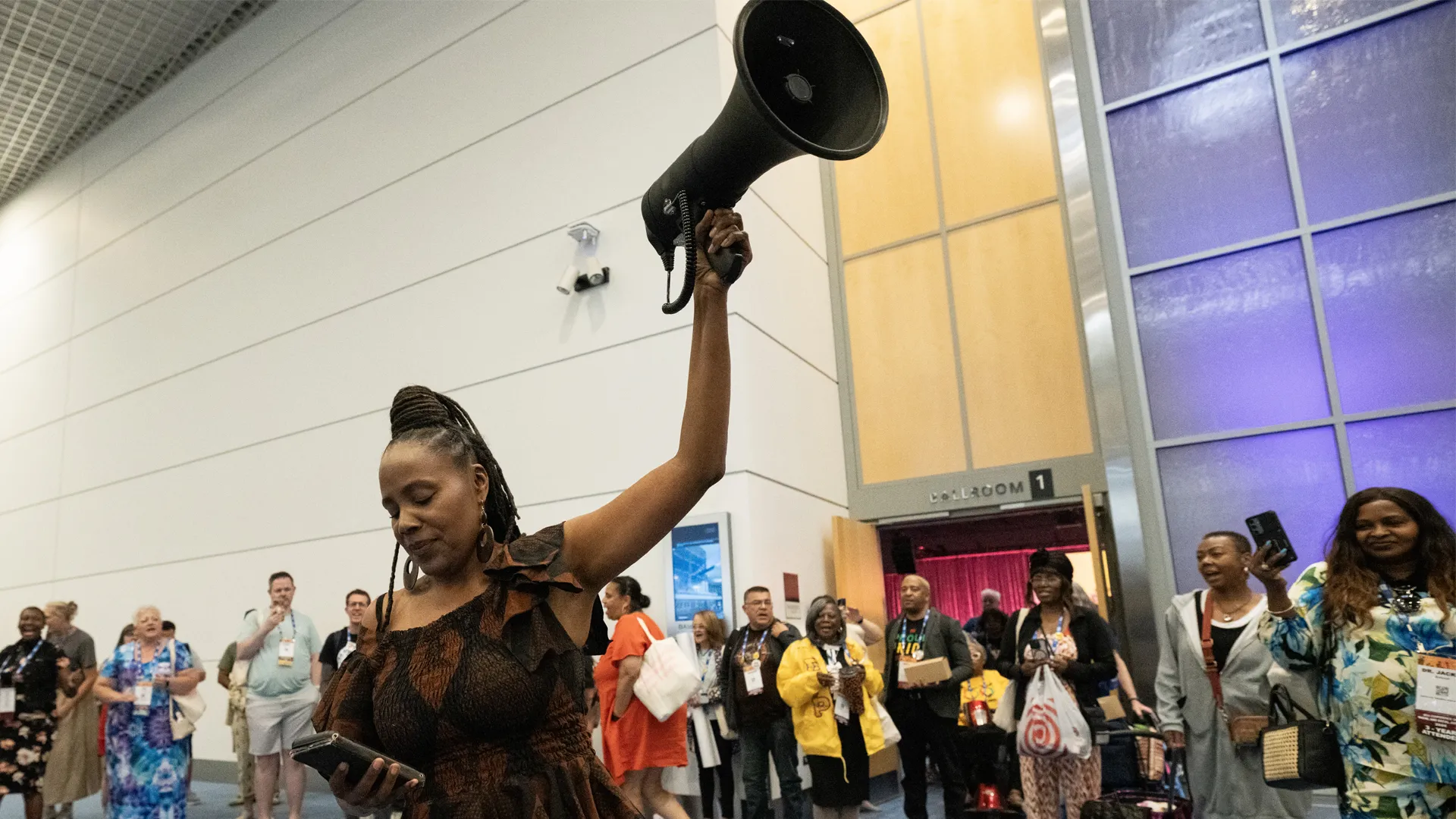
Before the organizing, healing, and defending public education began, educators arriving at this year’s NEA Conference on Racial and Social Justice, in Denver, were already talking about what they hoped to learn and how they could turn those lessons into action in their schools and communities.
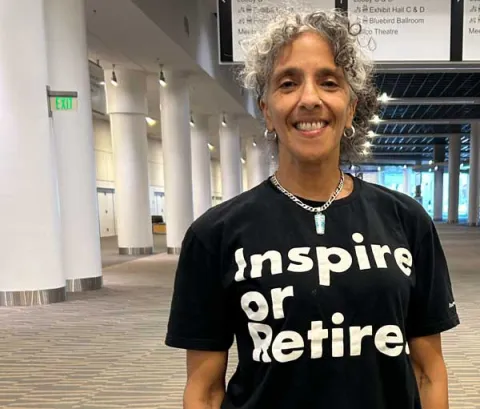
For Gillian Van Delft, a Massachusetts elementary school social worker, the answer wasn’t professional development. It was restoration.
She works in a district where she is one of only a few People of Color. After years of navigating spaces where she often feels isolated, she says the conference offers something harder to find than classroom strategies.
“Community,” she says. “To be re-energized and restored.”
For Van Delft, though, the reason for coming also runs much deeper.
“It’s been an entire lifetime of having to fight for your humanity. It’s stressful,” she says, describing the emotional toll of navigating decades of attacks on the rights, dignity, and belonging of People of Color and other marginalized communities.
At 57, she has watched decades of movements rise and stall. Her parents were active in the labor and civil rights movements, and she says the cycle can be exhausting.
“But you remember why you’re doing it,” she says of returning to the NEA’s Conference each year. “Restore and then bring back [home] anything I can.”
The moment demands unity
This year’s conference, held alongside the NEA Representative Assembly, brought educators from across the country to Denver for workshops on topics ranging from combating authoritarianism and protecting immigrant students to educator wellness and movement-building.
These sessions mirrored the urgency of the moment.
“During this season of injustice—created and curated by authoritarians and billionaires’ intent on achieving total power … we understand their ultimate goal: To make us dismayed and divided; afraid and alone; exhausted and eventually erased,” said NEA President Becky Pringle.
She encouraged educators, however, to “use your light and your leadership … your vision, your wisdom, and your commitment to fight forward as one … and use joy as a tool as resistance, defiance, and resilience.”
A path to collective action
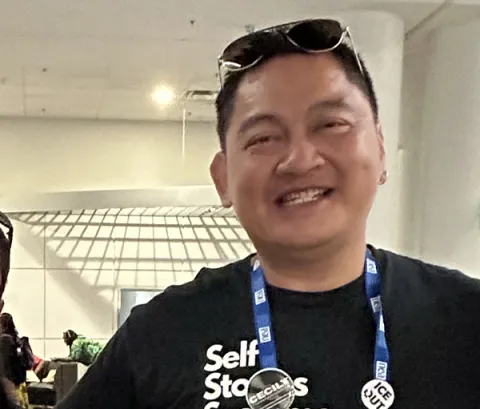
For Phiasivongsa Augustus, a restorative justice resource teacher and former history teacher from San Diego, the conference is a chance to move beyond outrage toward action.
“We live in a pivotal moment in history,” he says, pointing to attacks on voting rights, LGBTQ+ communities, and immigrant populations, as well as conflicts overseas.
He asks: “What do we do? How can we organize? How can we get together and fight back beyond protesting?”
Augustus says he came to the conference looking for practical answers—ways educators can build collective power instead of responding to one crisis at time.
“When you meet other people, you’re like, ‘Hey, you know what? I’m not alone,” he says. “There are possibilities and hope.”
A broader understanding
For Cherie Feemster, a member of the North Carolina Association of Educators and former classroom teacher turned administrator, the conference offered an opportunity to broaden her perspective so she could better serve her school community.
She said one of the greatest challenges isn’t so much disagreement—it’s a lack of understanding.
“A lot of times nobody wants to understand what it means to be different,” she says, adding that people tend to focus on their own experiences.
However, she says that the conference offers a space for educators to discuss “what it means to be different, included, or stand out.”
She hopes the conversations in Denver will help her return home with a wider lens on diversity and inclusion, which she can then share with colleagues and students.
A sense of community
Others came looking for ideas they can bring home and use immediately. Vinita Rajah, a speech-language pathologist with the San Diego Unified School District a first –time attendee, says colleagues had spent the previous year telling her she needed to experience the conference herself.
She found inspiration almost immediately while watching “Precious Knowledge,” a documentary about the fight to preserve Mexican American studies in Arizona schools that was featured as part of the conference’s film festival.
“There were so many moments where I just wanted to pause [the film] and talk about what we had just seen,” she says, recalling a scene in which students sought permission to run across tribal land before elders and other community members joined them.
“It was so beautiful,” Rajah says, “and that’s what this is about: We see each other, we support each other, and we come together.”
A commitment to justice
Despite their different backgrounds, educators returned repeatedly to one idea: Racial and social justice work is inseparable from education.
“We have every kind of student in our classroom,” says Andrea Romero, a California elementary music teacher. “We have to be able to serve all of them, and that requires understanding histories of segregation and discrimination in America.”