Would a public school teacher who receives a 10 percent raise one year be more likely than not to stay at their school? Probably. Salary always matters. But it's likely not the only factor in the decision. In fact, the conditions that support teacher retention are not necessarily tied to pay, according to Douglas B. Larkin and Suzanne Poole Patzelt.
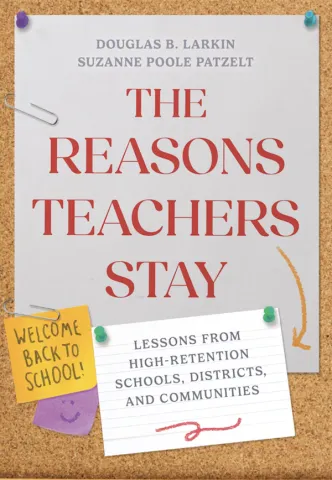
In their new book, The Reasons Teachers Stay (Harvard University Press) Larkin and Patzelt draw on a six-year study examining school districts with high retention rates to determine what has been working in those communities. NEA Today recently spoke with Larkin and Patzelt, both former K-12 public school teachers, about their findings.
Initially, the study was to have a much narrower focus. How did it evolve into a more expansive look at teacher retention?
Douglas Larkin: Our question was primarily around supporting new teachers and some of the inductions and mentoring programs that were working. That’s where this started. And the National Science Foundation, who funded the work, did ask us to also look at salary as a retention factor. As you know, there has been a lot written, especially from the NEA perspective, about fair teacher salaries and making sure teachers are compensated as professionals. So looking at pay seemed like an easy lift.
Fast forward six years, and we found out why teachers stay in the profession was much more complicated than that. So what started out essentially as a mentoring story, as a pay story, turned into something a much more comprehensive.
What did you find out about pay in the districts you looked at?
DL: What we ended up finding was that teachers wanted to be paid fairly. Teachers wanted to look around them and say, yeah, we're being paid a fair rate and this is worth staying. Now, what it means to be paid fairly in a highly-unionized state like New Jersey is very different than what it means to be paid fairly in North Carolina, where the legislature sets the salary guide for the whole state. But a sense of fairness is what they responded to. You know, we’re doing ok.
Suzanne Poole Patzelt: I think one of the big takeaways is that we can't just point to one factor and say this is the reason, right? Even if maybe the teachers we talked to did perceive they weren't being paid the best salary in the world, it wasn't the only thing that they considered. It really is a mix of these different things, which is what the book tries to highlight.
You organize a lot of your findings around what you call the “teacher embeddedness” framework.
DL: Right. We used that because we were dissatisfied with the framework of job satisfaction, which is still very common. There are some satisfied teachers who leave, and there are teachers who are not satisfied at all but stay because they kind of have to for lots of reasons. And so job satisfaction doesn't really go very far in explaining why teachers stay and why they don't. It didn't really fit.
"Teacher embeddedness" is a more specific framework than “job embeddedness,” which comes from researchers at the University of Washington to help explain the factors that determine whether an employee stays.
We took that framework, focused it on teachers and looked at the assets in their work. What does a teacher have? What do they value about their job? Who do they have relationships with? What are those things that they would give up if they left? The framework really helped us draw connections between these very different contexts we saw in different districts.
You looked at six districts in six states that had solid teacher retention rates. What was the one condition that rose to the top across these different districts?
SP: Without fail, no matter where we went, whether it was rural or urban, whether it was North Carolina, Wisconsin, Colorado, or Pennsylvania—over and over again, we heard that it was the people that teachers worked with. It was the relationships they were able to build. That's why they stayed.
So, maybe they got hired in like a cohort of folks, and they were able to build their sense of belonging together, or they went into a new building and just felt welcomed by the department. Sometimes you go to a new school and people are hiding resources and not sharing materials. What we learned about these districts we looked at, was that people were welcoming and were very willing to share their knowledge, to just open their doors to make people feel like they would be welcomed in the building. There was collaboration and a real sense of kinship.

So a feature of these schools was, as you put it in the book, a “real lack of teacher isolation.”
DL: Absolutely. There wasn't one specific solution, but it was dependent on factors such as, do teachers share a common space? Do they have the time to collaborate? Do they have the opportunity to eat lunch together? There are all sorts of different structures. Some of them were related to mentoring and induction. For example, teachers were mentors to novice teachers. This happens in a lot of places, but is there a real structure behind it?
You mentioned teachers having the time to work with colleagues. What else did they say about autonomy?
SP: Teachers didn't feel micromanaged. There was no “gotcha” at these schools. They felt that even with observations, it was really about feeling supported. They had flexibility in their teaching decisions, which we were surprised to hear. We also use the term ‘agency’ in the book—having a voice in what happens in your building, in school decision-making, including questions over new hires. We saw that as well.
Quote byTeacher from the Granite School District (PA), interviewed in “The Reasons Teachers Stay”
Also, teachers had planning time and professional development that were teacher-led. So overall, they felt they were treated like professionals. They were supported and valued for their knowledge that they have as teachers. They weren't seen as sort of caregivers, where they are told “this is what you have to do because you wouldn't know what to do otherwise.”
DL: And it's not just autonomy; it's that lack of surveillance. I was talking to a teacher from Georgia the other day, and all those classrooms in their district have live cameras in them. Think about the difference between those classrooms. In one, there's an administrator who at any point in the day can hit a button and look inside their classroom. In the other, the administrator says, “you're a professional, I trust you to do a good job.” That sends two very different messages, and for the teachers who stayed in our study, they really valued that autonomy.
Teachers of color often have different experiences than white teachers. What helps teachers of color stay?
DL: They do have different experiences and the administrators in schools in three of the districts—one was primarily Native American and the other two African American—that we looked at seemed to recognize that.
One district, and the administration confirmed this, was sort of like a district-wide HBCU. They had a different ethos and a shared sense of purpose, which was markedly different than the other districts that we visited. And they made it a priority to hire administrators of color.
Teachers of color didn’t encounter what Doris Santoro, Albert Morales and Julia Hazel in their study of Portland public schools in Maine call the “smog of racism” and the “impenetrable wall of whiteness.” This was a study about listening to teachers of color and responding to them at the district level. So we saw that the administrators in particular, were the ones who set the tone for the for those districts. School was like home. This was a kinship, which was a very strong pull for the teachers there.
SP: There were a couple of districts that had students of color but not necessarily a lot of teachers of color. And not everyone was doing a great job. But even some of those schools had a level of race consciousness to keep themselves and their teachers educated about challenges teachers of color face and how they could best support students of color. They told us their building wanted them to succeed and that was a reason why they wanted to be there.
Race consciousness, collaboration, autonomy and agency, collegial relationships—all of this doesn't just happen and at least some sound like low-hanging fruit, right? So what did the teachers you interviewed say about how these conditions were put into practice?
DL: Well, one of the factors that came up was people would say, ‘we have a strong union.’ Think about what a union does in a building. It's not just a teacher going to a union when they have a problem. I've been a union leader. I've been a strike captain. I know what it means to organize. When you are linking with other teachers, when you're building relationships, there's so much there that's similar to organizing.
Not everything is reproducible. The things that are reproducible are, for example, giving teachers the time to interact with one another—and not just when there's an immediate problem to solve, right? If we only bring teachers together when there's a critical problem, the relationships to solve those problems are not always there. And are we building a culture of support?
So, there is low-hanging fruit. We see it all the time. And we just wonder why nobody's picking it, because it’s so easy to treat people as professionals.