Key Takeaways
- Higher salaries are a key factor in recruiting and retaining educators, but the decision to stay in the profession can largely depend on the quality of their daily work lives and working conditions.
- According to teacher surveys, the top sources of job-related stress are student behavior, low pay, long hours, and excessive administrative work.
- "In a climate where large salary increases may be unlikely, we’re making sure leaders address these other issues,” says one educator and union leader.
43%
56%
The cliché is no one goes into the teaching profession to become rich. While educators may not expect great wealth, they have every right, however, to expect a clean, safe, healthy and supportive working environment.
Hannah Ball, an elementary school teacher in the Poudre School District, in Fort Collins, Colo., didn’t anticipate working in a classroom that topped 90 degrees. “It was unbearable,” she recalls. “Students were passing out and behavior problems only got worse.” Unfortunately, extreme temperatures—including cold classrooms during winter—are among the many ways teacher working conditions have declined.
“We always say working conditions are students’ learning conditions,” Ball says. “But they are also our living conditions. We take so much of this job home with us.”
Student behavior problems, lack of autonomy, increasing class size, crushing workloads, and an unsafe climate, are just a few of the working conditions that leave many teachers and school support staff burned out.
Workplace conditions were one of the major reasons educators in Albemarle County, Virginia, fought so hard to win their right to collectively bargain in 2024.
‘It wasn’t necessarily about money. It was about our experiences everyday at work,” says Albemarle Education Association President Mary McIntyre.
Noelle Gilzow, president of the Columbia MNEA (Missouri National Education Association), agrees. “I think [working conditions] are everyone’s No. 1 concern. Especially in a climate where large salary increases may be unlikely, we’re making sure leaders address these other issues.”
Section with embed
Feeling Safer at Work
Too often, when teachers and support staff are attacked, we’re pretty much told to suck it up. Maybe we get a little pep talk,” says Andrea Kelly, president of the Humboldt County Support Staff Organization, in Nevada. “That’s not enough.”
A 2026 survey by the RAND Corporation (paid for in part by NEA) found that more than one-half of teachers said managing student behavior was a top source of job-related stress. NEA members have also reported that student behavioral issues are a big concern.
Student misbehavior covers a spectrum of disruptions—from incessant personal device usage in class to more serious offenses, such as verbal or physical attacks on school staff.
Educators and their unions have been instrumental in persuading district leaders and lawmakers to pass restrictions on these devices in school. But addressing extreme student behaviors is a much more complicated and urgent task.
Students exhibit these behaviors for a lot of reasons, says Stanley “Ric” Calhoun, a campus supervisor at Inglemoor High School, in Kenmore, Wash. “We want to be equitable and fair in how we support students,” he notes. “At the same time, we shouldn’t excuse behavior that puts our staff in unsafe conditions.”
A 2025 report by the American Psychological Association and NEA revealed that 80 percent of teachers and 65 percent of school staff experienced at least one incident of verbal or threatening violence from students during the 2021 – 2022 academic year. Rates of physical violence were lower (56 percent of teachers and 53 percent of school staff) but still substantial.
For decades, educators and their unions have led the calls for more resources and staffing to address the root causes of behavioral incidents. They have also demanded measures to protect and aid school staff.
In 2023, NYSUT (New York State United Teachers) successfully lobbied the state legislature to expand the Workplace Violence Prevention Act to include public schools. The law requires schools to collect data on violent incidents and develop mitigation efforts, among other measures.
Kelly led a four-year battle in her district to win a contractual clause stipulating that if a member of the school support staff is injured by a student, the district will provide paid administrative leave, instead of that staff member having to use sick days.
Other districts have followed suit, and Kelly says the next step is making it state law. “It was huge getting that into the contract, but we’re not stopping there.”
And in March 2026, NEA-Danbury in Connecticut established the state’s first contractual definition of assault in a collective bargaining agreement for teachers. This provision makes it easier for educators to retain their full salary if they are out on workers’ compensation as a result of a student assault.
Reducing Class Sizes
For many teachers, class size is the working condition issue. In a classroom with too many students, fostering a learning environment in which students thrive can be impossible.According to data released by the National Center for Education Statistics in 2024, more than 1 in 4 of the nation’s public schools dealt with teacher and staff shortages by creating larger classes.
Reducing class size can be complicated and expensive, but ... well ... so what?
Class size matters and is worth the investment. “Ample research indicates that children in smaller classes achieve better outcomes, both academic and otherwise. Furthermore, class-size reduction can be an effective strategy for closing racial and socioeconomic achievement gaps,” Bruce Baker, a school funding expert, writes in “Does Money Matter in Education?”
And the impact of large class sizes on a district’s ability to recruit and retain teachers tends is undeniable.
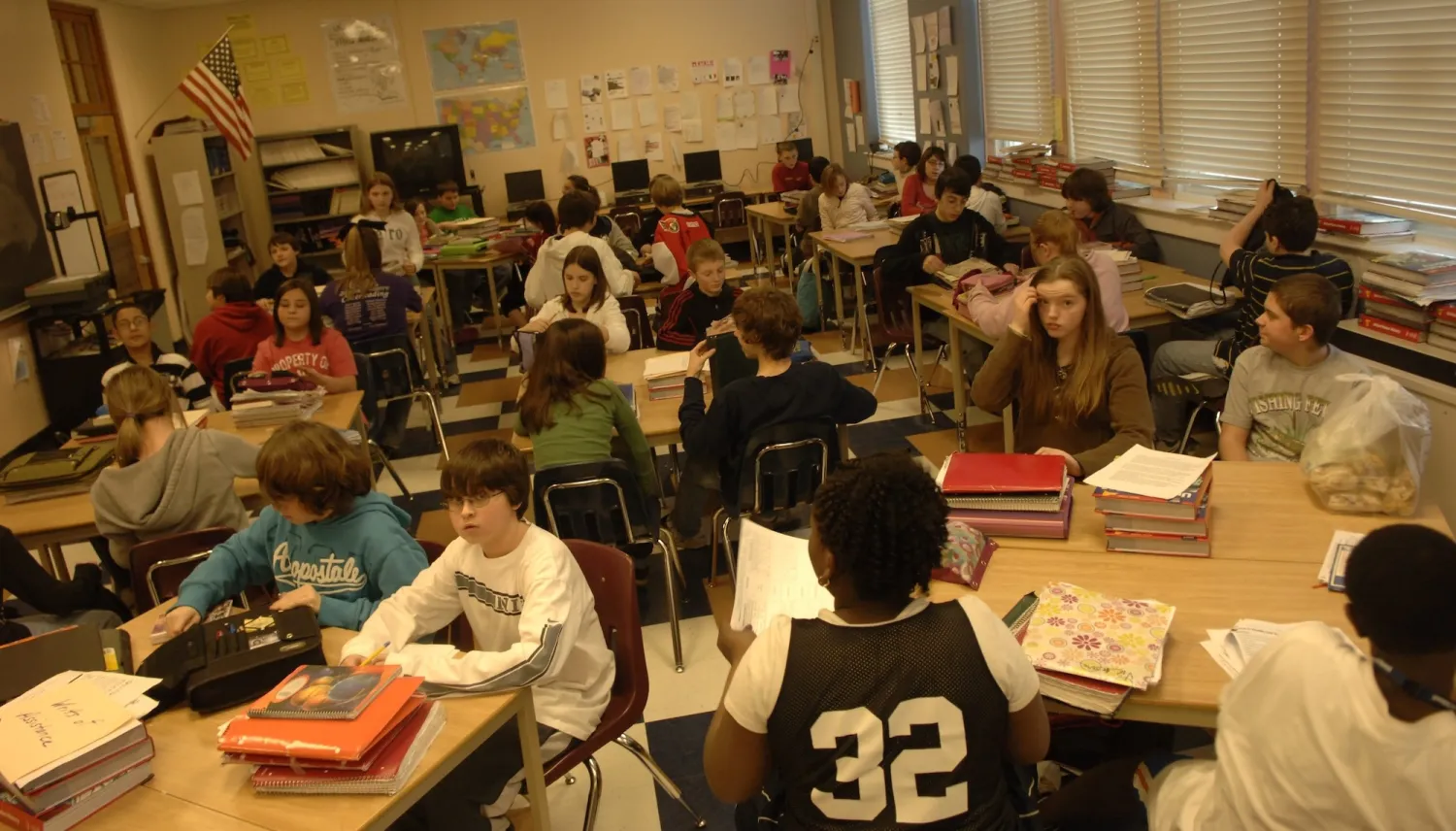
After years of being told the number of students in a classroom didn’t matter or that it was just too darn expensive to fix (or both), teachers, students, and parents have had enough.
Teachers have made class-size limits a focus of their collective bargaining and legislative advocacy. And when necessary, they have gone on strike in part to lower class sizes.
In April, a group of teachers in Denver, Colo., delivered a petition to the Denver school board, calling for class-size and workload relief. They demanded that the district honor what had already been negotiated in the Denver Classroom Teachers Association contract the previous year. The contract stipulated that beginning in 2026, the district would work toward keeping K–5 class sizes at 30 students or fewer, track class sizes, and document efforts to reduce overcrowding. The district, Denver teachers said, was falling short on tracking these levels.
At a press conference, high school English teacher Josh Thompson painted a picture of what overcrowded classrooms look like. “It’s easy to throw out numbers, like 35 students in a classroom or 130 across 5 periods,” Thompson said. “But in reality, it’s students packed in with no space, and educators stretched thin, trying to meet every need. Then we’re expected to plan and grade in chaotic shared spaces. That’s how class size and workload collide.”
Having More Time to Teach
Teachers should have enough time in the school day for lesson planning, sharing best practices with colleagues, mentoring, and grading. But 84 percent of teachers said there is not enough time during regular work hours to perform these and other tasks, according to a Pew Research Center survey.
The reason? Their workloads—crammed with administrative duties, ineffective professional development, or covering staff shortages—are too heavy.
Section with embed
“We seem to get a new curriculum every year,” says Noelle Gilzow. “So that eats up a good amount of time. Now schools are all data-driven, so much of planning time is taken up by data analysis.”
Planning time—particularly self-directed planning time—is a key element of teacher autonomy, which is critical in job satisfaction, says Lora Bartlett, associate professor of education at the University of California Santa Cruz. Speaking at a Harvard Graduate School of Education panel in January 2025, Bartlett said, “We are underutilizing teachers’ expertise. They’re feeling the disrespect, an they’re not wanting to stay in the profession.” Bartlett’s research shows that satisfied teachers feel their expertise, their knowledge, and their perspective is valued.
Bargaining for planning time. Local unions across the nation, including Columbia MNEA, have bargained successfully for expanded planning time.
After winning the right to bargain in 2024, Virginia’s Albemarle Education Association (AEA) made planning time a priority when they headed to the bargaining table for the first time. In addition to duty-free lunch periods of 25-30 minutes and limits on required staff meetings and evening events, AEA also negotiated a minimum of 50 minutes of daily planning time for all licensed staff—a big win, especially for elementary teachers. While state law guarantees secondary teachers at least one entire class period or block of planning every day, it gives elementary teachers an average of only 30 minutes daily spread over a week.
“Our contract ensures planning time every single day, and more of it,” says AEA President Mary McIntyre.
Cooling Down the Classroom
Extreme heat in schools has become commonplace as buildings decay, outdated HVAC systems break down, and climate change brings higher temperatures everywhere, posing serious health risks to students and staff.
“Working in heat takes a pretty tremendous toll on your body, especially over an eight-hour workday,” says Cris Fierro, a science teacher in the Poudre School District, in Fort Collins, Colo. “It’s very difficult teaching students who are also not able to fully engage, because we're also struggling with how hot it is.”
Classrooms are not the only locations affected by heat. For school bus drivers and students, the bus ride to school is another layer of exposure to extreme temperatures.
Many district leaders’ message to staff, students, and families essentially amounts to, “Well, the school year is almost over, and here’s a big fan for your classroom.” But May is getting hotter, and oppressive temperatures can stick around long after the school year begins in August or early September.
Coping with a sweltering classroom isn’t just a bothersome rite of passage before summer break. And, in Poudre, regardless of the temperature outdoors or in the classroom, school would always stay in session, forcing school staff and students to literally sweat it out.
Making the district feel the heat. Hannah Ball’s elementary classroom, in Fort Collins, occasionally topped 90 degrees. Some classrooms in the district hit 100.

In 2024, fed up with district’s inaction, Fierro and Ball joined other educators to form the Poudre Education Association Heat Committee. They documented classroom temperatures across the district and persuaded the district to adopt protocols for early release days, which went into effect for the 2025 – 2026 school year. Portable cooling systems were also installed in classrooms, which have been somewhat effective, despite being noisy and in need of constant maintenance.
While early release days are necessary in the short term, they can be hard for teachers and especially families. “It’s not a long-term solution,” Ball says. Fierro also serves on a districtwide committee that is looking at shifting the school calendar to avoid the hottest days and weeks.
The ultimate goal of the heat committee’s work with the district will be to bring air conditioners and cooling systems into each classroom, Ball says. “The world is getting hotter, and we need to do something, because teaching and learning in these temperatures can be dangerous.”
Supporting Life Outside of Work
When Stephanie Castro, an elementary school teacher in Los Angeles, became pregnant a couple of years ago, she was understandably anxious about using up all of her regular leave to spend time with her newborn.
California then did not have statewide parental leave for public employees. That means educators in Los Angeles—the second-largest school district in the nation—had gone without this critical protection.
“It was very stressful,” Castro says. “People should not be penalized for having a family.”
Teachers are less likely than other working adults to report that their employers offer certain benefits to help them maintain a work-life balance, according to a 2025 RAND study. The report also found that three times as many teachers as similar working adults said it was difficult to change their work schedule or attend to personal or family matters while at work.
Parental leave and childcare could make an enormous difference in helping teachers manage work as well as household and family responsibilities. That’s why educators and their unions have been making the case for more leave as a way to keep educators in the profession.
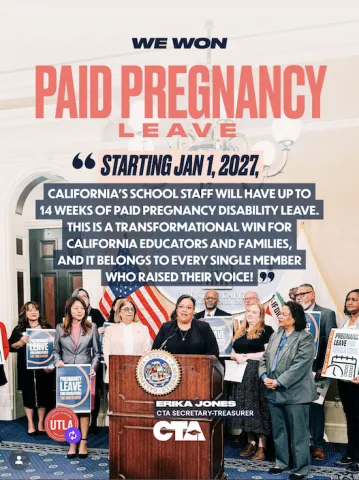
Parental leave at last. In April, United Teachers Los Angeles (UTLA) achieved a historic win. After a long and combative bargaining session with the district, the union secured four weeks of parental leave for school employees.
“It really shows the strength of our union,” Castro says. “And it’s a big win for people who are thinking about the teaching profession. They may want to be an educator, but they want to know: ‘Am I going to be supported outside the classroom?’”
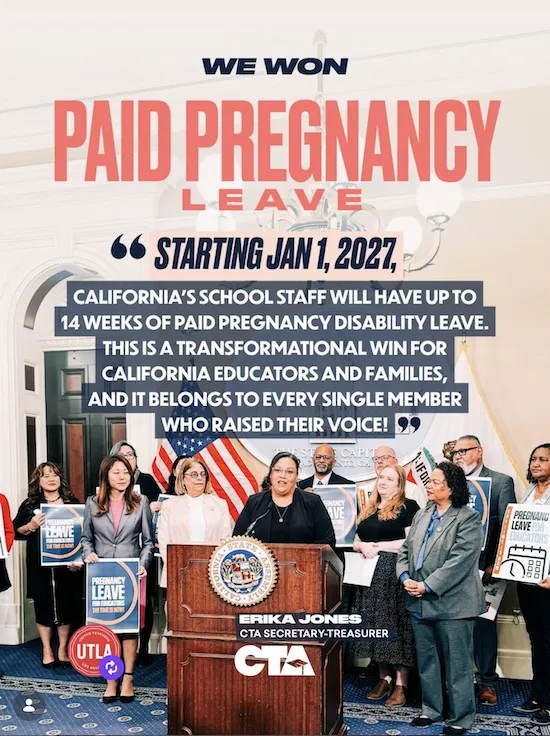
The California Teachers Association (CTA) took the UTLA win statewide. Erika Jones, CTA secretary-treasurer and an elementary school teacher in Los Angeles, led the union's advocacy of a bill that provides up to 14 weeks of paid pregnancy leave for pre-K–14 educators. In July, CTA celebrated when the legislature approved the measure in the 2026-27 state budget—a “transformational win for California educators and families,” says Jones.
“The hope now is that educators won’t have to sacrifice when it comes to their own family. They will see the benefits of having the time to heal and bond with their families.”