In 2025, Republicans created the first national voucher program when they passed the tax law known as H.R. 1. The legislation uses the tax code to create scholarship-granting organizations.
It is a private school voucher program, championed by Project 2025, Besty DeVos, Senator Ted Cruz and others, designed to funnel public funds into unaccountable K-12 private and religious schools.
1. It’s a voucher by law. Regulations can’t change this fact.
The Trump tax bill created a national school voucher program using the tax code. It is uncapped, with near-universal eligibility.
As with all voucher programs, it will harm public schools and destabilize communities.
Forthcoming regulations can’t change this fact or soften the impact on public schools because regulations can’t change statutory language.
Many states have held off on deciding whether to opt into the program, hoping that regulations would give them discretion to shape the program or even restrict it to supporting public school students.
Treasury has signaled it will not allow states to impose meaningful guardrails, so states must either say “no” or accept a program that will operate outside the systems states rely on to protect students and steward public education resources.
2. It’s not free money. The state and public schools will bear the costs.
The federal voucher is no free lunch. On the contrary, it imposes real costs including:
- voucher-driven enrollment loss for public schools and less state per pupil funding;
- public school district instability, especially in rural areas;
- pressure on the state budget to backfill funding losses; and
- administrative burdens.
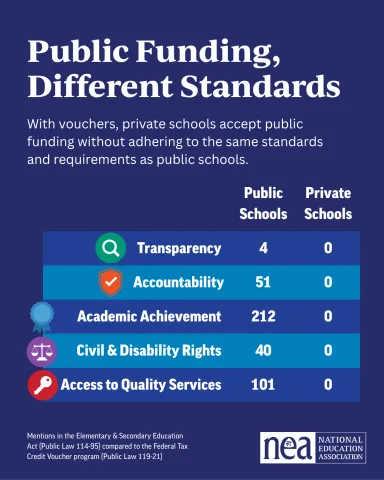
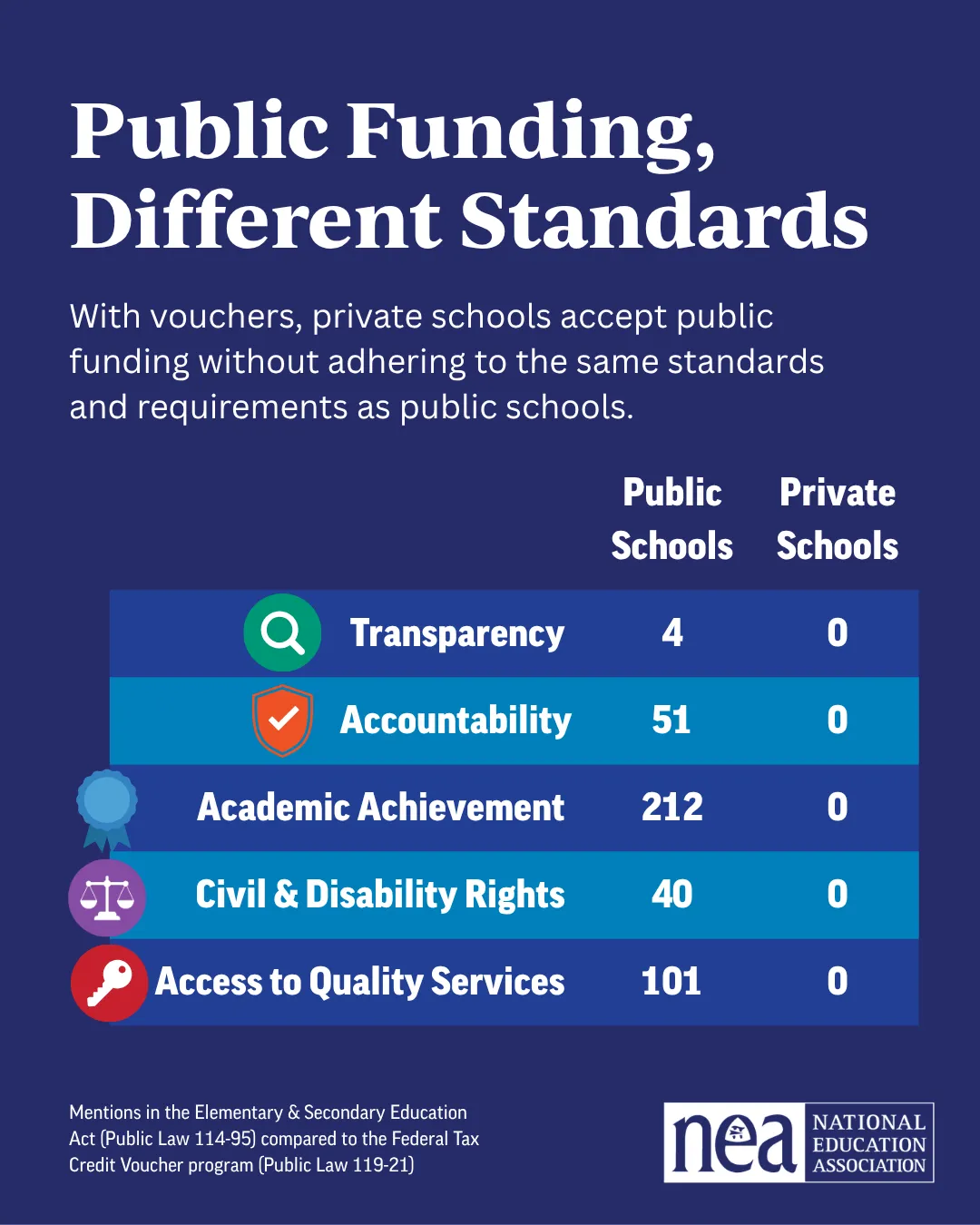
School districts and states bear all the financial risks—while the program’s promised benefits for public schools are diffuse, indirect, and unlikely to materialize in any meaningful way.
The truth is that the program will redirect federal tax dollars almost exclusively to private purposes such as private school tuition, room and board, or private tutors. Similar programs that already exist in states primarily provide subsidies to families with children already in private schools and fund big-box retailers.
Any benefits from that spending are speculative and cannot offset the strain the program will place on state and federal revenues for public education, including less support for Title I and IDEA.
Both federal programs already fund allowable expenses in a more direct, efficient, and accountable way.
3. It’s a net loser fiscally for states. Costs will outweigh the trickle of funds to public schools.
States and public school districts will bear real costs as described in reason #2. How do the potential benefits compare to the real costs?
By design, the statute will channel billions to private, not public schools. The program funds individual students through private intermediaries that pay vendors for services. This model aligns with existing private voucher operations, but poorly with public school funding models.
Moreover, the statute defines qualifying expenses in ways that closely track private school tuition, enrollment-based fees, and related charges.
By contrast, public schools do not charge tuition, and in many states, are prohibited by law from charging students and their families for many services.
The program is poorly suited to advancing public education goals.
Saying “no” to the program is the fiscally responsible choice.

4. Public schools don’t charge for essential services. Doing otherwise undermines its role as a public good available to all.
All state constitutions require the provision of a free public education. In addition, most states’ laws define essential services to which all students are entitled at no cost. This means there are very few services where public schools can legally assess fees.
For public schools to see any significant revenue as a provider of eligible services under the federal voucher program, they would need to begin charging fees to students for services not mandated by state law. Doing so is incompatible with the mission, purpose, and role of public schools in our communities.
Public schools are open to all students regardless of family income. The underlying strength of America rests on the provision of this public good.
Public school-focused Scholarship Granting Organizations (SGOs) will be limited to funding narrow categories of supplemental services that largely overlap with those already supported through Title I and IDEA.
5. Concern over donations going out of state is overblown. The smart fiscal decision remains “no.”
This claim rests on the assumption that the program is net positive for states in the first place, which as explained in reason #3 is far from a given. Moreover, it assumes taxpayers will be just as likely to donate to out-of-state Scholarship Granting Organizations as to ones in their own communities where they might have some personal connection.
But research shows that community connections significantly influence donor behavior. And opting in doesn’t actually guarantee that funds remain in the state: donors will have that option regardless of the state’s opt-in status.
This possibility does not weaken the case for saying "no" to the program. The choice is not between capturing federal dollars and losing them to other states; it is between welcoming a private school voucher program and rejecting the long-term threat it poses to the state’s public education system.
6. Federal vouchers will widen inequality and do nothing to improve student outcomes.
The federal voucher program will only widen existing inequality as wealthier communities will raise more funds.
It is a mirage perpetuated by proponents that it will benefit disadvantaged students.
Overwhelming evidence shows that vouchers subsidize families already enrolling their children in selective private schools.
Worse still, vouchers do nothing to improve student outcomes. “Voucher research has documented some of the worst policy-induced achievement declines in the history of education research.” By contrast, longstanding research firmly establishes that “simply investing directly in public schools creates larger and more widespread benefits”—for students and their communities.
The truth is that vouchers perpetuate racial and economic segregation; underwrite discrimination against students that would not be lawful in public schools; and deny students with disabilities the free, appropriate education they deserve—usually without even warning families about the legal and civil rights they forfeit when accepting a voucher.
Downloads
Are you an affiliate?