
Build Your AutoPay Campaign
Introduction
Protect your power with a proactive strategy!
This guide will help provide you the skills and tools to create and implement your proactive AutoPay campaign. To access even more support, download our full AutoPay toolkit.
Anti-education politicians in states across the country see our union as a threat to their corporate donors and political future. They are using every tool to weaken our voices, including eliminating our ability to pay our dues through automatic payroll deductions.
Since 2010, a number of state legislatures have enacted laws that bar or severely restrict public employers from deducting union dues from employees’ wages, including Wisconsin in 2011, Michigan in 2012, Iowa in 2017, and Indiana and West Virginia in 2021. The dam burst open, however, in 2023, when four states—Arkansas, Florida, Kentucky, and Tennessee—enacted payroll deduction prohibitions.
Proactively converting members from payroll deduction to AutoPay is the only way to neutralize this threat and protect our power. With every member who converts, we turn their threat into an opportunity to reconnect with membership, reaffirm the value of our union, strengthen worksite structure, and build new union leaders.
While no strategy will make AutoPay conversion painless, being proactive instead of reactive allows for an intentional campaign that supports membership growth and capacity-building while maintaining long-term solvency. Act now to protect your power and deliver on the vision of our union: a great public school for every student.
Get Started With Our AutoPay Glossary
Financial & Member Data Systems
Key Strategy 1: Prepare your financial and member data systems
Before you can begin converting members, your affiliate must set up your state’s processes for financial transactions and member data tracking. This section will walk you through the following:
- Tactic 1: Launch your AutoPay Portal
- Tactic 2: Configure AutoPay systems to support year-round collection
- Tactic 3: Follow a yearly cycle for reconciliation and list maintenance
- Tactic 4: Use IMS email notifications to comply with legal requirements
This setup can take longer than you might expect, so get started as soon as possible!
Tactic 1: Launch Your AutoPay Platform
Before your affiliate can begin converting members, you must set up your state’s AutoPay Portal. The AutoPay Portal is NEA’s online platform for processing EFT and RCC payments. Through the AutoPay Portal, members can switch payment methods from payroll deduction to AutoPay, as well as update bank account or credit card information. Launching your affiliate’s AutoPay Portal can take up to four to six months, so if there is a chance you will need the AutoPay Portal, begin the process far in advance.
Start by building a team composed of NEA and affiliate staff to lead the conversion to AutoPay. Include your affiliate’s executive director, business operations lead, field lead, membership processing lead, and your affiliate’s general counsel. From NEA, include your regional director from the Center for Organizing, assigned field staff, the Membership Management Services (MMS) manager, and your MMS state contact. Notify your MMS state contact when you are ready to get started!
In order to launch your AutoPay Portal, you will need to know the local dues amounts for every local in your state—collect this information alongside employer payday schedules and contact information for local leaders.
- Local dues amounts: This ensures the AutoPay Portal can charge members correctly for local dues.
- Employer payday schedules: This will allow you to align dues draft dates with members' paydays, reducing payment rejections.
- Local leadership: Make sure you have the contact information for the local president, as well as contact information for all building reps, the treasurer, and the membership chair. Ensure that the roles in NEA360 are current and accurate.
Payment Methods
- $0.03 - $0.05 per transaction
- $2.00 return fee per transaction paid
- 80% of account updates handled automatically
- 1% rejection rate
- Lower “maintenance” costs, as fewer members change bank accounts than have expired credit cards that need to be chased down (even after the “Auto Updater” program)
- $0.09 per transaction
- Fees and points cost 2%–4% of transaction value
- No return transaction cost
- NEA is enrolled in the credit card “Auto Updater” program, used to reduce the number of payments processed against “bad” cards (e.g., expired, etc.)
- 10% rejection rate
- Lead time is slightly longer due to the setup with the credit card processing vendor
- Most members are more willing to give credit card information than banking information
- Our research indicates that slightly more members will flip if given the option to pay with credit card
Affiliates are normally able to push EFT rejection rates down to about 1%. However, rejection rates for credit card payments will always be much higher, at around 10%.
As a result, credit card payments cost ten times more in staff time devoted to chasing rejected payments, in addition to their significantly higher fees. For these reasons, we recommend pushing members away from credit card payments and towards EFT.
While there are a number of ways to encourage members to pay with EFT, many affiliates have opted to allow for 10 or 12 monthly payments with EFT, while requiring a single lump-sum payment for those paying via credit card. This approach discourages members from paying with credit card while reducing the amount of staff time spent chasing credit card payments.
Tactic 2: Configure AutoPay systems to support year-round collection.
A Year-Round Model for Proactive Conversion
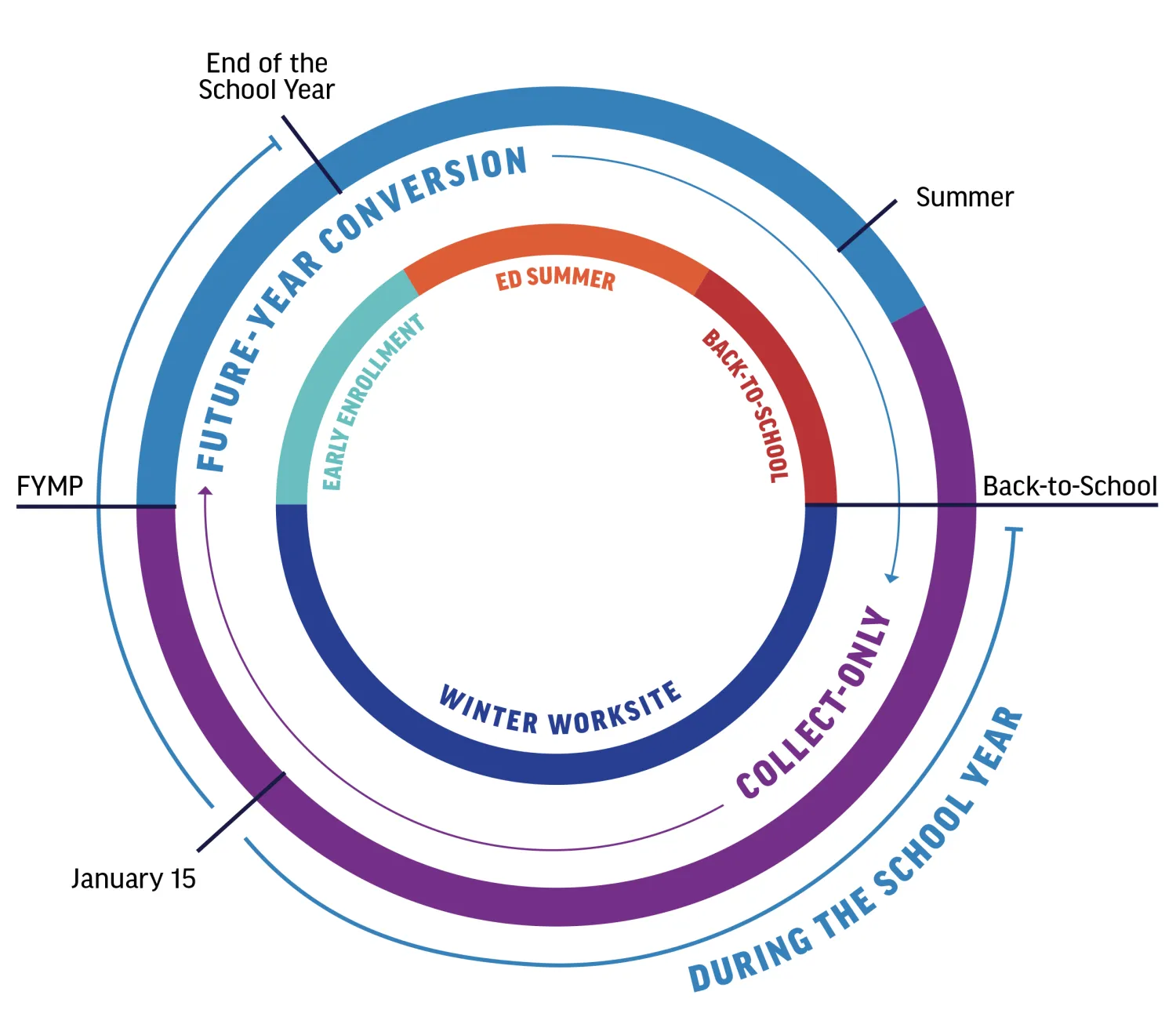
Affiliates engage with members in many ways throughout the year: early enrollment campaigns, back-to-school recruitment, winter worksite visits, and more. Running your proactive conversion campaign year-round allows you to take full advantage of all these opportunities to collect members’ payment information!
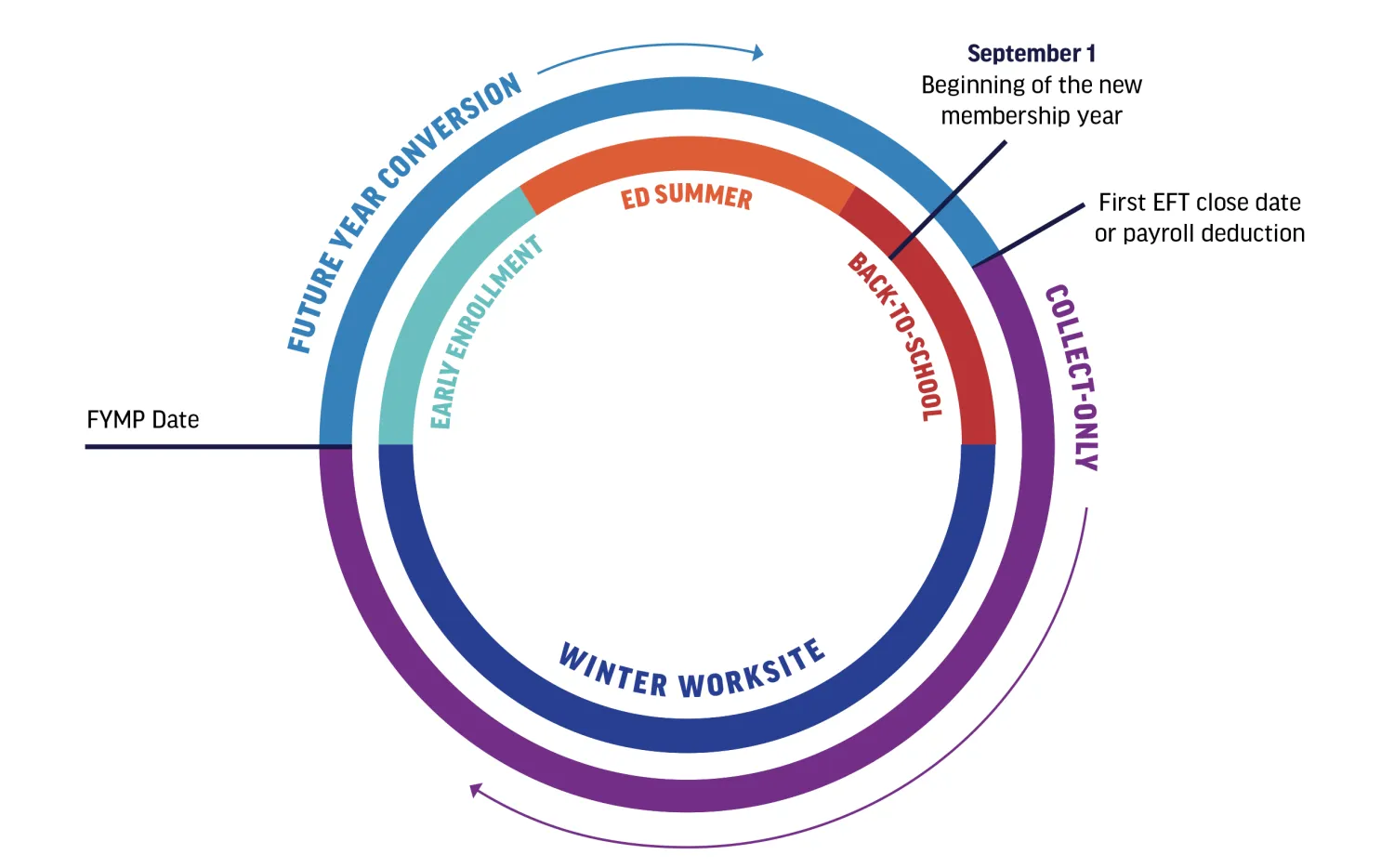
Future-Year Conversion (After FYMP, Before First Close Date)
Once your affiliate has completed Future-Year Membership Processing (“FYMPed”), use Future-Year Conversion to append payment information directly to a member’s future-year membership record, meaning that the member’s dues obligation for the upcoming membership year would be paid entirely via their chosen payment method (EFT/RCC). Any remaining balance for the current membership year would be paid via payroll deduction. This dramatically reduces workloads in membership and finance departments.
Future-Year Conversion is available at any point between your affiliate’s FYMP date and the first EFT close date* or payroll deduction for the membership year, meaning that the Early Enrollment period all the way through New Employee Orientations and other back-to-school events, are opportune times to gather members’ payment information.
After the First EFT Close Date or Payroll Deduction
Our members are most accessible during the fall and winter months, which is a great time to collect their payment information! Continue your campaign by engaging worksite structures and conducting worksite visits.
Once members have begun paying their dues obligations, either via AutoPay or payroll deduction, members should complete the remainder of that membership year’s dues obligation through the same payment method. After the first EFT close date or payroll deduction, your affiliate can continue collecting members’ payment information for use during the following membership year using Collect-Only.
Collect Only:
After the first payroll deduction or EFT close date of the membership year, whichever comes first, affiliates should reconfigure their AutoPay Portal for Collect-Only, which collects members’ payment information for use during the following membership year, meaning your affiliate can avoid time-consuming and logistically-challenging mid-year conversions. It’s essential that members receive an email notice at least 10 days before the first draft date that provides accurate payment amounts and schedules.
To avoid rejected payments when members change their payment method, via AutoPay, affiliates should regularly request pre-notes, which can identify bad bank accounts and credit cards before they are charged.
Why Immediate Flips?
Affiliates should configure Immediate Flips in select locals in order to road test and improve payment capture protocols with a smaller number of members before they must operate at scale. Under Immediate Flips, when members submit their payment information, their pay method is immediately converted to EFT/RCC, meaning their bank account or credit card is charged beginning on the next scheduled draft date.
Immediate Flips present two main logistical hurdles for affiliates:
- Working with district payroll offices to stop payroll deductions in time to avoid a member being double-charged; and,
- Quickly receiving payroll deduction files from district payroll offices and uploading them to IMS in time to ensure members are charged correctly.
Because of these hurdles, Immediate Flips are not a good fit for every local affiliate. Only local affiliates that have strong relationships with efficient, flexible payroll offices should be considered for Immediate Flips.
Allowing Immediate Flips by configuring “local overrides” for affiliates with strong partnerships with payroll offices creates a valuable testing ground. It enables affiliates to pilot and refine failed payment-capture processes with a small group of members before scaling up.
Autopay Portal User Agreements
NEA’s Office of General Counsel has created an AutoPay User Agreement for affiliates to agree and adhere to. The acceptance and ability to adhere to these requirements ensures our members and our organizations are protected. To that end, every affiliate must understand these requirements and sign the AutoPay Portal User Agreement. You can find a copy of the AutoPay Portal User Agreement under the “AutoPay Resources” folder.
- Approve language changes: All language changes on the AutoPay Portal should be approved by NEA's AutoPay team, which includes the NEA Office of General Counsel and should include the affiliate's counsel as well.
- Spot-check AutoPay Portal authorization screens: Affiliates must regularly review their AutoPay Portal authorization screens to ensure estimates are accurate, legal language has not changed without approval, and all required information is provided at the time of authorization. AutoPay Portal screens should be regularly spot-checked to ensure that the AutoPay Portals accurately reflect:
- The type of account being used (e.g., credit card, checking account, savings account)
- The account information—including account number, expiration date, and CVV or CVC number for credit/debit cards; account number and routing number for checks used to establish payment by EFT
- The recurring nature of the membership dues obligation
- The initial payment period (e.g., membership year ending August 31, 2026)
- The total of the dues obligation for the initial payment period (membership year)
- The amount of each installment payment
- A description of the payment schedule (e.g., 1st day of each month)
- A description of when recurring payments will begin (e.g., 1st day of the month after you complete this authorization)
- Date of Authorization
- Provide Ten-Day Notices (Status Sheets): Affiliates are required by law to provide written notice at least ten (10) days prior to the EFT close date for which any changes in payment amounts or schedules take effect. For members who enrolled in AutoPay months before their deductions begin, this notice reminds them of their commitment and provides a point of contact for any questions or changes, which is essential given the passage of time. Most importantly, these notices must reflect any changes in payment amounts or schedules that may have been finalized after members submitted their payment information.
- Given scheduled annual dues increases, affiliates must provide a Ten-Day Notice to each member paying via AutoPay ten (10) days prior to the first EFT close date of each membership year.
- If a member’s missed payment leads to a change in payment amounts (missed amount is spread across remaining payments, next payment is doubled, etc.), a Ten-Day Notice must be sent.
- Any changes in payment schedules, whether due to a member’s circumstance or affiliate logistical needs, requires a Ten-Day Notice to be sent.
- Configure AutoPay transaction emails: In addition to sending Ten-Day Notices, affiliates must set up automatic emails to members for account updates, payment failures, and refunds. See Key Strategy 1, Tactic 4 for more information on AutoPay transaction emails.
Tactic 3: Follow a Yearly Cycle for Reconciliation and List Maintenance
Clean and accurate lists are absolutely critical to converting your members and managing dues collection via AutoPay. Without strong lists, your conversion campaign will struggle to reach all members, and chasing rejected payments will be challenging.
Data cleansing is a cycle—not a one-time process. Good lists require constant care and attention. Take care of your lists, and they will take care of you! Before beginning your AutoPay campaign, take time to assess your lists by conducting a Membership Data Audit.
After completing a Membership Data Audit, work to verify and update contact information for all members and local leaders. Use all possible channels of communication to reach members to update/verify their contact information.
Membership Data Audit
- What percentage have personal email addresses?
- What percentage have home addresses?
- What percentage have cell phone numbers?
- How many members are not coded to a worksite in NEA360?
- How many members have a non-deliverable home address or personal email address?
- What percentage of worksites have building reps identified?
- Does the list of worksites in NEA360 contain all the worksites in your state?
- Has your state removed closed worksites?
- What percentage of locals have a Local President identified with complete contact information in NEA360?
- What percentage of locals have a Membership Chair and Treasurer identified with complete contact information in NEA360?
- What percentage of worksites have a building rep listed with complete contact information in NEA360?
A Surround-Sound Approach For Updating Contact Information
- Postcards: Send postcards to members with a link for them to update their contact information in our secure system.
- Email Campaign: Run an email campaign urging members to update their contact information!
- Telephonic Organizing Campaign: Use a Telephonic Organizing campaign to have all members who did not fill out postcards or respond to emails update their contact information through a YRO survey!
The transition to AutoPay requires affiliates to carefully track transfers and retirements to avoid mistakenly charging former members, alongside managing a whole host of new AutoPay-related tasks. By following a yearly cycle for reconciliation and list maintenance, affiliates can boost efficiency by routinizing this work.
Maintaining good lists is often more than just a technical question—our lists are only as strong as the local leaders and structures that are responsible for keeping them clean. By empowering local leaders with data like Join Now Abandoners and Year-Round Organizing Field Leads to assist in follow-up after New Employee Orientations, you demonstrate the value good data can have for local organizing, encouraging leaders to be good stewards of their lists.
Year-Round Tactics
- Send Ten-Day Notices to all members paying via AutoPay, including their updated total annual dues obligation, the schedule of payments, and recurring payment amounts.
- Have building reps and local leaders gather contact information for new hires at New Employee Orientations (NEOs) and verify local/worksite rosters.
- Digital tools (Hustle, email, Telephonic Organizing, etc.) can also be used
- Use the Join Now Abandoners list to identify members who didn’t complete the sign-up process at NEOs; send leads to local leaders for follow-up.
- Work with members who have failed payments to re-try transactions or change payment methods.
- Send transaction emails as outlined Key Strategy 1, Tactic 4.
- Continue to convert members and recruit potential members.
- Ahead of the allocation of NEA RA delegates, work with local leaders to validate local rosters.
- Before FYMP, reach out to locals to confirm payment schedules and dues rates for the upcoming membership year. It’s best to begin this practice in early spring, especially if your affiliate participates in early enrollment.
- Ensure the AutoPay Portal is pointing at the correct year.
- Update deduction and close dates to ensure they do not fall on a weekend or a federal holiday, as the AutoPay Portal will not charge members on these days.
- Test Join Now for potential errors by going through each screen. Report those errors to your NEA state contact.
- Future-Year local transfers open via Join Now.
- Convert pay method for members who have given payment information via Future-Year Conversion or Collect-Only; work with payroll offices to stop payroll deductions for these members.
- Work with local leaders and use digital tools to track retirements and upcoming transfers; stop dues drafts for retirees.
- Request pre-notes to identify bad banking information; work with members to update payment information.
- Reach out to members whose credit cards were not updated by the auto-updater, and ensure they have a valid credit card on file before payments begin.
- Audit membership records: Do you have good contact information for all members?
- Audit local roles: Do you have roles listed for every local? Are the roles accurate? Cancel any active roles without active memberships.
- Confirm correct local dues amounts to prepare for Ten-Day Notices.
Tactic 4: Use IMS Email Notifications to Comply with Legal Requirements
The IMS Email Notifications tool is essential for keeping members informed on the status of their membership and dues payments while complying with financial regulations and other legal requirements for collecting union dues.
Affiliates using NEA’s AutoPay Portal are required to send the following notifications to members via email:
→ Ten-Day Notices (Status Sheets)
→ Account Update Confirmation
→ Payment Notification
→ Failed Payment Notification
→ Refund Notification
→ Renewal Notice
→ Past Due Notices
→ Cancellation Notice
Affiliates should consult with legal counsel to determine if state-specific regulations mandate additional notifications.
Ten-Day Notices (Status Sheets)
Federal regulations require that if we change a member’s annual dues amount, recurring payment amount, or payment dues schedule in any way, we must first send the member notice of any such change 10 days prior to that change taking effect. We must send this “Ten-Day Notice,” also known as a “status sheet,” on an annual basis when we change dues rates, prior to the first EFT close date or the first time we run credit card charges, and during the year anytime there is a change in amount or the payment schedule.
Ten-Day Notices must be sent for new members, type changes, local-to-local transfers, or when a member misses a payment and elects to have it distributed across the remaining payments.
Account Update Confirmation
Members must receive an email confirmation after their payment information is successfully submitted to the AutoPay Portal. Additionally, they must receive an email confirmation whenever their credit card or banking information is automatically updated or updated manually by the member using the AutoPay Portal.
Payment Notification
Members must receive an email notification that their payment was successfully completed. This must include the date, the amount, and account identifying information.
Failed Payment Notification
Members must receive notification when their payment method has failed. This should also include a link to the AutoPay Portal where they can update their information and a contact person to whom they can reach out to with questions.
Refund Notification
If a member’s dues need to be refunded, members must receive a notification stating the amount of the refund, the date of the refund, and details on the account where the money will be refunded.
Renewal Notice
This is sent to members who must renew their membership annually such as check payers and members who are required to reaffirm their membership on an annual basis. It can include information on how to switch to AutoPay and any other relevant information that the affiliate wants to include.
Past Due Notices
If a member has missed a payment for any reason, these notices inform the member of the amount that is past due and should include information on how to update their payment information and who to contact with any questions.
Cancellation Notice
This is sent to members when their membership is cancelled due to lack of payment or other reason. Information on whom to contact with questions, or how to re-join, should also be included.
Leaders, Locals, & Allies
Key Strategy 2: Prepare your leaders, locals, and allies
An effective proactive AutoPay campaign taps the strengths and resources of your entire network. This section will walk you through the following:
- Tactic 1: Build governance buy-in
- Tactic 2: Protect PRD in CBAs or standalone agreements
- Tactic 3: Reconnect with members before making the conversion ask
- Tactic 4: Work in coalition to defend labor rights
Tactic 1: Build Governance Buy-in
Building governance buy-in is key to a successful AutoPay campaign, especially if you are pursuing a proactive strategy. Build buy-in at the highest levels before working outward, as shown in the graphic below.
Begin with your state’s officers and Board of Directors. Take time to meet and clearly articulate the real implications of losing payroll deduction on the organization’s budget, density, power, and priorities. Understand the key priorities of governance in your state and establish the loss of payroll deduction as a direct threat to those specific priorities.
Remember, the threat should only be half the picture. Focus also on how your conversion campaign is an opportunity to strengthen your union by re-engaging with members, affirming their commitment to the vision of our union, and developing new structures and union leaders. Introduce proactive conversion as the best strategy to turn this threat into an opportunity.
Tip: Effectively managing AutoPay dues collection requires a clear cancelation policy for non-payment of dues. Begin preparing your Board to develop this policy.
Tactic 2: Protect Payroll Deduction in Collective Bargaining Agreements or Standalone Agreements
In states with mandatory or permissive bargaining rights, local unions can bargain provisions that extend after a ban comes into effect, protecting payroll deduction until the bargained provisions expire. Use this tactic to secure additional time to convert members, prioritizing conversion campaigns in locals without such protections.
Conduct A Contract Audit
Most states that have banned payroll deduction have included provisions in their laws stating that if there is a collective bargaining agreement in effect providing for payroll deduction, it may continue until the CBA expires, but may not be modified or extended once the law takes effect. As a result, local unions should seek to extend existing provisions, or bargain new ones, before the law takes effect. This analysis will help establish a bargaining strategy and inform the prioritization of locals for conversion efforts. For each collective bargaining agreement reviewed, evaluate the strength of the payroll deduction provision using NEA’s Model Payroll Provisions and note the provision’s expiration date.
Bargaining Guidance for Affiliates Facing PRD Bans
When negotiating standalone agreements to protect payroll deduction, work with your legal team to ensure that agreements will be enforceable.
Many district superintendents do not have strong opinions on payroll deduction. Have a priming conversation with the superintendent before pursuing a standalone agreement. Additionally, look for allies within superintendents’ organizations and school boards who can help persuade their colleagues to support you.
Tactic 3: Reconnect with Members Before Making the Conversion Ask
Our research tells us the most challenging members to convert are those who struggle to see the value of the union. Converting these members requires engaging with them on their priorities and rearticulating the vision of the union.
Before you convert, local leaders and volunteers should engage with as many members as possible, especially in worksites where the local has been less visible. Have local leadership conduct 1:1 conversations with members, asking them what they want from their union. Think of how the union might deliver on these priorities. Do members want to take action in their workplace? Do they want a professional development training? Consider recording their responses in a Year-Round Organizing card.

Year-Round Organizing Cards are a Good Touchpoint
Tactic 4: Work in Coalition to Defend Labor Rights
Beating back payroll deduction bans and other anti-union legislation is best done in solidarity with other labor unions. Start meeting regularly before the state legislative session begins to discuss priorities, threats, and opportunities. Create a coalition, and branded materials, that can be used to distribute information from a united labor table to legislators. The coalition should hire lobbyists, identify key legislators, and share target sheets at every meeting. Legislatures have tried to carve out police and firefighters from the most detrimental effects of legislation, but if the labor table stays united, bad bills can be defeated for the benefit of all workers.
Lessons learned from affiliates who have successfully defeated payroll deduction bans:
- Work in coalition
- Determine who has the ear of the key legislators
- Bring in members from strategic districts to tell their stories
- Continually revise talking points with coalition as legislation changes
- Email, Hustle, and phone bank members strategically throughout the campaign
Members are our most important messengers. Successful coalitions have brought in members on a weekly basis to meet one-on-one with key legislators. Best practice is to meet with members beforehand, review regularly updated talking points, and to debrief with them afterwards. Building strong coalitions and engaging members is the strategic path for winning pro-labor legislation.
Surround-Sound Plans
Key Strategy 3: Develop a Surround-Sound Communication Plan
- Tactic 1: Keep members informed about incoming legislative threats
- Tactic 2: Use research-backed messaging
- Tactic 3: Use Hustle, email, and telephonic organizing to complement field work
Tactic 1: Keep Members Informed About Incoming Legislative Threats
According to our research, over half of our members have heard “just a little” or “nothing” about the bills that eliminate payroll deduction. What’s worse, members who have heard little or nothing feel most negatively about being asked to make the flip.
In states facing immediate legislative threats, educate members about the legislation proposed by anti-public education politicians and explain how to protect their membership. Emphasize that they will lose their membership if they don’t switch to AutoPay. Stress that enrollment is safe and secure and remind members that the union protects them and their students.
In states pursuing a proactive strategy, be careful not to rely too heavily on threat messaging. If the threat dissipates, members may no longer see the reason to convert. Instead, focus on the advantages of protecting their union membership.
Tactic 2: Use Research-Backed Messaging
NEA conducted message research to determine the most effective messaging for converting members off of payroll deduction. This research informs our messaging guidance.
Sample Talking Points
Tactic 3: Use Hustle, Email, and Telephonic Organizing to Complement Field Work
While we can’t expect digital tools to convert a large percentage of membership, building a strong surround-sound strategy can go a long way in supporting the in-person work and raising awareness about the switch to AutoPay. Use these tools to complement your field strategy, like by sending Hustle messages to members ahead of a worksite visit.
When building a surround-sound plan, don’t just focus on what will be sent out from the state level. How can partners like local presidents or building reps contribute to your surround-sound campaign? Using a variety of media from different senders will help your message stick.
Our research shows that many members are unaware of payroll deduction bans. Members who are unaware of bans feel more negatively about flipping. Make sure your members are well informed. Additionally, think about how you can use your surround-sound strategy to identify volunteers to help in the conversion efforts. How can members who want to help contribute to the campaign? If the communication includes a link to the AutoPay Portal, include the Member ID number to help members make the switch.
Telephonic organizing can be a useful tool at many points during your AutoPay campaign. In addition to calling members to convert them over the phone, our call center can also update contact information, identify new leaders/activists, and help alert members to the loss of payroll deduction through phone calls.
>Reminder: In order to convert to AutoPay, members will need their NEA ID number and ZIP code. Fortunately, this number can be inserted into communications like Hustles or emails through a merge field. For help setting up a merge field for NEA ID, contact NEA's Center for Communications.
Digital Surround-Sound and Your AutoPay Field Strategy
Send emails:
- Emails from State:
- What is the legislature doing? Update contact/worksite info!
- What's AutoPay? Why should I convert?
- Emails from Building Rep:
- Announce a 10-minute meeting to convert
- Don't forget about tomorrow's meeting!
- Conversion team is coming soon!
- I'll be coming to see you talk about AutoPay!
Sent texts:
- Hustle: Conversion team is coming to your school tomorrow!
- Hustle from Local: Time to convert! Interested in volunteer?
- 1:1 Engagement: Offer opportunities to meet individually to discuss AutoPay or other union topics.
- Reminders: Send a reminder note the day before and/or a few hours before your visit or event.
Make calls:
- Alert members to threat, update contact/worksite info!
In-person engagements are the most powerful opportunities to get accurate data and switch people to AutoPay. Tap into your staff and member volunteers to engage with educators:
- Worksite Conversion Meetings
- Worksite Visits
- 1:1 Conversations with Building Reps, Staff, or Other Members
- Email from Building Rep: f you couldn't make it, find time to convert!
- Building Rep: 1:1 conversations with unconverted members.
- Email from Building Rep: Thank you for converting! Please remind your friends
Get Sample Messages, Emails, Hustle Scripts, and Posts!
Get inspired and find samples for surround-sound communications in the NEA AutoPay Communications Toolkit.
Reach Every Member
Key Strategy 4: Reach Every Member Multiple Times
At the heart of every AutoPay campaign is the in-person field strategy. This section will walk you through the following:
- Tactic 1: Empower local leaders with data using the NEA AutoPay Dashboard
- Tactic 2: Design campaign strategy based on structure and data assessment
- Tactic 3: Activate worksite leaders
- Tactic 4: Energize members through worksite blitzes
- Tactic 5: Plan pop-up events for members to convert
- Tactic 6: Convert members through home visit
Tactic 1: Empower Local Leaders with Data Using the NEA AutoPay Dashboard
NEA’s AutoPay Dashboard is your field campaign’s one-stop shop for tracking conversion progress across your affiliate and quickly pulling rosters of unconverted members by local and worksite with ease! In order to effectively convert members, everyone involved in your campaign needs access to the most accurate data on who has or has not converted and how to contact them. Fortunately, NEA’s AutoPay Dashboard makes it easy to equip the campaign with accurate lists of members who have not converted, along with their contact information.
Note: Please be vigilant to protect confidential information. Only provide necessary member information and remind staff and leaders to zealously guard that information.
Guide to the NEA AutoPay Dashboard
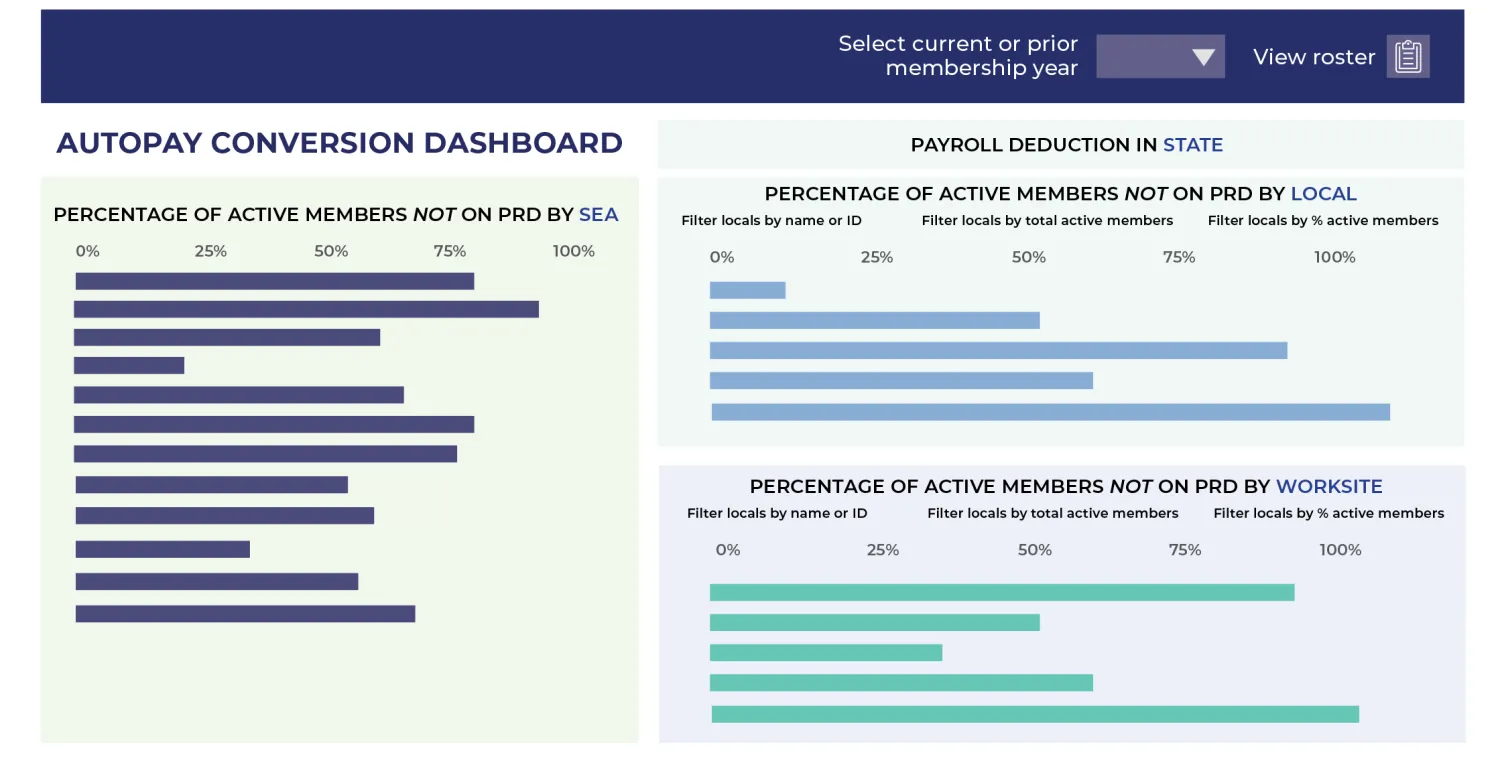
Note: To protect sensitive information, we've included only a simplified version of the dashboard. To request full access, email [email protected].
The NEA AutoPay Dashboard is an excellent tool for checking on the conversion progress in your state affiliate, locals, and individual worksites. The data is updated daily and reflects the percentage of members not on payroll deduction, as well as those in the “waiting room” who have AutoPay information on file but are still on PRD.
On the left side of the screen, click on a state’s dark blue bar to show that state’s locals and worksites. Using the sliders at the top of the screen, you can filter and sort locals and worksites based on their number of members and the percentage converted. Click on the roster tab from the dashboard, and you can easily download rosters of members by local and worksite, with their ZIP code, VAN ID, NEA ID, and PRD status. The dashboard also links directly to members’ VAN profiles. Access to the NEA AutoPay Dashboard is limited to staff only. If you’d like access, please email [email protected] to request it.
Tactic 2: Design Campaign Strategy Based on Structure and Data Assessment
A thorough and well-informed planning process is critical to the success of your AutoPay campaign. Before choosing tactics and targets, affiliates should work with UniServ staff, member leaders, and data specialists to assess the strength of local structures and member data.
Questions for Member Leaders:
- Which worksites in your locals have strong building reps?
- How can your campaign build up new member leaders in your local who may need some support?
- What campaigns or issues is your local working on that your AutoPay campaign can support?
Questions for UniServ Directors:
- Which worksites in your locals have strong building reps?
- Which districts/worksites are the most permissive when it comes to building access for staff or released leaders?
- Where are locals running issue or bargaining campaigns that can be used as touchpoints for your conversion campaign?
- Which locals have strong leadership teams that could help with the AutoPay conversion?
- Which locals have strong relationships with flexible district payroll offices?
Questions for Data Specialists:
- Which locals have the most robust member contact information? Email addresses, mobile phone numbers, home addresses, etc.
- Which locals have strong member leaders who can help with data entry and updates throughout the campaign?
Once your team has completed this assessment, use it to inform which locals your campaign should target and with what tactics. For example, locals with strong worksite structures should activate those structures to encourage members to convert to AutoPay. Locals with developing structures and poor member contact information will need additional support.
Tactic 3: Activate Worksite Leaders
Trusted building reps are the most effective organizers when it comes to AutoPay conversion! Worksite leaders have strong relationships with members, easy access to buildings, and knowledge of planning periods and other non-instructional time.
Where it works: Locals with strong worksite structures and trusted building reps in most buildings
Best practices:
Begin by holding a meeting with the local’s leadership team and building reps. Provide information on how the AutoPay conversion process will work for members in your affiliate and then have local leaders and building reps convert themselves. Train them on how to talk to members about the importance of AutoPay conversion and how to guide members through the AutoPay Portal.
Building reps should leave the meeting with a plan to use 10-minute meetings, 1:1 conversations, mailers, and other tactics to convert the members at their worksites. Additionally, building reps should be provided with the following to support their conversion efforts:
- Regularly updated lists of members who still need to convert, with their membership IDs and ZIP codes
- FAQ sheet with answers to common member questions
- A list of routing numbers for local banks
- Screenshots and instructions on how to navigate the AutoPay Portal and anticipated questions
- Talking points on the importance of converting to AutoPay now
- Sample 10-minute meeting agenda
Remember, around 80% of members will need a 1:1 conversation to convert to AutoPay. Use this as an opportunity to gather information from members about workplace concerns, bargaining topics, or other issue campaigns. It is also an excellent time to identify potential leaders and update member contact information.
Sample 10-Minute Meeting Agenda
Tactic 4: Energize Members Through Worksite Blitzes
A worksite blitz is a way to kickstart momentum in your campaign by maximizing the number of conversations in a concentrated period of time. Members, staff, and volunteers from outside your local will need to be briefed on the issues and challenges in your district to ensure success.
Where it works: Locals/regions with high member density
Preparing for the blitz:
- Consider how your blitz can support other goals for the local. Engage with local leadership: What work is the local doing, and how can the blitz support it? Is there a bargaining survey or other ask for members that the blitz can amplify?
- Connecting your AutoPay campaign to local wins and issue campaigns helps demonstrate the value of the union and builds stronger relationships with members.
- Members should be aware of threats to payroll deduction before the volunteers arrive. Work with local leadership to raise awareness through mailers, calls, texts, and emails.
- Gather schedules of planning periods and lunch times so volunteers can plan to connect with members at these times.
- Prepare materials for your campaign, including lists of unconverted members with contact information, NEA membership ID, and ZIP code; FAQ sheets for converting to AutoPay; a list of routing numbers for local banks; and local B.R.A.G. sheets.
- Plan to talk to potential members while in the worksites by having lists of potential members, local B.R.A.G. sheets, membership packets, and a link to Join Now.
During the blitz:
- Have volunteers use digital tools (like text and emails) to notify members before a scheduled visit.
- If possible, release the building rep for the day to collaborate with the volunteers.
- At the school building:
- Ask to set up in the lounge or another space where members congregate.
- Ask if an announcement can be made over the PA system reminding members where you will be.
- Use planning/lunch schedules to determine the best time to reach the members you need to convert.
- Have one volunteer stationed in the staging location to assist members while they convert, while other volunteers use the planning/lunch schedules to meet members and potential members where they are.
- Identify new potential leaders to assist with the campaign.
Following the blitz:
- Hold a debrief for volunteers and leaders to celebrate wins and share learnings from the visits.
- Collect contact information for potential leaders, potential members, and members who may need follow-up support.
- Create a follow-up plan for members and leaders to contact members who failed to convert, recruit potential members, and engage new leaders.
Tactic 5: Plan Pop-Up Events for Members to Convert
Where it works: Locals with good contact information, limited/no building access
Best practices:
Hosting a pop-up event in partnership with a local business is a fun way to encourage members to convert to AutoPay! Members are invited to visit a local business where leaders and volunteers will help them convert to AutoPay.
Selecting a Local Business Partner:
When choosing a local business to partner with for your pop-up event, begin by considering what members want. Are there local spots frequented by members?
Choosing a business that aligns with the values of your members may help drive turnout. Consider supporting minorityowned or pro-worker businesses that support your local’s values.
It’s also important to consider the physical location of your pop-up. Is it close to worksites or other locations your members will be at? Consider maximizing your pop-ups by scheduling them around district events, such as commencement, sporting events, and district wide PD, that would make it easy for a large number of members to stop by.
Before the Pop-Up:
Drive turnout to your pop-up using digital tools, mailers, and worksite structures. It may be helpful to set up a Hustle text bank for a night-before reminder. Encourage members to attend and convert to AutoPay while having time to build connections with other members they might not usually see. Prepare similar materials as you would for a blitz: lists of members with contact information, NEA membership IDs, and ZIP codes; FAQ sheets; and lists of routing numbers for local banks. Don’t forget your laptop, QR codes, and other necessary materials to convert members.
During the Pop-Up: Set up a table for members to meet with you and convert. Take advantage of this time when members may not be in a hurry—are there other volunteer or leadership asks you could be making at this time? Ensure there is space for members to connect with each other. This is a great opportunity for members to socialize and build relationships with members they may not be able to see regularly.
Turn Union Events Into Pop-Ups: During a conversion campaign, take advantage of all union events (Rep Assemblies, Board Meetings, P.D. sessions, etc.) to convert members to AutoPay. Leaders and active members are our best AutoPay ambassadors.
Tactic 6: Convert Members Through Home Visits
Where it works: Locals with accurate home address information where members live in close proximity to each other, limited/no building access
Best practices:
Home visits (knocking on doors) are a great way to target members who need to convert. If you are planning on using home visits as a tactic, pre-work is essential to success. Here are some things to consider:
- Targeting locals/areas: Look at the list of members who remain on Payroll Deduction and consider the locals that have a high density of members left to convert. When thinking of areas to knock on doors, consider how to maximize volunteers time by focusing on geographical areas with a large number of doors to knock.
- Assembling your team: Home visits are most effective when led by members. A member will always be the best person to have conversations with their coworkers. This is an opportunity for staff to pair with member organizers, member leaders, and local leaders to coach and develop their skills while converting their coworkers. As you are doing pre-work, consider whom you want on your dream team and when the member leaders will be available.
- Data: Home visits require accurate addresses to make the best use of volunteers’ time. If your data is not up to date, consider doing a data cleanse campaign before you start home visits. Also use this opportunity to update member worksites, personal cell phone numbers, and other important information.
- Communication: Home visits should not be the first time a member hears about AutoPay conversion. Similar to worksite blitzes, they should be layered with other communications to introduce members to the campaign.
- Organizing Materials: Ensure that you have all the materials to give to volunteers before they knock on doors. Refer to Tactic 3: Activate Worksite Leaders for a list of necessary materials for volunteers to have everything they need to help a member convert.
- Leave Behinds: Create material to leave at members’ doors when they are not home. The leave behinds should communicate why we are asking them to convert to AutoPay, how to convert, and a QR code to easily access the AutoPay Portal. Create space on the leave behinds to write the member’s NEA ID and ZIP code for ease of conversion.
- Training: A thorough training is important to the success of the home visits and the experience of volunteers. An AutoPay home visit training should include:
- Messaging for the campaign
- A walk-through on how to convert someone’s membership
- MiniVAN: How to record attempts, record assessments or other data points you are collecting, and the preloaded script
- Roleplay and 1:1 conversation training
- Logistical and safety information
Payment Capture Systems
Key Strategy 5: Strengthen Payment Capture Systems
Payment capture occurs when dues leave a member’s account and are transferred to the union successfully. This section will walk you through the following:
- Tactic 1: Reduce rejected payments
- Tactic 2: Reconcile payments and membership rosters
- Tactic 3: Systematize payment chase
- Tactic 4: Develop clear cancelation policies
Glossary
Tactic 1: Reduce Rejected Payments
For EFT payments, we strongly recommend aligning the draft schedule to members’ paydays. When they first begin collecting dues via AutoPay, many affiliates shy away from having multiple payment schedules in order to minimize the logistical burden on membership processing staff. However, running multiple payment schedules aligned with members’ paydays significantly reduces rejected payments, minimizing time-intensive payment chase work. The most effective payment chase strategy is to reduce rejections!
By following these steps, many affiliates have been able to reduce EFT rejection rates to around 1%.
It is more difficult to reduce rejection rates for credit card transactions. The easiest way to reduce credit card rejections is to spread the dues obligation over fewer transactions, minimizing opportunities for a failed payment. For example, an affiliate could offer quarterly payments for credit card payers, while offering monthly draws for EFT payers. Some affiliates have had success limiting credit card payers to a single draw date for the entire annual dues obligation.
Tip: 1-2 weeks before drafting members’ accounts via EFT, request a pre-note from NEA. The pre-note will check for closed bank accounts before the payment draft, allowing staff to rectify the issue with the member before a payment is rejected.
Tactic 2: Reconcile Payments and Membership Rosters
Once members have been converted to AutoPay, it is critical to ensure that all payments are applied to the correct member and local dues are forwarded to the correct local. Reconciliation is the process of matching payments to members and identifying rejected payments.
It is important to leave time to verify local rosters at the beginning of the school year before payment drafts begin. Verifying rosters before the first EFT or credit/debit charge will help prevent double-charging members who have transferred locals or mistakenly charging members who have retired.
Since AutoPay takes the employer out of the dues collection process, systems must be in place to continually update when member’s dues obligation ends, either because they have transferred, retired, or resigned. Under payroll deduction, if a member left a district or retired, the payments would be stopped automatically by the employer. However, when collecting dues via AutoPay, members will continue to be charged until the membership department is notified that they have left the district or retired. Local leaders, association representatives, and other governance members should institute regular roster validation and develop procedures to notify membership departments when members are transferring locals or retiring.
Since membership departments may need to reach out about payment information, work locations and Association roles should be updated and stored in a centralized database such as NEA360.
Reconciling EFT Return Statements
Affiliates will receive an EFT Return Statement from Bank of America listing the successful and rejected payments, as well as any closed bank accounts. This report, coupled with receipts from IMS FRS and reports from IMS Custom Extracts and MRA, will provide membership processors and financial staff with the information that they need to reconcile payments to members and identify members whose payments were rejected. It is imperative to notify members of missed payments as soon as possible so that they can provide updated information to stay current with their membership dues obligation.
Building Trust with Large Locals
Many large locals resist AutoPay because of changes in their revenue flow. With AutoPay, dues are collected at the state level before being disbursed to the local and to NEA. Sending FRS receipt reports from MRA, showing how much money the state received and how much has been sent to the local and to NEA, can help to build trust and overcome resistance with large locals. Additionally, state affiliates should collaborate with locals to determine disbursement dates for dues.
Tactic 3: Systematize Payment Chase
Membership Processors Should Handle Payment Chase
Payment chase—the process of collecting dues from members after their payment was rejected—is a significant challenge that comes with collecting dues via AutoPay.
Payment chase processes should be centralized and handled by your affiliate’s membership processing staff for several reasons:
- Efficiency: Membership processors are uniquely equipped to communicate with members and make immediate changes directly in IMS, eliminating chains of communication that can increase the risk of errors.
- Communication: Membership processors understand how to handle sensitive, confidential matters with members in a professional and respectful way.
- Simplicity: Assigning this work to a membership processor, instead of a complex patchwork of staff and leaders, greatly reduces the risk of error and ensures that all missed payments will have a timely follow-up.
- Compliance: There are legal rules around collecting rejected EFT and RCC payments. By centralizing this work to a smaller group of staff who can be more easily trained, your affiliate can minimize legal risk.
Effective Payment Chase Systems
The best payment chase systems communicate with individual members using multiple methods, while ensuring local leadership is aware of membership status.
Most affiliates bifurcate their approach to payment chase based on whether the payment was rejected because of (1) a closed bank account or expired credit/debit card and (2) insufficient funds or exceeding one’s credit limit. This is because insufficient funds or credit limit reached are temporary issues, while a closed bank account/credit card is permanent and will require the affiliate to obtain new payment information immediately.
Sample Rejected Payment Process: Insufficient Funds/Credit
- Membership department is notified that a payment has been rejected for insufficient funds or because a member has exceeded their credit card limit.
- The member will receive an automated email alerting them to the rejected payment and providing information regarding their options. The email should direct the member to contact the state’s membership department immediately.
- Affiliates can attempt to retry a failed EFT draft only after notifying the member that they will do so. Affiliates do not need to notify the member if they are retrying a credit card charge.
- If the member still has not paid, membership processing staff will call the member.
- Only if membership processing staff is unable to contact the member should the issue be escalated to UniServ staff or local leadership.
- A monthly email may be scheduled automatically to the members who have repeatedly missed/rejected payments.
- After all these steps have been exhausted with no resolution, notify the member that their membership will be canceled in accordance with affiliate bylaws.
Caution: Do not reveal information about members’ finances to staff or local leadership. Do not say that payments were rejected because of “insufficient funds” or because the member exceeded their credit line. Instead, simply refer to a generalized “payment issue.” Train staff and leaders on how to address members’ finances with sensitivity and professionalism.
Options for Making Up a Missed Payment
- Schedule a one-time payment with a credit card to make up the difference.
- Retry the EFT transaction at a later date when the member will have funds in their account and only after they have provided authorization.
- Make a double payment on the next scheduled EFT draft.
- Spread the missed payment out across all remaining scheduled EFT drafts.
Since rejections for a closed bank account or a closed or expired credit card are permanent issues, direct membership processing staff to call members immediately. Typically, affiliates will give members a shorter timeframe to provide a new bank account or credit card number than to rectify insufficient funds. New banking or credit card information should only be collected over the phone or through the eDues site, and never via text, email, or in writing. This information should be entered into the AutoPay Portal by the member or entered into IMS immediately by staff, and never written down for future entry.
When collecting dues via AutoPay, the state affiliate will know more about the status of a local’s members than local leadership because dues are collected at the state level. State affiliates should set up systems to communicate membership issues to local leadership. While it is not their responsibility to collect dues, local leaders can often be helpful in engaging with members and should be kept informed on all changes to their membership.
Important: If a member elects to make a double payment or spread the missed payment out, a new status sheet with new draft amounts MUST be sent more than 10 days before the new draft amount begins.
Tactic 4: Develop Clear Cancelation Policies
AutoPay requires clear policies dictating when members will be cancelled for non-payment of dues. Developing and enforcing clear cancellation policies protects your affiliate from legal liability. Inconsistent cancellation practices could lead to some members retaining the rights and benefits of membership for longer than other members, setting up a potential Duty of Fair Representation claim.
Without a clear policy, leaders and staff will struggle to apply the rules with consistency.
Most affiliates tie cancellation to several missed payments or a length of time since the last successful payment (e.g., members are cancelled after two consecutive missed payments or two months of non-payment).
Strong cancellation policies must go hand in hand with strong drop and save protocols. Often, members will not take seriously non-payment of dues until they receive their cancellation notice, and then they will want to re-join. Develop a standardized procedure for outreach to cancelled members. All cancellation notices should include information on how and why to re-join.
Strong cancellation policies must go hand in hand with strong drop and save protocols. Often, members will not take seriously non-payment of dues until they receive their cancellation notice, and then they will want to re-join. Develop a standardized procedure for outreach to cancelled members. All cancellation notices should include information on how and why to re-join.
Download the Playbook
You can find more information, samples, and additional resources in the Playbook.
Thank you for taking action to protect the future of our union!
For even more support, download our full AutoPay toolkit or contact us at [email protected].
Organizing Resources at Your Fingertips