Key Takeaways
- While grades keep going up, up, up in high schools and colleges, other measures of achievement are not.
- Teachers and faculty face pressure to keep students and families happy—and some research says more rigorous grades wouldn’t help students' learning (or their mental health).
- A new study from the University of Texas, however, says grade inflation is a problem. Lenient grades lead to worse outcomes for students, including lower lifetime earnings.
The most common grade today in U.S. high school and college classrooms is an A, according to the College Board.
And it’s not because all students are above average. Even as grades go up, student achievement—as measured by the National Assessment of Educational Progress—is going down.
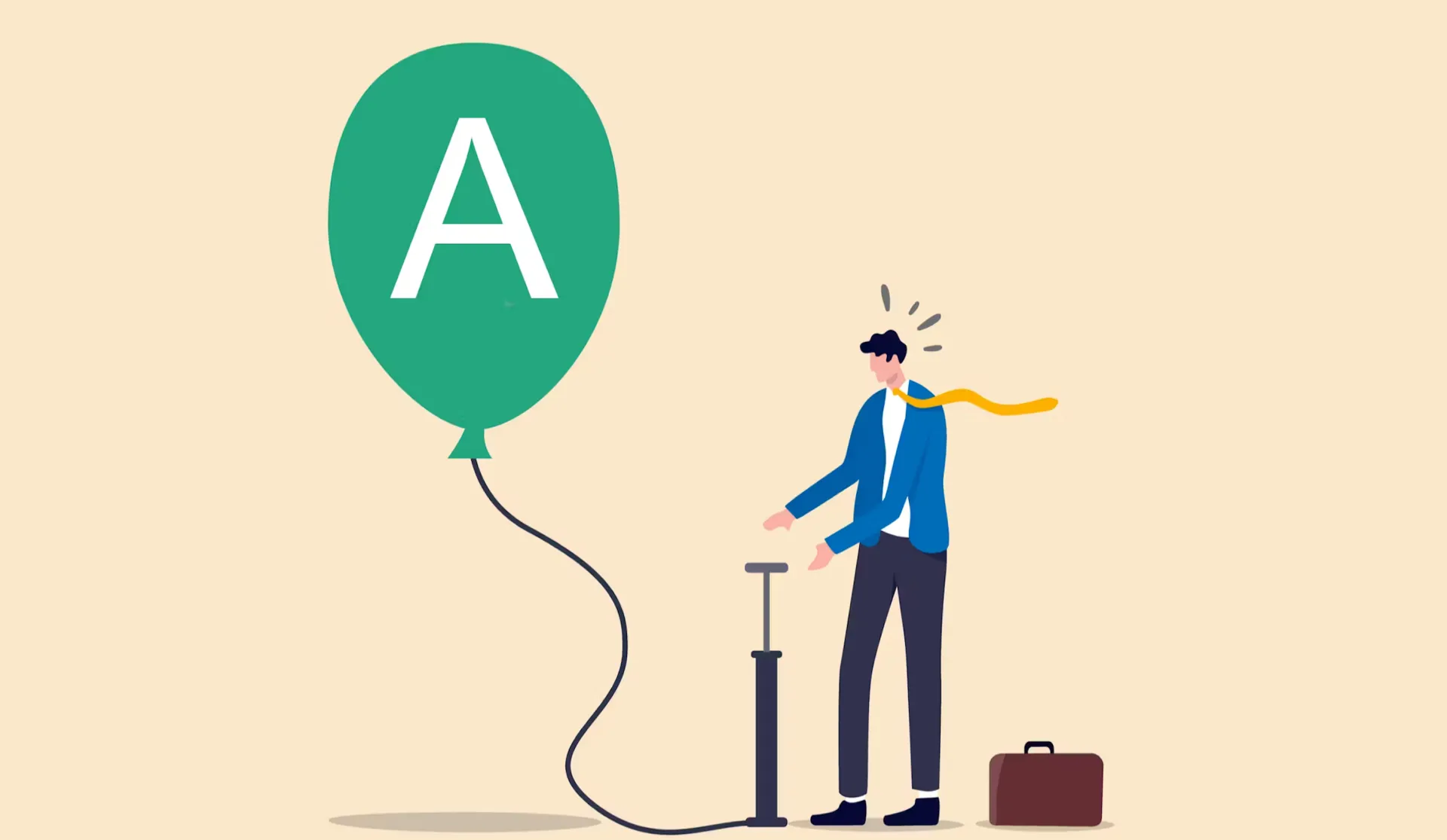
The cause is “grade inflation,” or the common, decades-old practice of handing out A’s for lesser work, due to constant, consequential demands by students, parents, and administrators.
For example, take Harvard University, where last year 84 percent of all undergraduate grades were an A or A-minus. Meanwhile, a few years ago, a high school in Arlington, Va., had 213 valedictorians among its graduating class of 595—and every one of them had a GPA of at least 4.0.
Grade inflation is prevalent—but does it really matter? New research says it may. A study co-written by a University of Texas at Austin economist found that high school students who experience more lenient grading are less likely to pass subsequent courses, to graduate from high school and go to college, and will earn significantly less money over the course of their lives.
Still, many educators say the outrage around grade inflation is misplaced. It’s just another way to vilify educators, pile on “kids today”, and distract public attention from real problems. The truth is that grading often has nothing to do with learning, they say. When it comes to incentivizing students or assessing what they’ve learned, there are better ways to do it than grading.
The Roots of Grade Inflation
When Seth Czarnicki was in his first year, teaching English at a high school in central Massachusetts, a parent asked to meet with him and his principal. The problem? Czarnicki had given her son a B-minus on an essay and this parent wanted an explanation of how that was possible. “I stumbled, stammered and sweated through the entire meeting,” wrote Czarnicki, in an essay for WBUR in 2024.
These kinds of meetings—and interrogations—are common and have been for many years. Often, administration will suggest to teachers that they avoid conflict with parents by creating clear grading rubrics, while simultaneously suggesting they avoid failing students at all costs. Says one Maryland high school teacher: “I’ve been told to pass every student if they come to class. It doesn’t matter if they do zero work, like absolutely zero work. Admin says I can’t fail them.”
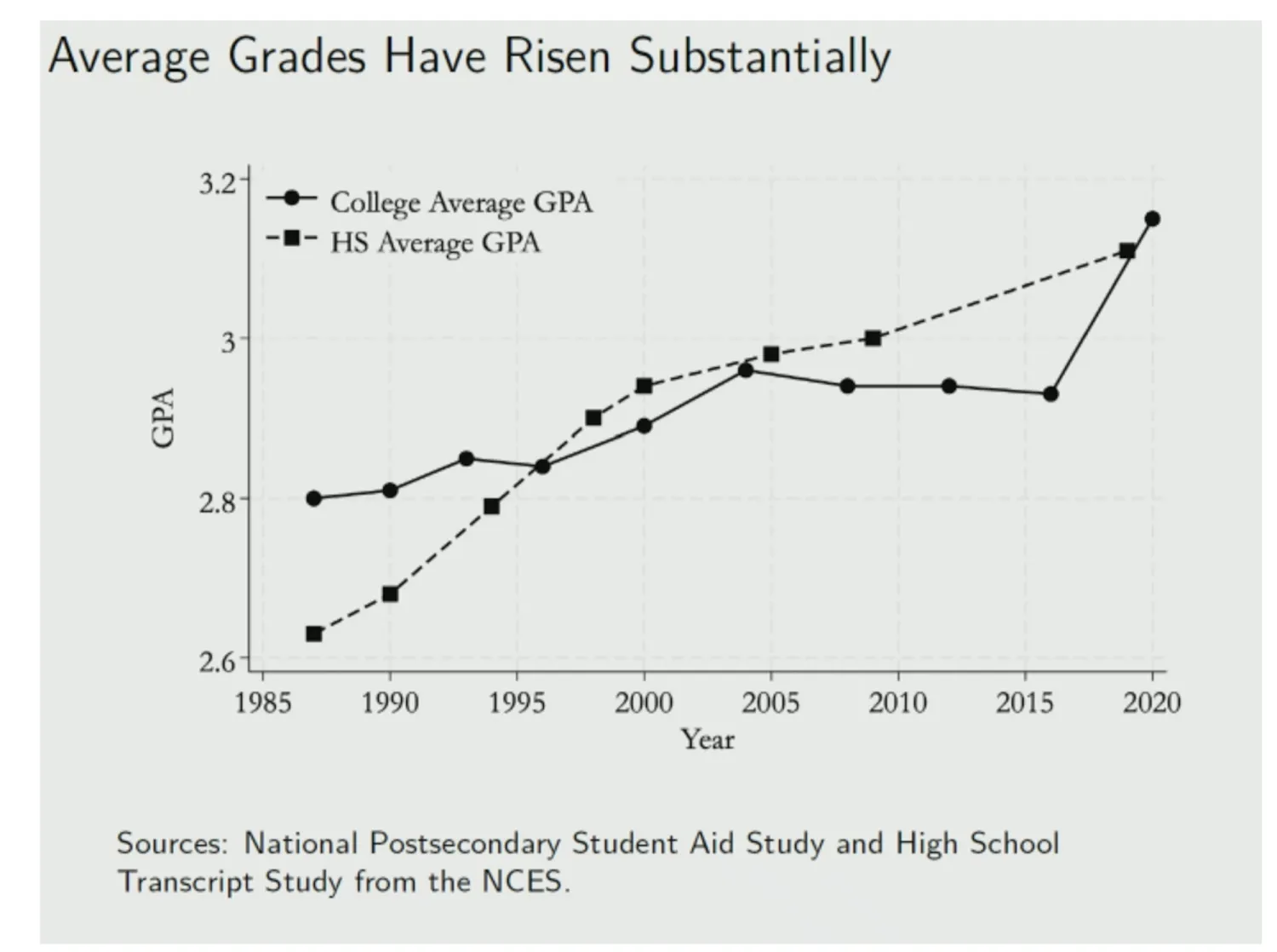
There is no question that grade inflation exists. The average GPA in America has risen from around a 2.6 in 1985 to 3.1 in 2020, among high schoolers, and from a 2.8 to nearly 3.2 among college students, the Texas study shows. But the fault doesn’t lie with faculty or teachers. Pressure from school district officials and principals can play a major part.
At the higher education level, it’s students who are knocking on their doors during office hours.
Says one New Hampshire professor: “Things I’ve heard from students, and it always seems to be at the very, very end of the semester, like when final grades are due and there’s really nothing more they can do to improve them, include: ‘If you gave me extra credit for something, I could get an A-minus instead of a B-plus.’ and ‘At my high school, we got [test] retakes. I thought you’d give us retakes, too.’”
Just once, the professor adds, a student said to her: “My parents are paying a lot of money for this class.”
Indeed, as grades have risen over the past decades, so has the cost of college, she notes: students may think they deserve the grades they’re paying for, not the grades they’re earning.
Why Now?
None of this is new. Americans have been talking about “grade inflation” since 1972, when the phrase—attributed to a Harvard sociologist—first appeared in a front-page New York Times article. At the time, colleges had been experiencing a great deal of campus activism, especially anti-Vietnam War protests, and student bodies were growing more diverse.
“Grade inflation quickly emerged as a synecdoche for broader cultural unease with the state of American higher education, and, by extension, ‘kids these days,’” wrote Alex Brondini-Vender, in the Washington Monthly, earlier this year.
Today, the setting is similar. On campuses across the country, some students are engaged in high-profile demonstrations.
Are rising complaints about grade inflation just another way for conservative pundits to grumble about a more progressive generation?
“In the right-wing media, the old narratives about grade inflation have returned with new force,” writes Brondini-Vender.
Teacher unions, of course, are a favorite target.
“But teachers are usually the ones resisting grade inflation,” writes Los Angeles Teacher Glenn Sacks. “They’re usually demanding rigor and accountability. Also, our unions don’t tell us how we should grade; instead, they defend our discretion in grading.”
Educators are caught between a rock and a hard place, he notes, and it’s not just that administrators and parents are demanding higher grades. In recent decades, and especially since COVID, students’ mental health concerns have multiplied. More and more are unhoused. More and more are hungry. Chronic absenteeism is an issue. Would more rigorous grades help or harm them?

The Research on Grading
A lot of research shows it would harm them, actually. A 2023 study, published in a journal of higher education, compared students at colleges with traditional grades versus students at colleges that use a pass/fail system with an “end of course narrative evaluation” by professors. It found that grades increase student anxiety and made students avoid more challenging courses, while narrative evaluations led to higher levels of intrinsic and autonomous motivation among students. Without grades, students were driven to learn because they enjoyed learning and because they felt it was important for their personal growth.
Meanwhile, the pressure to get good grades is the biggest contributor to young people’s mental-health issues, like depression and anxiety, according to a Pew Research Center survey of 13- to 17-year-olds.
The negative impacts of grading have been understood for a long time. According to researcher and author Alfie Kohn:
- Grades tend to diminish students’ interest in whatever they’re learning.
- They create a preference for the easiest possible task.
- And they tend to diminish the quality of students’ thinking.
And yet, new research suggests more rigorous grades might pay off in the long run. A 2026 draft paper from economist Jeffrey Denning and co-authors shows that high school students who experience more lenient grading are less likely to pass subsequent courses, to graduate from high school and go to college, and will earn significantly less money over the course of their lives.
In the study, Denning looked at data from hundreds of thousands of students in Los Angeles and Maryland, and followed Maryland’s students into college and employment. "The cumulative impact is economically significant: a teacher with one standard deviation higher average grade inflation reduces the present discounted value of lifetime earnings of their students by $213,872 per year," he writes.
What’s Next?
As grade inflation gains new attention, schools and colleges are responding. This month, Harvard is weighing a new policy, which would cap the number of A’s in any class to 20 percent of students, plus four. In a class of 100 students, this means only 24 could get A’s.
The proposal is “clumsy, arbitrary and represents some degree of invasion into faculty autonomy. It is not ideal. But the alternative is the status quo, and the status quo is awful,” Harvard professor Steven Levitsky told Inside Higher Ed this week.

To deal with grade inflation at the secondary level, many colleges are turning back to SAT and ACT scores, once again requiring high school students to submit them as part of their college applications.
But many educators wish the current angst would provoke more consideration of the point of grading. “Where do we go from here?” asks Czarnicki. “I think about the problem of grades a lot like I think about our reliance on fossil fuels: Both are so entrenched in our lives that it’s hard to see a realistic way out. And yet we must.”
Alternatives to traditional grading systems exist, like narrative evaluations, but also “specifications grading,” which are based on the number of assignments completed successfully, or “mastery learning,” which is based on how well students have met learning objectives and allows students to try and try again. Some educators may also be experimenting with “ungrading,” which is when students give themselves a grade, and educators decide whether it should go up or down.
Ethan Hutt, a professor of education at the University of North Carolina at Chapel Hill, suggests focusing more of the usefulness of what students are learning and making grades “overwriteable.” “An example we use is riding a bike,” Hutt told NEA Today last year. “Once you learn how, it no longer matters how many times you failed previously.”
“The path ahead isn’t to rebrand grades the same way we have ‘clean coal’ — as if it’s something that actually exists,” says Czarnicki. “Instead, we need to end our reliance on traditional grades and create new systems based on what we know is true about learning and motivation.”
In other words, the problem isn’t grade inflation, it’s grades.