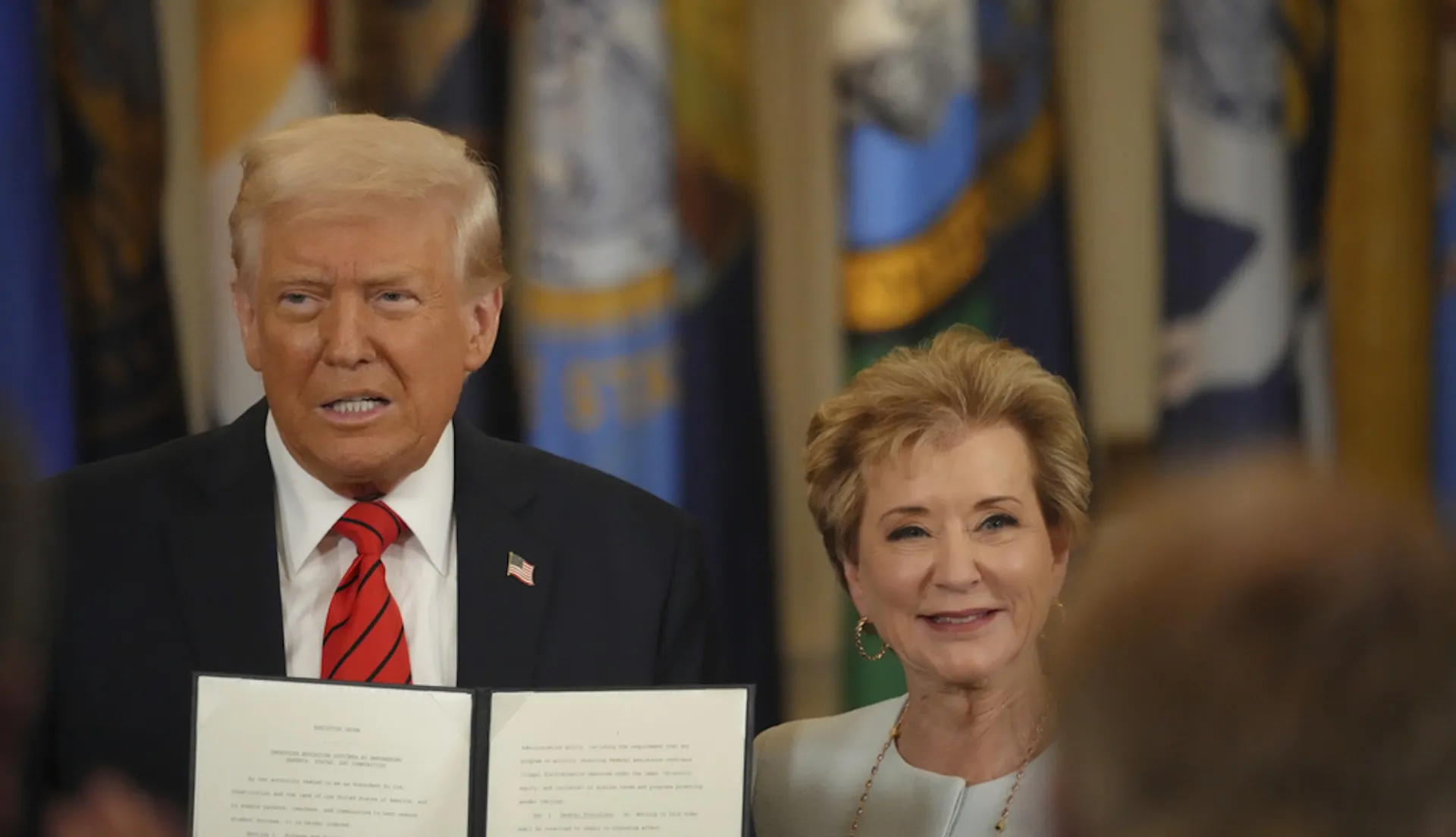
On March 20, 2025, President Donald Trump issued an executive order to abolish the U.S. Department of Education (ED).
Although the Trump Administration cannot eliminate the department altogether without the support of Congress, Secretary of Education Linda McMahon said soon after taking office that shrinking the department as much as possible was in effect its “final mission.”
Over the past year, the administration has taken a wrecking ball to public schools, harming the most vulnerable and underserved students. In one year, McMahon fired nearly half the department’s staff, moved the management of major programs to other federal agencies, cut grant programs that serve as the lifeline for minority-serving institutions, shifted funding away from basic needs for students and their schools—afterschool programs, meals, building modernization updates, literacy programs, and more—and made school privatization the administration’s top education priority.
One Year of Disastrous Change
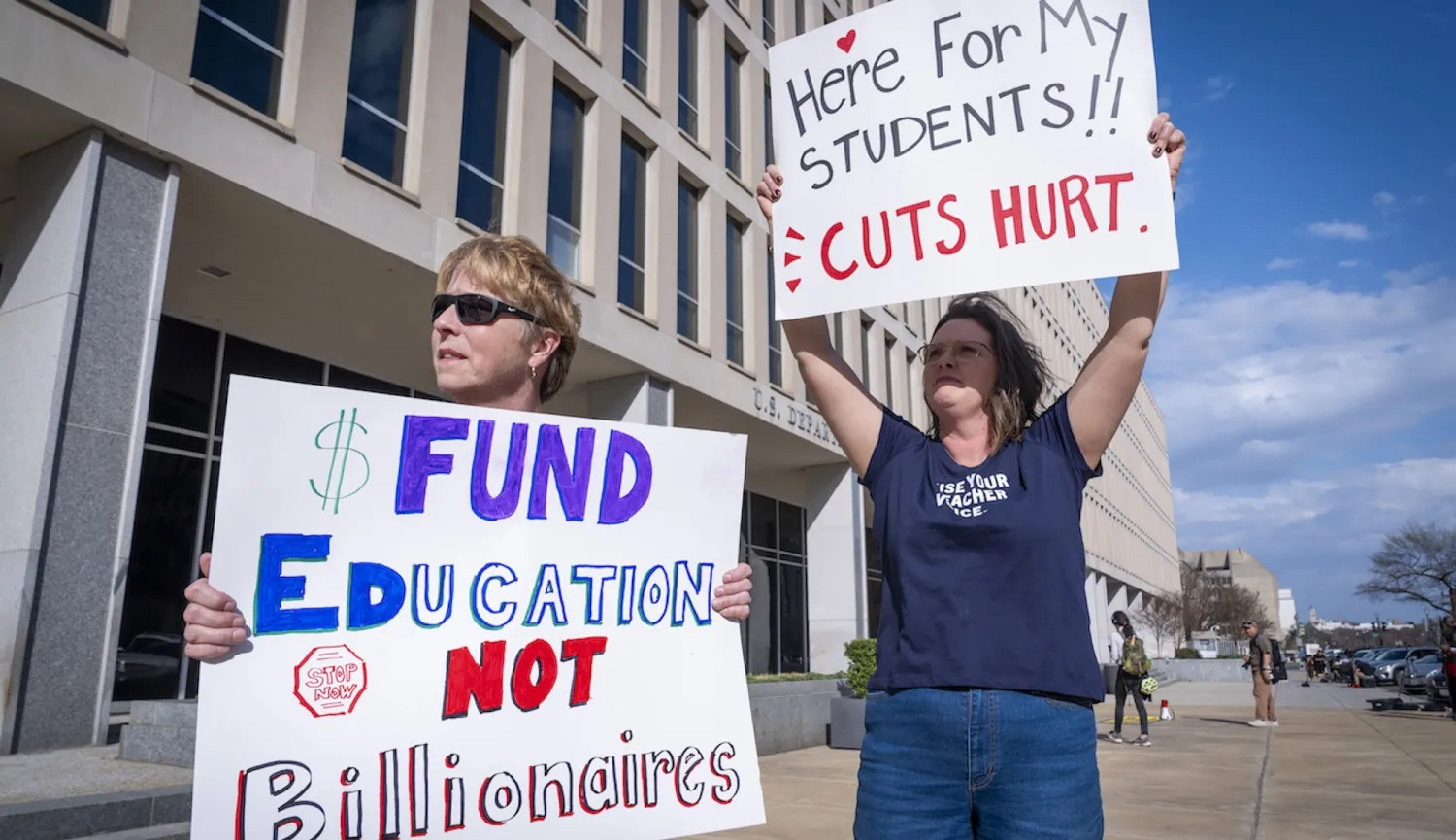
On March 4, the one-year anniversary of McMahon’s confirmation by the U.S. Senate, a group of education leaders, activists, government employees, and students, braved the rain to gather outside the Department of Education to spotlight Trump and McMahon’s destructive year.
“We may be standing here in the rain today, but educators are used to showing up in every kind of storm across the country,” NEA Secretary-Treasurer Noel Candelaria told the crowd.
Joining Candelaria were U.S. Representatives Mark Takano of California and Adelita Grijalva of Arizona, and former ED staffer Michael Pillera.
As Candelaria, a special education teacher and the father of a public school student with an IEP, told the crowd, “McMahon has never been qualified for this role. She has no meaningful experience in public education and no understanding of what it takes to help students like my students in my classroom and my own child to thrive in their public schools.”
ED’s Office for Civil Rights (OCR)—which is tasked with ensuring equal access to education and addressing complaints of discrimination—has been a particular focus of McMahon’s destructive agenda.
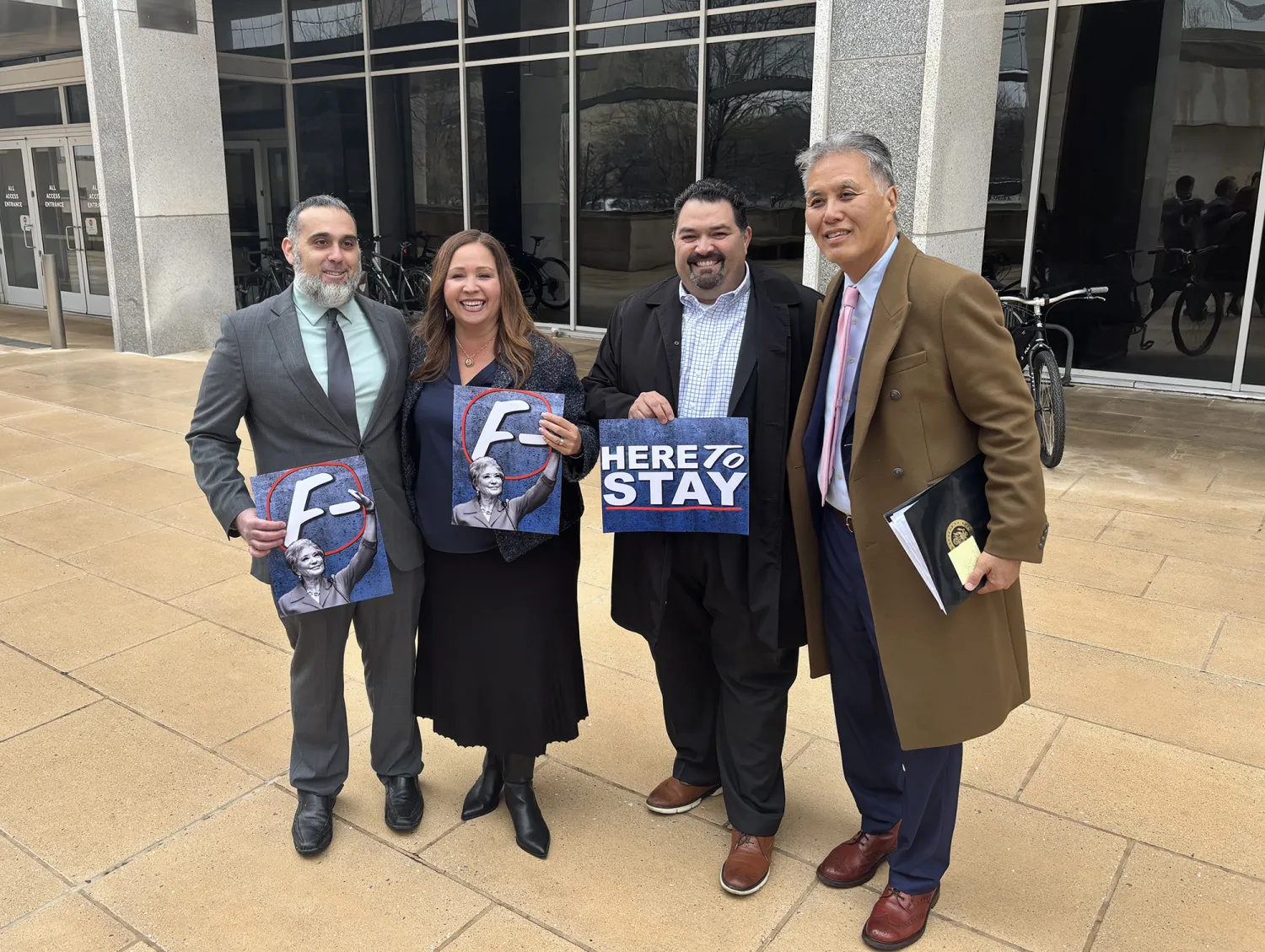
Michael Pillera, a former attorney at OCR, said, “For nearly a decade... I had the privilege... of working with some of the brightest, most dedicated public servants you can imagine.”
Most of those public servants are no longer at the Department of Education. Over the past year, the ED has fired 90% of OCR’s staff.
Even though the staff may be gone, discrimination is not. Pillera pointed out that while there are 30,000 pending discrimination complaints, the department's leadership is abandoning OCR's mission of enforcing federal civil rights in schools.
"The office that once helped enforce the promise of equal opportunity in American education has been gutted, repurposed and weaponized, and it is students and school communities across the country who are paying the price," Pillera said.
Moving—and Undermining—Critical Programs
In addition to gutting OCR, the administration is offloading ED’s programs to other federal agencies, working to dismantle the department piece by piece. As of March, the administration has struck nine interagency agreements, transferring a total of 118 programs out of the department and forcing the responsibility onto other government agencies.
It launched an aggressive campaign against diversity, equity, and inclusion (DEI) programs in schools, manufacturing a culture war crisis that limits academic freedom and dictates what educators are allowed to teach in their own classrooms.
Additionally, the administration has eviscerated education research grants. By revoking nearly $900 million in research contracts, Trump is eliminating critical data on what schools and families need. This includes information on school crime and safety, early childhood education, trade schools, teaching students with disabilities, and much more.
The administration also dismantled higher education student loan forgiveness for certain public servants, including teachers, firefighters, librarians, nurses, and others, and proposed a rule to significantly lower the cap on federal student loans for specific degrees, including education, nursing, and social work.
On March 19, the Education Department announced it was moving its student loan debt portfolio of nearly $1.7 trillion to the Department of Treasury. In addition to the fact that Treasury does not have the expertise or staff to administer this complex program, the administration's plan, which will be rolled out in three phases, will likely limit access of these funds to various populations—including those targeted by this administration under other executive orders and policies.
Broader Attacks on Education
The gutting of the Department of Education does not exist in a vacuum. Since Trump took office in January 2025, his administration has waged a sweeping assault on public schools and the communities they serve.
The administration withdrew federal protections around immigration enforcement in schools, encouraging ICE agents to terrorize students and educators, disrupting teaching and learning.
Trump also created a new federal voucher program. Across the country, vouchers have weakened public schools, blown up state budgets, and fostered discrimination, without any accountability. Included as a provision in the budget reconciliation bill signed into law in July 2025, the federal voucher program could direct up to $30 to $50 billion annually to fund vouchers.
Legal Challenges
Because so much of this assault has been in direct conflict with existing law, NEA and other organizations have responded with a series of legal actions to protect public schools and students.
NEA is part of multiple lawsuits challenging the $12 billion in withheld funds affecting multiple grants. While some funding has been restored, most of it remains in limbo.
Under pressure, the administration in December 2025 did bring back hundreds of OCR employees to handle the backlog of civil rights cases.
In November, NEA joined a lawsuit to protect federal loan forgiveness for public servants.
While many of these lawsuits are still pending, in February, a federal court permanently struck down the administration’s efforts to restrict DEI in schools, a victory for academic freedom and education equity. The decision was in response to an ACLU lawsuit filed on behalf of NEA and NEA-New Hampshire, the Center for Black Educator Development, and several New Hampshire school districts.
“The Trump administration’s unlawful Dear Colleague Letter and certification requirement have now been vacated and abandoned, underscoring how badly Trump and McMahon overreached in their attempt to interfere with curriculum and instruction,” said NEA President Becky Pringle. “Educators, parents, and community leaders will continue to organize, mobilize, and take action to protect our students and their futures.”