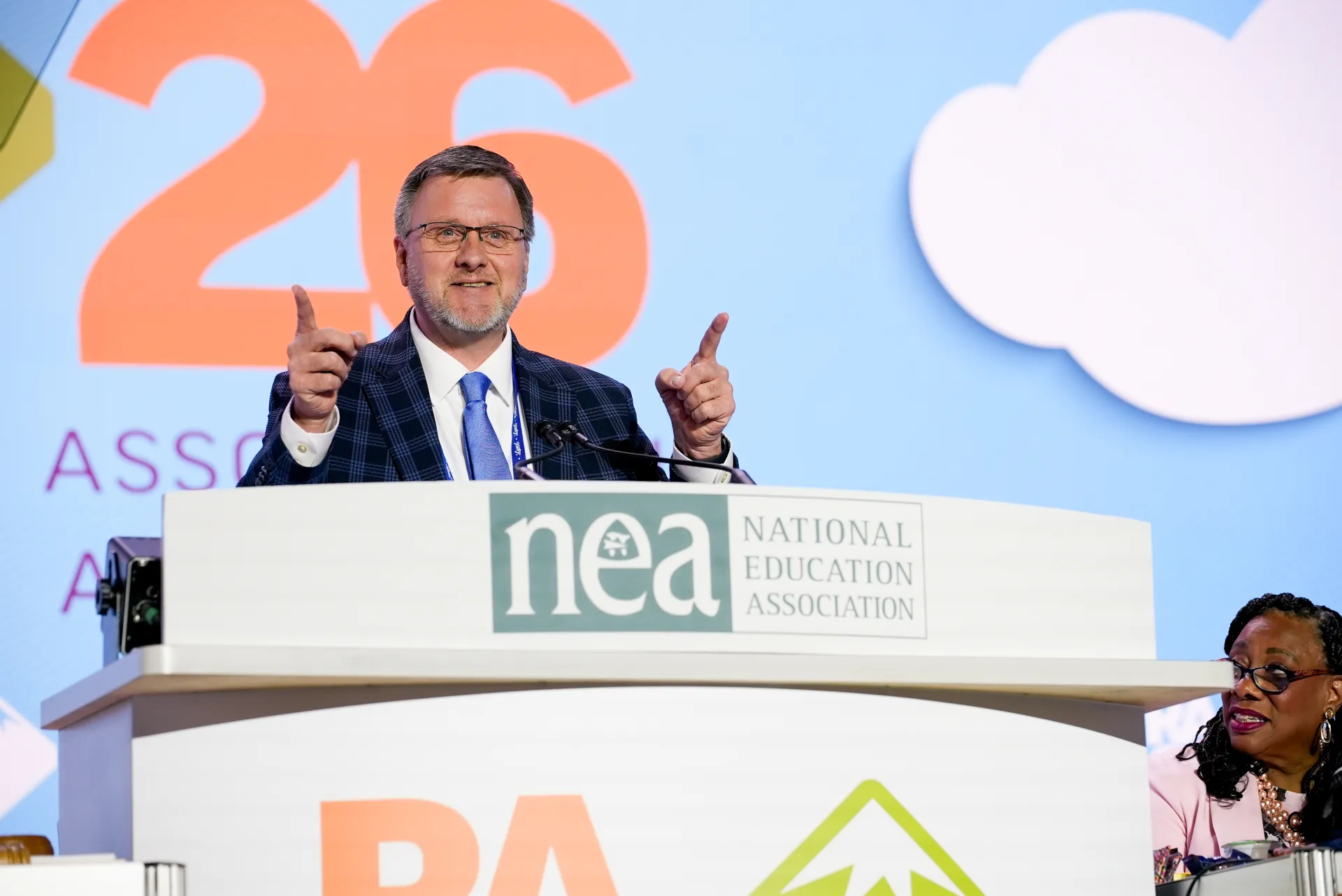
NEA Higher Educator of the Year Clinton Smith, a professor of special education at the University of Tennessee at Martin, told a story on Monday about a Special Olympics athlete named Sam.
Smith, who addressed the NEA Representative Assembly (RA) delegates, in Denver, has been involved in Special Olympics for decades. In 2022, he coached Sam at the USA Special Olympics Games.
“Sam was in a track event. And right after the starting gun, another runner in his heat went down, hard. Just fell. And the field took off,” Smith recounted. “Sam stopped. He turned around, went back, and helped that athlete up. And then—instead of sprinting for the finish line—he linked arms with him, and they walked across the finish line together.
“Sam didn’t want the medal more than he wanted that person to finish the race. That is solidarity,” Smith told the nearly 7,000 NEA members—teachers, classroom aides, cafeteria workers, college staff, and others—who are gathered at the Colorado Convention Center to set policy for the nation’s largest union.
“I think about Sam a lot when the work gets hard—because it does get hard. And it's tempting, when it's hard, to just run your own race,” Smith told delegates. “Remember, an individual is a spark; a collective is a wildfire. Alone, they can ignore us. Together they have to face us.
“Be someone’s Sam. That’s our mission. Stand up for each other.”
Meeting the Challenges Ahead
Faculty and staff at the nation’s public colleges and universities face growing challenges these days. State and federal funding cuts. Attacks on academic freedom, or their ability to do research or debate issues in the classroom without political interference. In Florida, politicians are attempting to remove entire fields of study from campuses, and making it harder and harder for faculty and staff to belong to unions and speak up together.
Smith—who has worked in K–12 and higher education for 30 years—addressed those issues on Monday, saying that he doesn’t take his selection as NEA Higher Educator of the Year as “a compliment,” but rather as a “challenge.”
“To keep fighting. To bring more people into this work. And to make sure the next 30 years look better than the first.”
To do this, Smith referred to “the seven powerful verbs” that have been championed by NEA President Becky Pringle, who is overseeing her final RA as NEA president. (On Sunday, the RA elected Virginia teacher Princess Moss as the next NEA president.)
“First, we educate,” Smith told delegates. “That's the foundation of everything we do. But part of that mission—a part we sometimes skip—is educating the public about what we actually do and what we’re actually up against …. Faculty working conditions are student learning conditions. That’s not a talking point. That’s a fact the public needs to hear. And we need to say it like we mean it.”
Second, educators need to communicate, Smith said. “Now, I coach sixth-grade boys’ basketball. And I will tell you—there is no situation in my professional life that has better prepared me for difficult communication than trying to run a half-court of offense with 12-year-olds who think they’re Steph Curry.
“At some point every season, I am standing on the sideline watching one of my guys dribble directly into triple coverage. And I have to make a choice—do I stay quiet, or do I say something? I say something. Every time. Because silence doesn’t teach anybody.
“On our campuses, we have to make the same choice. Our value, our research, our expertise—none of it speaks for itself. We have to speak for it. Clearly, consistently, and without apologizing for taking up space.”
Organize, Mobilize, and More
The third verb is organize. “When you organize, you look a colleague in the eye and say: we are stronger together, and there is a place for you here,” said Smith. “That’s the whole pitch. And it works. You can’t truly fight for students without also fighting for the people who teach them.”
Next? Mobilize. Find the room where decisions are being made “and pull up a chair,” said Smith. Take your energy into faculty senate meetings, into shared governance, he urged.
Then, legislate and elect. Know your legislators by name. Show up in their offices. “Support candidates who understand what public education is worth,” Smith advised.
And finally, the seventh verb: “When they come for our contracts, when academic freedom gets attacked, when tenure gets treated like a suggestion, we litigate,” Smith said. “Look at the NEA’s injunction against the Higher Education Dear Colleague Letter. That decision protected real people, faculty who would have lost protections they’d spent careers earning.
“That’s what it looks like when we stop asking politely and start drawing lines in the sand.”
In conclusion, Smith thanked his family, the Tennessee Education Association, NEA’s National Council for Higher Education, the NEA Foundation, and “every delegate in the room.”
“Now, let’s go back to our campuses and do what we do. Let’s demand what’s fair. Let’s bring out the brilliance in every person we serve.”