Key Takeaways
- Since 2023, more than 40 states have passed laws banning or limiting the use of student personal devices in school.
- According to a new survey by RAND and NEA, teachers and principals report that new cellphone policies have had a positive impact on their students and classrooms, although challenges around enforcement remain. Generally, principals had a more upbeat view of the policies’ implementation and impact.
- NEA supports limiting student use of cellphones and other personal devices from “bell-to-bell” and has produced a new action guide to help affiliates take the lead in advocating for new policies.
63%
60%
In 2023, Florida was the only state that had enacted a law restricting cellphone use in schools. As of October 2026, that number has grown to more than 40 states. Most of these laws impose “bell-to-bell” restrictions (prohibiting cell phone/personal device usage during the entire school day), while others limit during instructional time only.
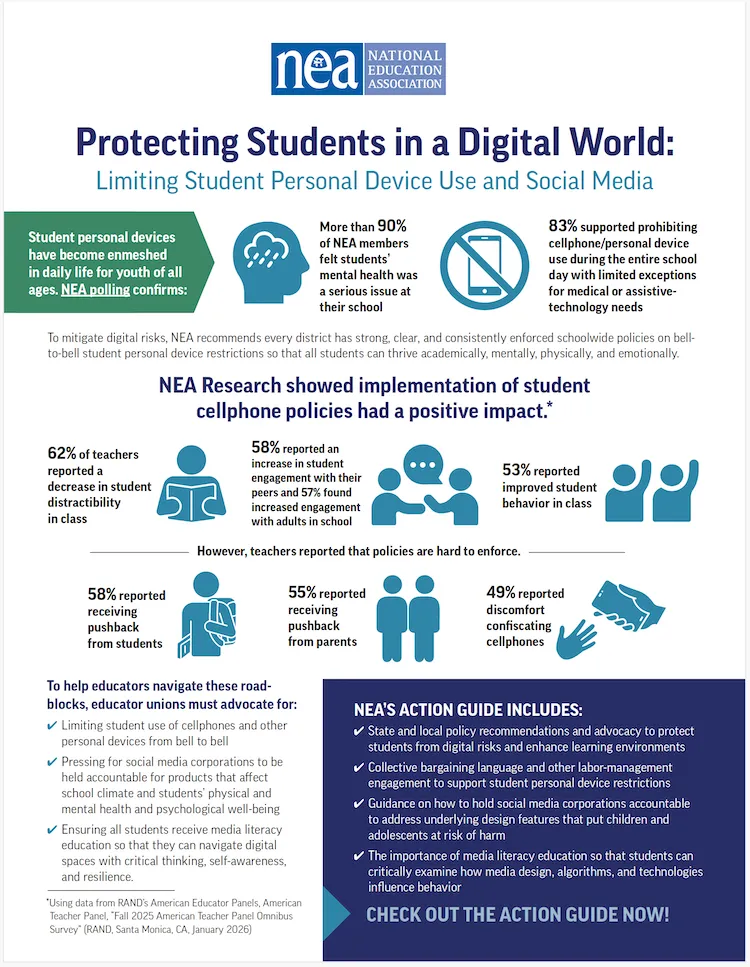
In many of these states, districts have had new policies in effect for an entire school year. With educators and administrators supporting these new regulations (a 2024 NEA survey found that 83% of educators favored bell-to-bell bans, with exceptions for things like medical or assistive-technology needs), expectations are high. So, the question now is: How are these new policies working out? Are they clearly designed and enforced? Are classrooms less disruptive? Are students more engaged in classroom work? Has student behavior improved?
Earlier this year, the RAND Corporation and NEA surveyed public school teachers and principals to find out if they believe personal device policies are succeeding.
What do they think so far? It depends largely on who you ask. On one hand, both teachers and principals expressed support for the new policies and cited improvements on several key measures. On the other, a closer look reveals that principals had a measurably more positive take on the impact.
Positive Results, With Caveats
According to the survey, more than half of principals and teachers said their school was implementing its cellphone policy “using clear and consistent rules,” “using consistent enforcement,” and “using clearly defined exceptions.”
However, fewer than half of teachers agreed that their school implemented its policy “using regular feedback and evaluation mechanisms.”
Also, 87% of principals said the school was using consistent enforcement, while only 57% of teachers said the same.
The survey also asked about ten measures of the policies' effectiveness, including student distractibility, student engagement, student mental health, student behavior, etc. On nine of the ten measures, at least 69% of principals reported positive impact (the highest being student distractibility with 85%). The only measure in which a majority did not report progress was student participation in extracurricular activities.
Teachers cited the positive impacts on a variety of measures but were not quite as enthusiastic as principals. Most teachers said they saw results on student distractibility (63%), engagement with peers (59%), engagement with adults in schools (56%), and student behavior (52%).
But less than half of teachers reported positive results on improving student mental health (47%), reducing cyberbullying (37%), reducing bullying in person (29%), or participation in extracurricular activities (28%). Forty-nine percent said new cellphone policies increased time for teaching, and 46% said academic performance had improved.
The survey also found that the principals and teachers, when asked about enforcement obstacles, most commonly cited pushback from students, followed by pushback from parents and educator discomfort at confiscating cellphones. Thirty-nine percent of teachers also cited a lack of administrative support.

Better Engagement, Better Work
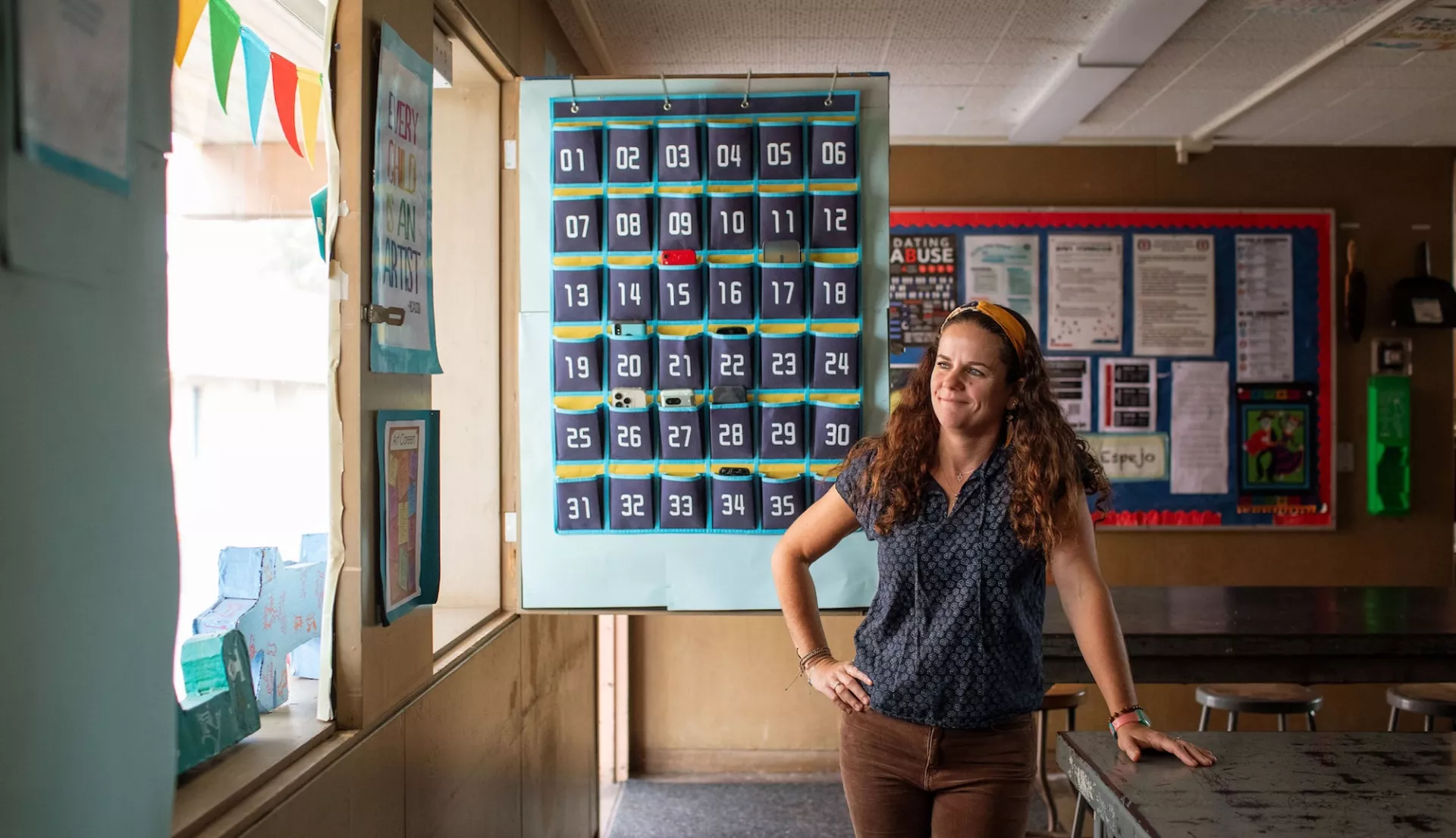
Kimberly Bleier, a high school social studies teacher in Concord, New Hampshire, has seen many of these improvements in her school since a statewide bell-to-bell prohibition was passed in 2025.
“The hallways used to be silent,” recalls Bleier, who is president of the Concord Education Association. “Students would be staring at their phones, bumping into each other. Now, we’re hearing conversations in the hallway, in the cafeteria, and in the classroom. And they're doing better work academically. Students are much more focused on learning, instead of the screen.”
Bleier also says her days of being the “cellphone police” are largely in the past.
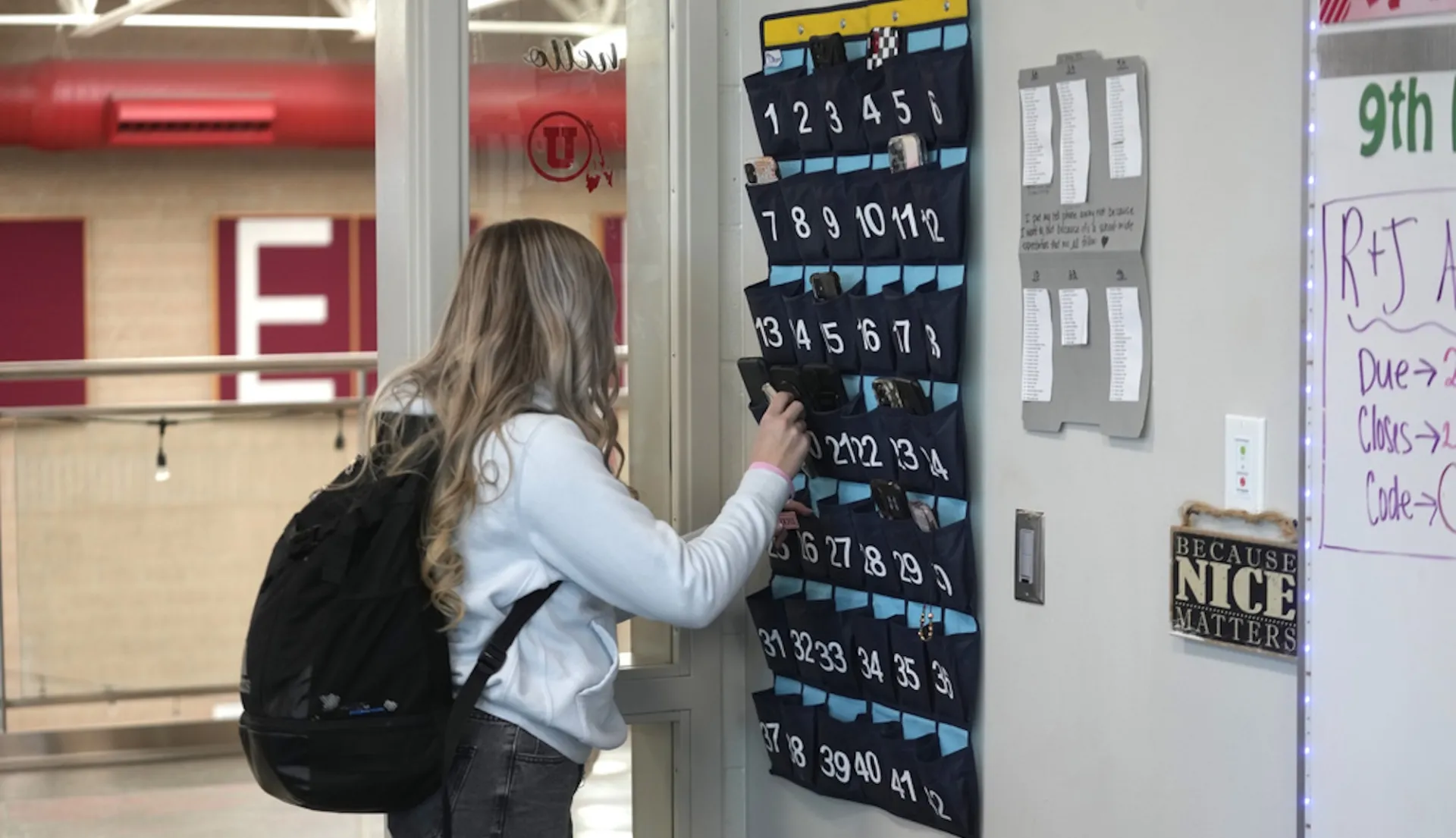
“It was a constant battle for every teacher, and it was exhausting. It really wears you down. But since the bell-to-bell law went into effect, I very rarely have conversations with kids about their phones. It's been taken off my plate, which is nice when there are so many things on my plate in the first place.”
NEA-New Hampshire (NEA-NH) was instrumental in the cellphone law’s passage. By bringing the issue to the attention of a bipartisan group of lawmakers, “we were the boots on the ground from the start,” says Bleier.
Unions Take the Lead
New Hampshire’s law went into effect when schools were out of session, so district leaders and educators had a short turnaround time on figuring out new policies and procedures.
NEA-New Hampshire leaders had used an NEA toolkit with sample policies and school board resolutions to help shape the legislation, including when they worked with the senate sponsor of the bill and the Governor's office on the final negotiations of the bill language.
After the bill was passed, those same resources helped NEA-NH hit the ground running on implementation. (The NEA action guide, recently updated and expanded, can be used by affiliates to not only advocate for bell-to-bell personal device policies, but also for social media corporate accountability and media literacy education.)
“Many local leaders, myself included, shared that toolkit with our school administrators,” says Bleier. "We had to move fast. Each district could make their own policy as long as it fits within the law's parameters. So, some schools are trying to figure out, are we going to use lockers? Are kids going to keep them in their bags? And in some districts, it may not be going quite as well as they hoped.”
But New Hampshire law requires districts to review new policies annually. “It’s good that we're being asked to continually analyze how it's going,” Bleier adds.
Bleier says the message and support from her school’s administration has been clear and consistent. “When there’s been an issue, it’s been dealt with swiftly and effectively, and that’s been a great help, because I don’t want to battle with my students. I just want them to enjoy school and engage with each other, with me and the curriculum. That should always be the focus.”