
Share this book
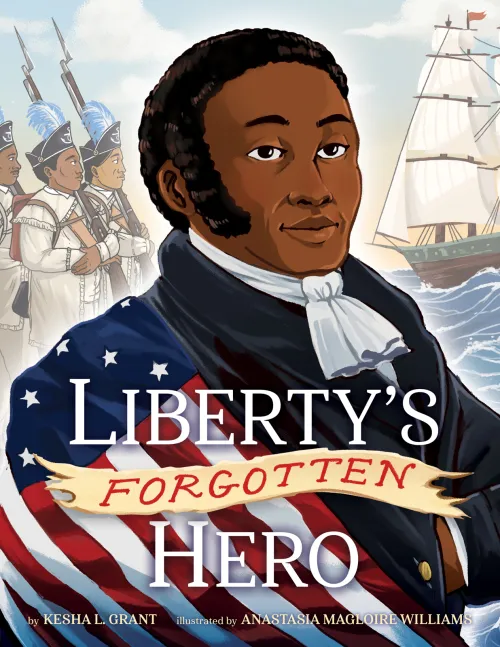
After reading Liberty’s Forgotten Hero, explore the author’s imagery of “stitching America into a more perfect union, where all people will be truly free and equal.” Talk with students about the many pieces of cloth that must be carefully cut and stitched together to create a sail strong enough to catch the wind and carry a ship forward. What “pieces” are needed to create a country where everyone is valued and treated fairly?
Invite students to put those pieces together by creating a class “Freedom Sail.” Have each student create a panel representing a value, action, person, law, right, responsibility, community institution, or another idea they believe is essential to building a community where everyone can belong. Ask them to include an illustration and a brief explanation of why they chose that idea. Younger students can draw and dictate their explanations, while older students can support their thinking with a quotation, example, or evidence.
Work together to stitch the panels into a large Freedom Sail and invite students to share the thinking behind their contributions. Discuss how each panel adds strength to the sail, just as every act of courage, fairness, and kindness helps move our communities and our country toward a more perfect union.
Questions for Discussion or Reflective Writing
- Why do you think James kept believing in freedom and equality, even when he saw that his country was not living up to those ideas? What gave him the strength to keep working for change?
- James Forten knew that one person could not end slavery and unfair treatment alone. How did he work with others to create change? Why is working together important when people are trying to make the world more fair?
- What does James’ story teach us about who gets remembered in history? Why do you think some people are forgotten while others become famous? What can we do to make sure more stories are known?
- If you could spend one afternoon talking with James Forten, what would you most want to ask him? Why?
- How did James use what he was good at to help other people? Why do you think James kept speaking up even after he became successful? What do his choices tell you about what mattered most to him?
Related Resources
Liberty’s Forgotten Hero Teacher’s Guide from Lee & Low Books
Author Kesha L. Grant Introduces Liberty’s Forgotten Hero: The Revolutionary Life of James Forten from Lee & Low Books
Telling the Stories of Black People Living During the American Revolution from the 1619 Project
Historic Craft of Sailmaking from Absolute History
An Historical Guide to Sailmaking from History Extra
More Titles to Try
-
Black Hands: Builders of Our Nation
by Carole Boston Weatherford, illustrated by R. Gregory Christie

-
Forgotten founders: Black Patriots, Women Soldiers, and Other Thinkers and Heroes Who Shaped Early America
by Mifflin Lowe, illustrated by Wiliam Luong
-
Fort Mose and the Story of the Man Who Built the First Free Black Settlement In Colonial America
by Glennette Tilley Turner
-
Sojourner Truth's Step-Stomp Stride
by Andrea Davis Pinkney and J. Brian Pinkney
-
William Still and His Freedom Stories: The Father of the Underground Railroad
by Don Tate
Stay on top of current education news