NEA speaks up for the rights of students. Browse recent messages to Congressional leadership, and add your voice.
We're speaking up for our students and public schools. Visit our Action Center to find out what you can do.
Learn More

Published: February 18, 2025
More careers than ever require post-secondary education, yet higher education is increasingly out of reach. Students and families—not public dollars—now fund the bulk of higher education costs.
For years, NEA members advocated canceling college debt to help fix educator shortages. In the last decade under NEA’s advocacy, student loans taken out by 48 million borrowers have been substantially reduced, forgiven, or even canceled outright. This includes more than 1 million public service workers who have received over $78 billion in student debt forgiveness thanks to Public Service Loan Forgiveness (PSLF).
NEA also supports dedicated faculty, staff, and graduate workers of our nation’s colleges and universities who help students pursue their passions. We advocate for safe working conditions, fair pay and benefits, academic freedom, increases to tenure density, and so much more.
-
Don’t Move Education Programs
Submitted on July 15, 2026
-
Treat Educators as the Professionals They Are
Submitted on June 24, 2026
Bills in Congress
Learn NEA's position on pending legislation related to public education, and take action to protect our schools
-
Support
S 5559 Basic Assistance for Students In College (BASIC) Act of 2026 www.congress.gov
Introduced on September 24, 2026
The BASIC Act would establish a $1 billion competitive grant program to help institutions of higher education identify and meet students' basic needs, including food, housing, transportation, child care, health care, and technology. The bill also requires a national report on student basic needs insecurity.
-
Support
HR 10612 Basic Assistance for Students In College (BASIC) Act of 2026 www.congress.gov
Introduced on September 24, 2026
The BASIC Act would establish a $1 billion competitive grant program to help institutions of higher education identify and meet students' basic needs, including food, housing, transportation, child care, health care, and technology. The bill also requires a national report on student basic needs insecurity.
-
Support
S 5429 Hot Meals for College Students Act www.congress.gov
Introduced on September 17, 2026
This bill will allow for college students to use their Supplemental Nutrition Assistance Program (SNAP) benefits to purchase hot and prepared meals from on-campus vendors.

A History Advocating for Higher Education
1965
Higher Education Act Becomes Law
President Johnson signs the Higher Education Act (HEA) into law to “strengthen the educational resources of our colleges and universities and to provide financial assistance for students in postsecondary and higher education.”
1972
Pell Grants Begin
The Pell Grant program, the largest grant program that the U.S. Department of Education offers to undergraduate students, is created.
1992
Higher Education Act Reauthorization
Congress reauthorizes the Higher Education Act and Pres. George H.W. Bush signs it into law. The reauthorization significantly expands the student loan program.
1998
GEAR UP Begins
The Higher Education Act Amendments of 1998 authorize Gaining Early Awareness and Readiness for Undergraduate Programs (GEAR UP). GEAR UP provides six-year grants to help increase the college-going rate of low-income students.
2007
PSLF Program Created
The Public Service Loan Forgiveness Program (PSLF) is created under the College Cost Reduction and Access Act. PSLF is designed to encourage students to enter public service professions, such as education, through a promise to forgive student loans after 10 years’ worth of payments.
2008
Higher Education Opportunity Act Enacted
The Higher Education Opportunity Act is enacted, reauthorizing the amended version of the Higher Education Act of 1965.
2021
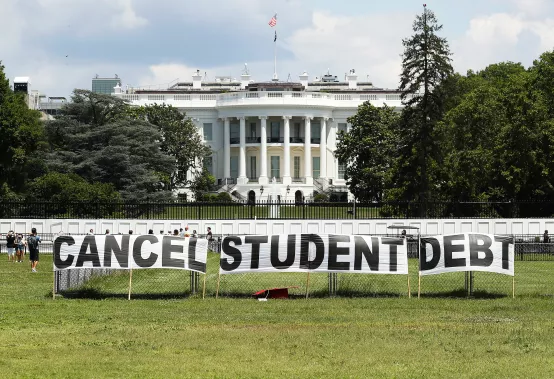
PSLF Program Overhauled to Meet Educators' Needs
The Biden-Harris administration on October 6 announces an overhaul of the PSLF program, including a broad expansion of the types of payments that count toward loan forgiveness. An estimated 550,000 public-service workers will see their progress toward PSLF grow because of the changes. The overhaul resulted after the administration received 168,000 emails from National Education Association members.
We're speaking up for our students and public schools. Visit our Action Center to find out what you can do.
Are you an affiliate?
Jump to updates, opportunities, and resources for NEA state and local affiliates.

Cancel Your Student Debt
By working to cancel student debt and improve forgiveness programs, we can make sure everybody who wants to learn and grow can do so—without exceptions.