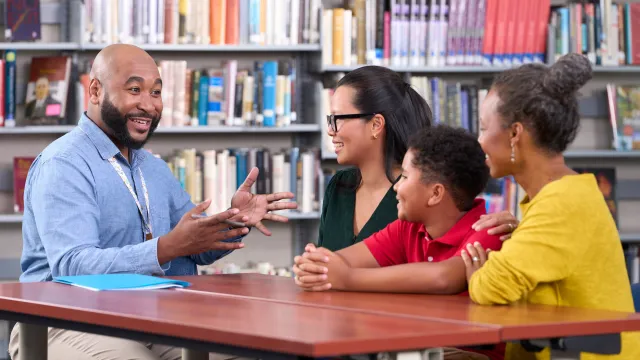
John Quesenberry on Vouchers
Transcript
Thank you, Senator, for this opportunity to talk with you on behalf of my students and colleagues in our local communities regarding the threats our community public schools are facing from the voucher programs that both the state and federal governments are imposing upon us.
My name's John Quesenberry. I'm a history and civics teacher at Woodrow Wilson High School in Beckley, West Virginia. And like many of my colleagues over the years, teaching has been a calling, not a career. The influences of my parents, my faith, scouting, love of country, and inspirational teachers in my own life have led me to believe that God truly blesses us to be a blessing to others and that our lives only truly are well-lived when we dedicate them to lifting up, serving and encouraging others.
And I've had that opportunity and privilege for 38 years in my classroom as I face students each day who will be those next generation of students to help lead us into becoming a more perfect union.
(01:04)
Today, however, it's becoming much more difficult to provide these opportunities to our students.
As our local community public schools are not only being underfunded, but defunded as public taxpayer money is being confiscated from the local community schools with a redistribution of funds to private and charter schools, home schools, micro schools. And our state taxpayer money has even been sent out of state to other online schools and spent as part of the HOPE voucher program.
The HOPE program takes about $5,400 from the school whenever a student leaves the public school, reallocates that to parents to spend however they dictate if they homeschool or for tuition in a private voucher school. In my county, we're facing the closing of two elementary schools due to dropping enrollment and the bleeding off of these funds.
(02:22)
It was really heartbreaking to listen to students, scores of students and parents and teachers speaking, pleading for their school to be left open, talking about the high transient student population.
There are so many students whose families had fallen into the opioid drug epidemic who were being raised by their grandparents, great grandparents, foster care, in some cases no support at home. And one of the teachers spoke of a little boy that he wasn't prepared, he was sleeping, he wasn't putting forth much effort, what's wrong?
She finally talked to him and said, "I found out that for the past 30 days he had been sleeping in a bathtub. He didn't have a bed, he didn't have a couch, that's what he had.
And then he came to school and did the best that he could, but he was in a local caring community public school where they found out what was going on in his life.
(03:29)
Fifth grade students who won't even be in this school next year were begging, please keep this school open for my little brother and sister. They need someone to take care of them like we've been taken care of." In my county, a lot of the loss of funds have come to homeschool.
And in neighboring counties, we've had tragedies in the last few years of an eight year old girl who was withdrawn from school when teachers noticed there were signs of abuse and she ended up dying from severe abuse and neglect. Then a 14 year old ended up being withdrawn from public school.
Police found how they described her was emaciated skeletal remains, 58 pounds as a 14 year old. And our state legislature, some tried to pass a law to prevent things like this from happening, saying that you could not move your child to be homeschooled if you're actively under investigation for abuse.
(04:47)
But our state legislature refused to pass that. Instead, they said, "Our HOPE voucher program now is open to every student in West Virginia. So any parent, whether they're under investigation for this or not, could receive that $5,400." And
I know those are extreme cases that doesn't happen with every homeschool parent, but these are kids' wellbeing and their lives that we're talking about. The little boy that had been sleeping in a tub, there's a lot of kids that don't have a whole lot, but for five days a week, they're fed, they're acknowledged, they're listened to, they're taught, they're loved and cared for and made to know that they matter.
(05:46)
And those nights when there's a ball game or a concert or a school activity, there's that chance for them to see that yes, even if you're what some would call the least of these, you're one of us.
My high school is one of the larger and more diverse in the state. Our nickname's the Flying Eagles and our coaches like to say, "Once a Flying Eagle, always a Flying Eagle." The little school I graduated from only had 300 students, grade seven through 12, little town called Herndon, but we would say, "Herndon born and Herndon bred, when I die, I'll be Herndon dead." Now those sound like cute, maybe trite sayings, but they're important. It's that sense of identity, of belonging, of knowing you matter.
Our founding motto, Eplora Basunam, out of many one, I firmly believe our military and our public schools are the only functioning institutions left where we are forced to be not only around people like us, but sometimes people very different from us and to learn from and with each other while we share a common identity.
(07:05)
And in our polarized society, this idea of losing those local community public schools, it's not just a danger for that school, that family, that student, it's a danger for our republic. Our founders believed in the necessity of civically engaged, educated public.
And as you've heard from many people today, some of these voucher schools do not have to accept students who are the most vulnerable and in the most need. We accept them, we offer what they're required to have, but the vouchers are making that so difficult because we can't afford the resources and the personnel to do that.
It makes me so angry to think that an American child could be told, "Yes, you can come to our school if you give away all of your federally guaranteed rights under IDEA or Title IX." That's not how it should be. So I applaud you for what you're doing.
(08:24)
I encourage you to keep fighting this good fight.
What Abraham Lincoln called the last best hope on earth, it's in those classrooms with those students that are all valued, accepted and playing a part in who knows becoming our next greatest generation.
Our public schools are an oasis of hope and we need to keep our public funding there because our kids deserve it and we owe it to them.