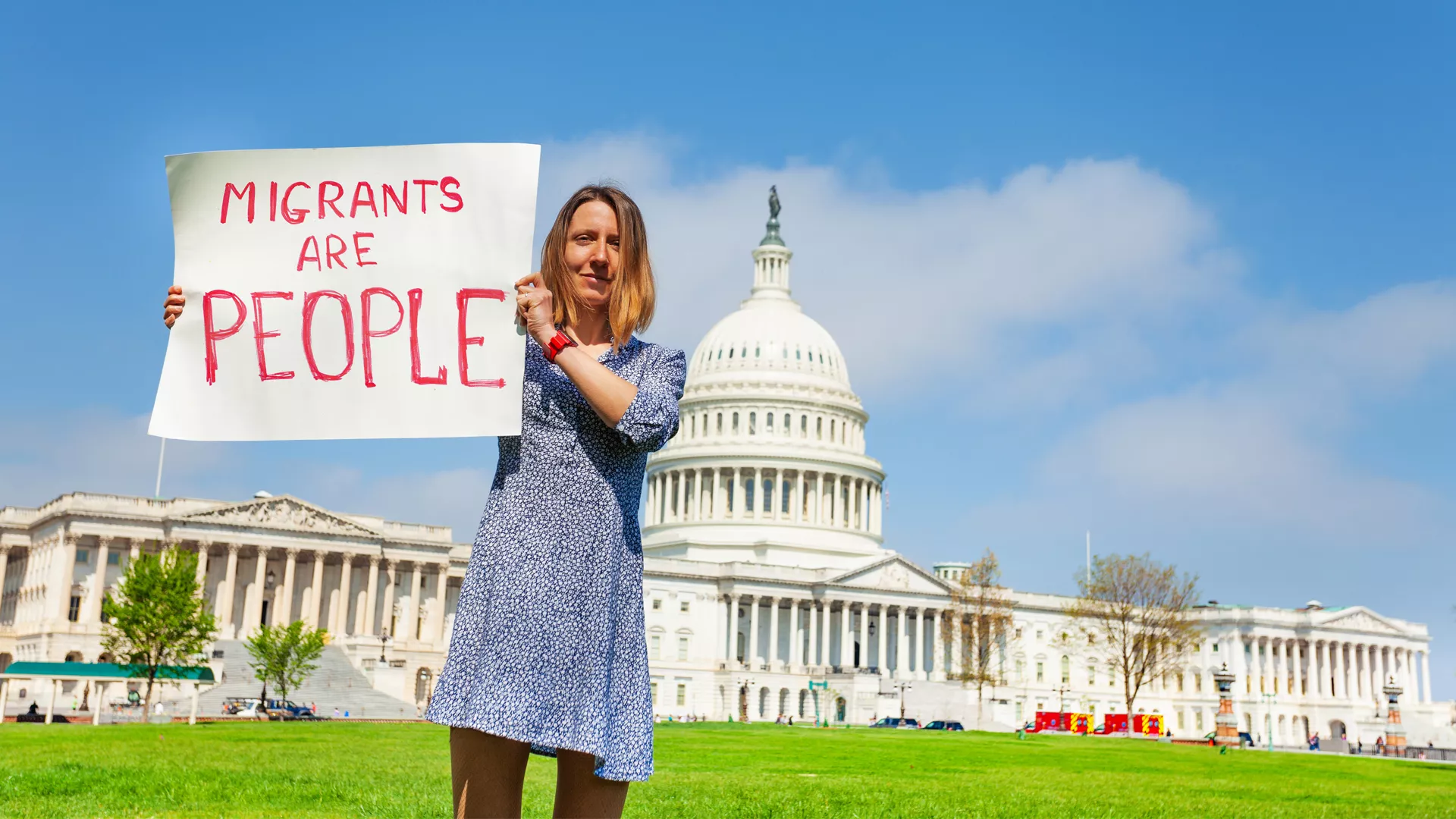
Here are some guidelines for educators to consider in safely and effectively advocating for immigrant students’ rights.
A more in-depth discussion around educator advocacy rights at school and outside of school can be found in NEA’s Educator Rights Guidance.
1. Your Protections Are Strongest When You Engage in Activism Outside of Work.
The First Amendment provides legal protection to educators when they are speaking as “citizens”— i.e., outside of their role as district employees. Educators can engage in off-the-clock political and community action to advocate for immigrants and immigrant communities. Educators can, among other things, march, sign petitions, write letters, post statements of support on social media, and call and lobby their federal, state, and local legislators. They can work with NEA and our affiliates, as well as other advocacy groups, to advocate for change such as encouraging their school districts to pass Safe Zone resolutions or to distribute red cards in their communities.
Educators are most protected when they engage in political discussions or activism outside of work, provided it does not cause disruption at the school. If the activity creates a disruption to the educational environment, an educator may be disciplined.Pickering v. Bd. Of Educ., 391 U.S. 563 (1968); Connick v. Myers, 461 U.S. 138 (1983).
Go to reference
Even speech on social media and private blogs may be unprotected if it concerns the educator’s official duties.Rubino v. City of New York, 950 N.Y.S. 2d 494 (N.Y. Sup. Ct. 2012), aff’s, 106 A.D. 439, 965 N.Y.S. 2d 47 (2013).
Go to reference
For that reason, educators should focus such activity on advocacy for immigrant students and not disparage or insult students, parents, or co-workers.Richerson v. Beckon, 337 Fed. Appx. 637 (9th Cir. 2009).
Go to reference
2. Protections That Apply to Your Speech at Work are More Limited as a School Employee.
Generally speaking, the First Amendment will not protect you from discipline based on statements made in class,Garcetti v. Ceballos, 547 U.S. 410 (2006); Mayer v. Monroe Cty. Cmty. Sch. Corp., 474 F.3d 477 (7th Cir 2007); Brown v. Chicago Bd. of Educ., 824 F.3d 713 (7th Cir. 2016). Go to reference or to students during your usual work hours but outside of class. See Johnson v. Poway Unified Sch. Dist., 658 F.3d 954 (9th Cir. 2011). Go to reference Tenured teachers are provided due process and should be protected when engaged in classroom discussions about immigration that are both age-appropriate and relevant to the coursework. In addition, some collective bargaining agreements may contain explicit protections for academic freedom, which may protect educators who discuss these issues in a manner that is both age-appropriate and relevant to the curriculum.See Nalichowski v. Capshaw, No. CIV. 95-5577, 1996 WL 548143, at *2 3 (E.D. Pa. Sept. 20, 1996) (holding that violations of a collective-bargaining agreement containing an academic freedom provision were grieveable); Charlotte Garden, Teaching for America: Unions and Academic Freedom, 43 U. TOL. L. REV. 563, 580-82 (2012). Go to reference
Still, tenure protections and academic freedom are not absolute, and teachers risk discipline for classroom discussions that administrators consider too controversial, not age appropriate, or too great a departure from established curricula.Hollis v. Fayetteville Sch. Dist. No. 1, 473 S.W.3d 45 (Ark. App. 2015); Freshwater v. Mt. Vernon City Sch. Dist., 1 N.E.3d 335 (Ohio 2013). Go to reference School districts may also have policies restricting educators’ in-school activism and use of handouts. Educators should seek the school administration’s approval of advocacy materials that they plan to distribute to students and their families.
- Garcetti v. Ceballos, 547 U.S. 410 (2006); Mayer v. Monroe Cty. Cmty. Sch. Corp., 474 F.3d 477 (7th Cir 2007); Brown v. Chicago Bd. of Educ., 824 F.3d 713 (7th Cir. 2016).
- See Johnson v. Poway Unified Sch. Dist., 658 F.3d 954 (9th Cir. 2011).
- See Nalichowski v. Capshaw, No. CIV. 95-5577, 1996 WL 548143, at *2 3 (E.D. Pa. Sept. 20, 1996) (holding that violations of a collective-bargaining agreement containing an academic freedom provision were grieveable); Charlotte Garden, Teaching for America: Unions and Academic Freedom, 43 U. TOL. L. REV. 563, 580-82 (2012).
- Hollis v. Fayetteville Sch. Dist. No. 1, 473 S.W.3d 45 (Ark. App. 2015); Freshwater v. Mt. Vernon City Sch. Dist., 1 N.E.3d 335 (Ohio 2013).
3. Engaging in Protests at School Can Be Prohibited.
Educators have even more limited protection against discipline for activism at school including by way of encouraging students to engage in protests that involve civil disobedience or school disruption. Because educators are acting within the scope of their job duties while at school, the First Amendment may not apply when educators wear political buttons or other activist symbols, or discuss protest activity with students.Weingarten v. Bd. of Educ., 680 F. Supp.2d 595 (S.D.N.Y. 2010); Birdwell v. Hazelwood Sch. Dist., 491 F.2d 490 (8th Cir. 1974). Go to reference Likewise, because many school districts have policies that explicitly prohibit employees from engaging in political activity during work time, violations of such a policy could qualify as insubordination that justifies discipline, even of a tenured educator.Ca. Teachers Ass’n v. Governing Bd. of San Diego Unif. Sch. Dist., 53 Cal. Rptr. 2d 474 (Cal. Ct. App. 1996). Go to reference Similarly, students have a right to voice their opinions and engage in certain forms of school protest, but they can be disciplined if such activities become disruptive or disorderly.Tinker v. Des Moines Indep. Cmty. Sch. Dist., 393 U.S. 503 (1969). Go to reference
- Weingarten v. Bd. of Educ., 680 F. Supp.2d 595 (S.D.N.Y. 2010); Birdwell v. Hazelwood Sch. Dist., 491 F.2d 490 (8th Cir. 1974).
- Ca. Teachers Ass’n v. Governing Bd. of San Diego Unif. Sch. Dist., 53 Cal. Rptr. 2d 474 (Cal. Ct. App. 1996).
- Tinker v. Des Moines Indep. Cmty. Sch. Dist., 393 U.S. 503 (1969).
4. What can faculty teaching in public higher education institutions do to advocate for immigrants?
Like public K-12 educators, faculty members at public colleges and universities can engage in off-the-clock political and community action. In addition, principles of academic freedom under the First Amendment give higher education faculty speech protections while engaged in core academic functions such as teaching and scholarship. Combined with widespread policies on academic freedom in faculty handbooks, collective bargaining agreements, and faculty contracts, faculty speech in the higher education workplace receives more protection than in the K-12 setting. However, faculty are not immune from discipline based upon their speech, and speech may lose First Amendment or institutional policy protection if it is not related to the academic subject or is unduly disruptive.
5. Congress Has Criminalized the Harboring of Undocumented Immigrants and Impeding Law Enforcement, Including ICE.
If you provide shelter to students or their families knowing that they are undocumented, you may face criminal consequences. Federal law prohibits a person from concealing, harboring, or shielding from detection someone who that person knows—or should know— to be undocumented. 8 U.S.C. § 1324(a)(1)(A)(iii) (2005). Go to reference This crime is referred to as “harboring” undocumented immigrants. A conviction can result in up to five years in prison for each immigrant sheltered. 8 U.S.C. § 1324(a)(1)(B)(ii) (2005). Go to reference
Harboring requires that the person charged must have intended both (a) to substantially help an undocumented person remain in the United States (such as by providing shelter, transportation, money, or other material assistance) and (b) to help the individual avoid detection by immigration authorities.United States v. Vargas-Cordon, 733 F.3d 366, 382 (2d Cir. 2013); United States v. Costello, 666 F.3d 1040, 1047 (7th Cir. 2012); United States v. You, 382 F.3d 958, 966 (9th Cir. 2004). Go to reference When the act of sheltering an undocumented person is done publicly—i.e., a church offering sanctuary to immigrants in danger of deportation—such actions are grounds to infer an intent to evade immigration authorities and would thus support a charge of criminal harboring.Costello, 666 F.3d at 1047; United States v. McClellan, 794 F.3d 743, 749 (7th Cir. 2015). Go to reference Merely providing a place to stay for an undocumented person, however, should not constitute a criminal offense so long as the person providing shelter does not intend to help the undocumented individual evade immigration authorities.See, e.g., Costello, 666 F.3d at 1046 (declining to extend the prohibitions of § 1324 to prosecute a woman whose undocumented boyfriend lived in her house). Go to reference
Courts have also interpreted the harboring statute to prohibit efforts to warn or tip off undocumented individuals about the presence of immigration enforcement officers. If you warn specific individuals that you know, or should know, are undocumented that an ICE enforcement action is underway, you may face criminal consequences. However, warning people generally of law enforcement presence is protected under the First Amendment, such as blowing a whistle in public or informing school administration of ICE presence near schools.
Federal law also makes it a crime to forcibly assault, oppose, impede, or interfere with federal officers performing official duties. During the ICE surge in Minnesota, federal officers frequently threatened people with arrest for “impeding” their operations. In exercising First Amendment rights to observe and record immigration enforcement agents, it is important to always remain peaceful and to not try to stop or impede officers. See the section “How to Safely Record and Document ICE Activity” for further information.
- 8 U.S.C. § 1324(a)(1)(A)(iii) (2005).
- 8 U.S.C. § 1324(a)(1)(B)(ii) (2005).
- United States v. Vargas-Cordon, 733 F.3d 366, 382 (2d Cir. 2013); United States v. Costello, 666 F.3d 1040, 1047 (7th Cir. 2012); United States v. You, 382 F.3d 958, 966 (9th Cir. 2004).
- Costello, 666 F.3d at 1047; United States v. McClellan, 794 F.3d 743, 749 (7th Cir. 2015).
- See, e.g., Costello, 666 F.3d at 1046 (declining to extend the prohibitions of § 1324 to prosecute a woman whose undocumented boyfriend lived in her house).